Baobab
- Igbo Yiri mango
- Yoruba Ose
- Hausa Kuka, Kukaa
Adansonia digitata

What it is used for
- Fever leaf, bark, root, fruit, seed · traditional use
- Asthma and cough leaf · traditional use
- Kidney and bladder diseases leaf · traditional use
- Feeling full after eating fruit · tested in people
Tap a use to read how it is prepared and how well it is supported.
How each use is prepared
Parts used: leaf, bark, root, fruit, seed.
Fever
Traditional useFever · leaf, bark, root, fruit, seed
People use it this way, but it has not been tested.
PROTA states that all plant parts are used for treating fever, and it also gives leaves as a fever prophylactic (a preventive use). PROTA also says adansonin, a bark compound, has been found to have febrifugal (fever-reducing) properties, but the underlying experiments were not read. No human study of this use was read, so the evidence is traditional only. [1]
Asthma and cough
Traditional useCough and breathing · leaf
How it is prepared: Leaf powder taken by mouth
People use it this way, but it has not been tested.
A Nigerian survey (Borno State row) records leaf powder taken orally for asthma and cough, and PROTA and Useful Tropical Plants also list asthma among the leaf uses. No study of this use was read, and the dose and safety of the powder are not documented in the sources read. [4][1][2]
Kidney and bladder diseases
Traditional useOther · leaf
People use it this way, but it has not been tested.
Useful Tropical Plants and PROTA both report leaves used to treat kidney and bladder diseases, alongside other complaints such as diarrhoea and fatigue. This is a traditional report only, and no study of this use was read. [2][1]
Feeling full after eating
Studied in peopleNutrition · fruit
How it is prepared: Fruit extract (15 g) mixed into a smoothie in the study
Tested in at least one human study. Read the note for how strong the result is.
This is one small, short study of 20 healthy adults, read as its PubMed abstract. The fruit extract reduced hunger, but the calorie intake did not differ significantly. It is weak evidence: it measured only short-term fullness, not weight loss or any effect in people with obesity, and it is not a basis for using baobab as a treatment. [5][3]
Safety
Baobab is a traditional remedy for fever, asthma and cough, and other complaints, but its bark contains adansonin, which PROTA says itself causes Strophanthus-like poisoning. The sources read found no studies of baobab in pregnancy, breastfeeding, children or with other medicines, so these uses have no safety data and must not be assumed safe. Do not use any baobab preparation in pregnancy, for children or with other medicines without advice from a health worker.
Poisoning and overdose
- Adansonin, isolated from the bark, is described by PROTA as causing Strophanthus-like poisoning, and PROTA notes that the bark, fruit pulp and seeds have been used as an antidote for Strophanthus poisoning. [1]
- In an animal acute-toxicity table within a 2025 review, methanol leaf extracts gave an LD50 (the dose that kills half of the animals tested) above 2000 mg/kg in rats, and stem bark extracts showed no toxicity at 5000 mg/kg in rats. These are animal figures from a review's summary table, not a guide to safe human doses. [3]
Pregnancy and breastfeeding
- No pregnancy data were found in the sources read. The absence of data is not evidence that baobab is safe in pregnancy, so it should not be used in pregnancy without medical advice. [1][2]
Children
- No safety study in children was found in the sources read. PROTA records a bark decoction used to bathe rickety children in Congo, which is a traditional report, not a safety finding, so children should not be given baobab preparations without medical advice. [1]
About this plant
Baobab is a very large African tree whose leaves, bark, roots, fruit and seeds are reported in traditional use for fever, asthma and cough, and other complaints. Its bark contains adansonin, which can cause a poisoning pattern called Strophanthus-like poisoning, and the sources read found no studies of baobab in pregnancy, in children or with other medicines. The only human study read is one small test of baobab fruit extract and fullness after eating, so do not use any baobab preparation in pregnancy, for children or with other medicines without advice from a health worker.
How to recognise it
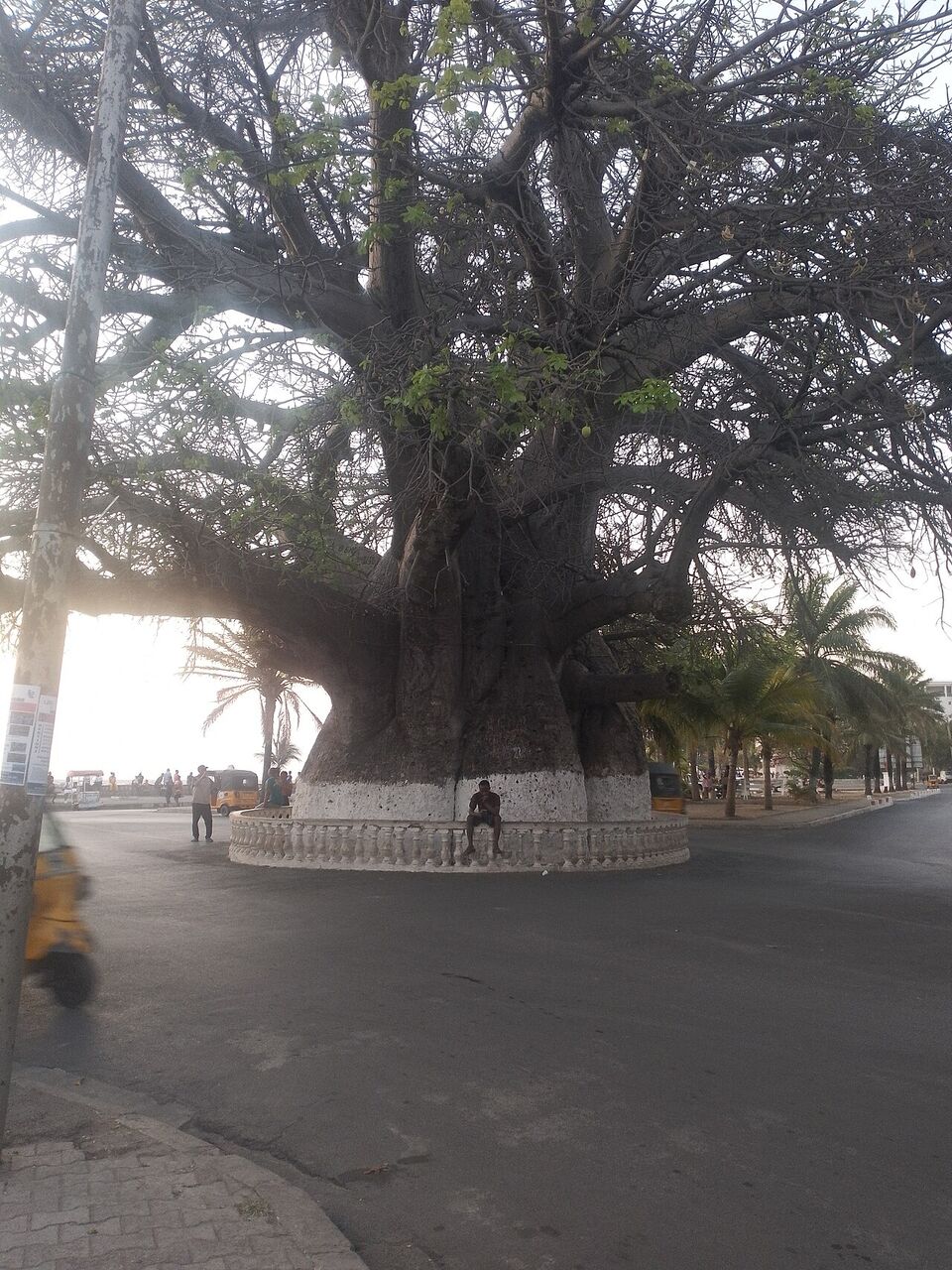
Baobab is a very large deciduous tree (it sheds its leaves in the dry season) with a swollen trunk of vast girth and smooth bark that varies in colour, and it grows up to about 20 m tall, according to Useful Tropical Plants and PROTA. Young trees and the first leaves of the season on older trees have simple leaves, a single blade with no division, but most mature leaves are digitately compound, meaning they are split into 5 to 7 leaflets (sometimes up to 9) that spread from one point like the fingers of a hand, with the whole leaf about 20 cm across. The leaves are arranged alternately, one at each point on the stem and staggered along it, and they grow at the ends of the branches. Each leaflet is elliptical (oval), 5 to 15 cm long and 1.5 to 7 cm wide, with a wedge-shaped base, a long tapering tip (acuminate), a small sharp point at the tip (mucronate), and an edge without teeth (entire). The flowers are solitary or paired, hang downwards from the leaf joints (axillary and pendulous), and are bisexual, meaning each flower carries both male and female parts.
Where it grows
Useful Tropical Plants describes its habitat as thorn woodlands of the African savannahs.
- Native to
- Useful Tropical Plants gives the range as tropical Africa, from Mauritania to Sudan, south to Angola and Tanzania.
- In Nigeria
- GBIF holds 165 occurrence records from Nigeria. No source read names the states or regions where it grows.
Scientific details
- Scientific name
- Adansonia digitata L.
- Family
- Malvaceae
- Main compounds
- adansonin, betulinic acid
Sources
Not yet reviewed Drafted with AI from the sources below. Treat with care.
- Bosch CH, Sié K, Asafa BA. Adansonia digitata L. (PROTA record). PROTA (Plant Resources of Tropical Africa), Pl@ntUse, 2004.
- Adansonia digitata - Useful Tropical Plants. Useful Tropical Plants database.
- Anyanwu GO, Anzaku D, Bulus YJ, et al.. An Ethnobotanical Survey and Pharmacological and Toxicity Review of Medicinal Plants Used in the Management of Obesity in the North Central Zone of Nigeria.. J Obes, 2025. PMID 40026359.
- Rafiu BO, Omotayo AO, Lawal IO, Aremu AO. Ethnobotanical uses of plants in Nigeria: an analysis of current research trends and patterns.. J Ethnobiol Ethnomed, 2025. PMID 40841969.
- Garvey R, Clegg M, Coe S. The acute effects of baobab fruit (Adansonia digitata) on satiety in healthy adults.. Nutr Health, 2017. PMID 28413912.
- GBIF Backbone Taxonomy: species match for Adansonia digitata (accepted, exact match, usageKey 5406695). GBIF.
- GBIF occurrence search: Adansonia digitata in Nigeria (country NG, taxonKey 5406695; count 165). GBIF.