Alligator pepper
- Igbo Ose-oji
- Yoruba Ataare, Atare
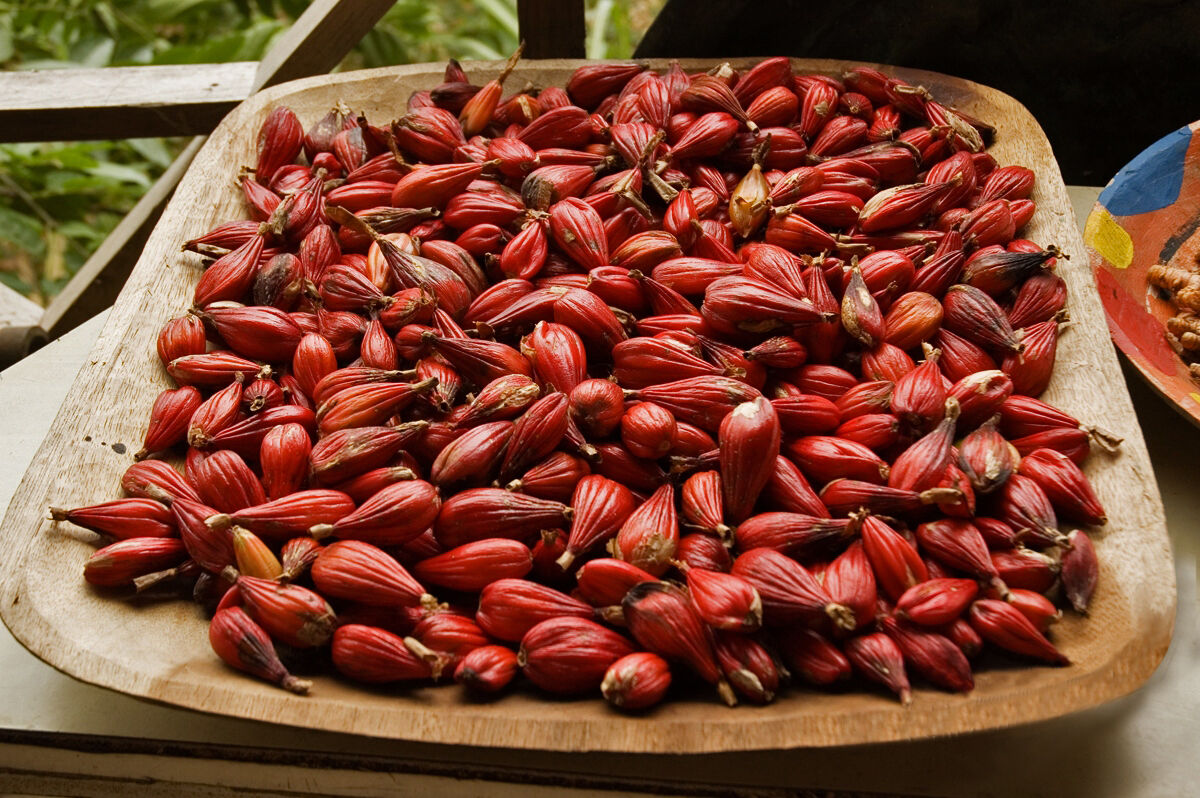
Aframomum melegueta · also called Grains of paradise

What it is used for
- Birth control seed · traditional use
- Anxiety, low mood and poor sleep seed · tested in people
- Spice and flavouring seed · traditional use
- Stimulant fruit · traditional use
- Worm infections seed · lab tests only
Tap a use to read how it is prepared and how well it is supported.
How each use is prepared
Parts used: seed, fruit.
Birth control
Traditional useWomen's health · seed · reported in a Nigerian survey
People use it this way, but it has not been tested.
A survey of medicinal plants used to control birth in four Nigerian states lists this plant under the Yoruba names Ataare and Atare, with the seed as the part used in one state table. The authors state that its safety and effectiveness have not been scientifically validated. This is a report of use, not evidence that it works, and it should not be relied on for contraception. [7]
Anxiety, low mood and poor sleep
Studied in peopleOther · seed
Tested in at least one human study. Read the note for how strong the result is.
One randomised, double-blind pilot trial gave a seed extract (50 to 150 mg for 3 days) and reported better scores for anxiety, mood and sleep than placebo. Only 37 people were randomised and 30 completed it, the trial was short, and it was funded by industry. The evidence is weak and needs larger, longer trials. The sources read do not report this as a traditional use. [4]
Spice and flavouring
Traditional useNutrition · seed
People use it this way, but it has not been tested.
The seeds are described as aromatic and pungent (peppery) and are used to flavour food. This is culinary use; the sources do not make a medical claim for it. [3]
Stimulant
Traditional useOther · fruit
People use it this way, but it has not been tested.
The fruit pulp is eaten or chewed as a stimulant, according to Useful Tropical Plants. No study of this use was found in the sources read. [3]
Worm infections
Lab or animal studiesWorms and parasites · seed · helminths
Tested in the laboratory or in animals, not in people.
A laboratory study tested extracts against Taenia tapeworms in vitro (in a dish, not in a living host). A separate laboratory study used extracts of the grains with blood cells from people with onchocerciasis (river blindness) and found reduced release of two immune markers. Traditional healers in Togo are reported to use the plant for these infections, but these are not Nigerian reports. None of the sources read tested it against worms in people. [5][6]
Safety
Alligator pepper is used as a spice, and a short trial of a seed extract reported no adverse effects. Toxicity has not been studied in detail, and no source addresses safety in pregnancy, breastfeeding or children, so these data are lacking rather than showing that it is safe. Do not use it as a medicine or contraceptive without advice from a health worker, especially if you are pregnant, breastfeeding, or taking other medicines.
Side effects
- In a 3-day randomised trial of a seed extract at 50 to 150 mg, no adverse effects or serious adverse events were reported. The trial was small and short, so rarer or longer-term effects are not known. [4]
Poisoning and overdose
- Useful Tropical Plants lists no known hazards for this plant. This is not a formal toxicity study. [3]
- No toxicity study of the seeds or fruit was found in the sources read.
If you take other medicines
- No drug interaction data were found in the sources read.
Pregnancy and breastfeeding
- No source read addresses safety in pregnancy or breastfeeding. A Nigerian survey lists the plant as used to control birth, but its authors state that safety has not been scientifically validated. [7]
Children
- No source read addresses use in children; data are lacking.
About this plant
Alligator pepper, also called grains of paradise, is a forest-growing plant in the ginger family whose aromatic seeds are used as a spice. Its seeds and fruit have been studied only in small laboratory and trial settings, and its safety in pregnancy, in children and with long-term use is not documented.
How to recognise it
Aframomum melegueta is a herbaceous plant in the ginger family, with tufted stems 1 to 4 metres tall that grow from a rhizome (a thick underground stem). Leaf shape, arrangement and size are not documented in the sources read. Flower colour and form are not documented in the sources read. The fruit contains aromatic, peppery-tasting seeds, the spice known as grains of paradise, and the fruit pulp is eaten or chewed as a stimulant. The rhizome is the underground part, and its features are not documented in the sources read. Bark is not described for this plant.
Where it grows
Forest, especially secondary (regrowth) forest, according to Useful Tropical Plants.
- Native to
- Senegal to Sudan, Uganda and Kenya, south to Angola and Tanzania (Useful Tropical Plants).
- In Nigeria
- GBIF holds 38 occurrence records from Nigeria. The sources read do not name particular Nigerian states or regions.
Scientific details
- Scientific name
- Aframomum melegueta K.Schum.
- Family
- Zingiberaceae
Sources
Not yet reviewed Drafted with AI from the sources below. Treat with care.
- GBIF Backbone Taxonomy. GBIF species match: Aframomum melegueta K.Schum. (ACCEPTED, usageKey 2758930). Global Biodiversity Information Facility (GBIF), 2026.
- GBIF. GBIF occurrence search: Nigeria records for taxonKey 2758930 (38 records). Global Biodiversity Information Facility (GBIF), 2026.
- Useful Tropical Plants database. Aframomum melegueta (Useful Tropical Plants). Useful Tropical Plants, 2026.
- Pérez-Machín R, Vega-Morales T, Elvira-Aranda C, et al.. Aframomum melegueta Seed Extract's Effects on Anxiety, Stress, Mood, and Sleep: A Randomized, Double-Blind, Pilot Clinical Trial. Pharmaceuticals (Basel); full text via Europe PMC PMC11859572, 2025. PMID 40006090.
- Douti FV, Katawa G, Arndts K, et al.. Potential of Aframomum melegueta and Xylopia aethiopica Against Taenia spp.: Plant-Based Remedies as Novel Anthelmintics. Pharmaceuticals (Basel); full text via Europe PMC PMC12115246, 2025. PMID 40430566.
- Katawa G, Ataba E, Ritter M, et al.. Anti-Th17 and anti-Th2 responses effects of hydro-ethanolic extracts of Aframomum melegueta, Khaya senegalensis and Xylopia aethiopica in hyperreactive onchocerciasis individuals' peripheral blood mononuclear cells. PLoS Neglected Tropical Diseases; full text via Europe PMC PMC9071127, 2022. PMID 35468134.
- Ibrahim MB, Odewo AS, Lawal BA, et al.. Traditional contraceptive practices: survey of medicinal plants used to control birth in four states in Nigeria. BMC Complementary Medicine and Therapies; full text via Europe PMC PMC12147339, 2025. PMID 40490736.
- Rafiu BO, Omotayo AO, Lawal IO, Aremu AO. Ethnobotanical uses of plants in Nigeria: an analysis of current research trends and patterns. Journal of Ethnobiology and Ethnomedicine (BMC), 2025. PMID 40841969.