Goat weed
- Igbo Ula ujula
- Yoruba Imi-esu
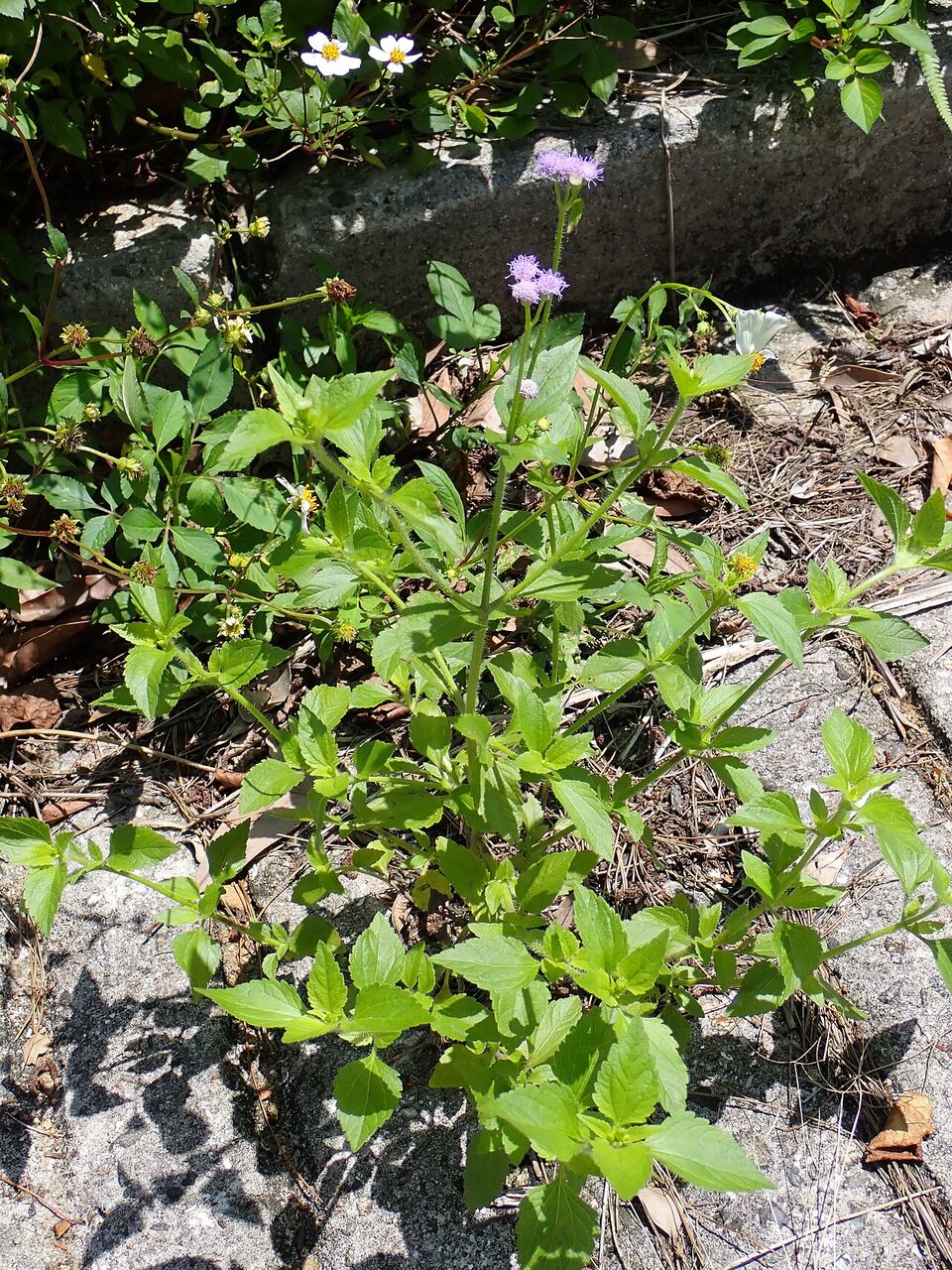
Ageratum conyzoides · also called Billygoat weed, Blue top, Whiteweed, Goatweed

What it is used for
- Skin wounds, cuts and rashes leaf, whole plant · traditional use
- Diabetes leaf, stem · traditional use
- High blood pressure leaf, stem · traditional use
- Cough leaf · traditional use
- Pain relief leaf · traditional use
Tap a use to read how it is prepared and how well it is supported.
How each use is prepared
Parts used: leaf, whole plant.
Skin wounds, cuts and rashes
Traditional useWounds · leaf, whole plant
How it is prepared: Leaves squeezed and applied to the skin or taken orally (Ondo); leaf infusion (Delta); whole-plant decoction applied to the skin (Oyo and Ogun)
People use it this way, but it has not been tested.
Reported in a table of uses from Nigerian ethnobotanical surveys, and the table gives no dose or method of preparation beyond the lines above. No clinical study of this use was found in the sources read. [4]
Diabetes
Traditional useBlood sugar · leaf, stem · reported use
How it is prepared: Leaf juice taken orally (Lagos); decoction of leaves and stem taken orally (Kogi)
People use it this way, but it has not been tested.
Reported only in a survey table of Nigerian plant uses. The sources read contain no human trial of this use, so no effect on blood sugar is established. [4]
High blood pressure
Traditional useBlood pressure · leaf, stem · reported use
How it is prepared: Decoction of leaves and stem taken orally (Kogi)
People use it this way, but it has not been tested.
Reported in the same survey table (Lagos, Osun and Kogi). No human trial of this use was found in the sources read. [4]
Cough
Traditional useCough and breathing · leaf · reported use
People use it this way, but it has not been tested.
Reported in the same survey table (Lagos and Osun). No study of this use was found in the sources read. [4]
Pain relief
Traditional usePain and swelling · leaf · reported use
People use it this way, but it has not been tested.
Reported as an analgesic (pain-relieving) use in the same survey table (Ogun). No study of this use was found in the sources read. [4]
Safety
The plant contains pyrrolizidine alkaloids (PAs). The authors of a Tigray, Ethiopia survey link the plant to hepatic veno-occlusive disease (a blockage of small veins in the liver), but a second study from the same region challenges that attribution. Data on side effects, interactions, pregnancy and children are lacking, so this is not a sign that the plant is safe, and it should not be taken by mouth without medical advice.
Side effects
- Data lacking: the sources read report no controlled human side-effect studies of this plant. The Useful Tropical Plants page lists hazards as 'None known', which conflicts with the PA evidence below and should not be read as reassurance. [3][4]
Poisoning and overdose
- Contains pyrrolizidine alkaloids (PAs). An analysis of stingless bee honey identified Ageratum conyzoides as a botanical source of PAs. [7]
- A 2026 community-based survey in Tigray, Ethiopia reports a burden of hepatic veno-occlusive disease (HVOD), and its authors link HVOD to A. conyzoides. A 2025 study of community perceptions in the same region challenges that attribution, so the link is contested. [5][6]
- A single 2026 case report describes new-onset convulsive status epilepticus (a prolonged seizure) that began after accidental inhalation of smoke from burning the plant. The authors describe a temporal association from one case only. [8]
- Data lacking: the sources read do not state which plant part carries the PAs or at what dose they cause harm. [7]
If you take other medicines
Pregnancy and breastfeeding
- Data lacking: no safety data on pregnancy or breastfeeding were found in the sources read. Because the sources link PAs to liver harm, pregnancy and breastfeeding should be treated as a reason to avoid the plant unless a health worker advises otherwise. [4][5]
Children
- Data lacking: no safety data for children were found in the sources read. [4]
About this plant
Goat weed is a common roadside and field weed in Nigeria whose leaves are used in several traditional remedies. It contains pyrrolizidine alkaloids, and some authors link it to a serious liver condition, so it should not be taken by mouth without medical advice.
How to recognise it
Ageratum conyzoides (goat weed) is a coarse annual herb, meaning it grows from seed and dies within one season, usually about 1 m tall. Its stem is erect (grows upright) and the whole plant gives off a strong, unpleasant smell when crushed. The leaves are ovate (egg-shaped, broadest near the base) with a toothed edge, about 3 to 7.5 cm long, and the margin is toothed except near the base. Leaves are arranged in pairs on either side of the stem (opposite) on the lower stem, and sometimes one at a time (alternate) higher up, and both leaf surfaces carry white or silver hairs. The flowers are white to purple and grouped in small rounded heads of several dozen flowers. The fruit is a small dry, one-seeded fruit called an achene, about 1.5 to 2 mm long, hairy and ribbed, with a tuft of plumes at its tip, and the seeds are spread by wind.
Where it grows
A common weed of cultivated ground and disturbed land in the tropics. The Useful Tropical Plants database reports it within 20 degrees of the Equator, up to about 2,500 m altitude.
- In Nigeria
- GBIF holds 188 occurrence records from Nigeria (a count of records, not a field survey). The sources read do not name Nigerian states or regions for this plant.
Scientific details
- Scientific name
- Ageratum conyzoides L.
- Family
- Asteraceae
- Main compounds
- pyrrolizidine alkaloids
Sources
Not yet reviewed Drafted with AI from the sources below. Treat with care.
- Ageratum conyzoides L. (Flora & Fauna Web, NParks Singapore). National Parks Board, Singapore, 2022.
- Ageratum conyzoides subsp. conyzoides (Australian Tropical Rainforest Plants, Lucid key). CSIRO, Lucid Central, 2020.
- Ageratum conyzoides (Useful Tropical Plants database). Useful Tropical Plants (Ken Fern), 2024.
- Rafiu BO et al.. Ethnobotanical uses of plants in Nigeria: an analysis of current research trends and patterns. Journal of Ethnobiology and Ethnomedicine, 2025. PMID 40841969.
- Haileselassie M et al.. Burden of veno-occlusive disease in Tigray region of Ethiopia: Evidence from community-based survey. Scientific African, 2026. PMID 42291613.
- Haileselassie M et al.. Community perceptions and practices on hepatic veno-occlusive disease in Tigray, Ethiopia: An explorative study challenging the attribution to Ageratum conyzoides. PLoS Neglected Tropical Diseases, 2025. PMID 41091797.
- Hungerford NL et al.. Analysis of Pyrrolizidine Alkaloids in Stingless Bee Honey and Identification of a Botanical Source as Ageratum conyzoides. Toxins (Basel), 2024. PMID 38251258.
- Gowda P et al.. New-Onset Convulsive Status Epilepticus Temporally Associated With Accidental Inhalation of Billygoat Weed (Ageratum conyzoides) Smoke: A Case Report. Cureus, 2026. PMID 42625901.
- GBIF species match: Ageratum conyzoides L. (usageKey 5401673, ACCEPTED, EXACT). Global Biodiversity Information Facility, 2026.
- GBIF occurrence search: Ageratum conyzoides, country NG (taxonKey 5401673). Global Biodiversity Information Facility, 2026.