Christmas bush
Alchornea cordifolia · also called Uwanwe

What it is used for
- Arthritis and rheumatism leaf, stem bark, root · traditional use
- Wounds and ulcers leaf, stem bark · traditional use
- Cough leaf, stem bark, root · traditional use
- Diabetes leaf, stem bark, root · traditional use
- Malaria leaf · lab tests only
Tap a use to read how it is prepared and how well it is supported.
How each use is prepared
Parts used: leaf, stem bark, root.
Arthritis and rheumatism
Traditional usePain and swelling · leaf, stem bark, root
How it is prepared: Decoction, chewed, macerated, used in washing (ablution), snuffed or smoked, as reported in Nigerian records (parts and preparations are from the review, not tied to a single condition)
People use it this way, but it has not been tested.
Reported in the Lagos survey (arthritis among the reported uses) and in the review's Nigeria record. No study of the effect was read. [3][4]
Wounds and ulcers
Traditional useWounds · leaf, stem bark
People use it this way, but it has not been tested.
Reported in the Lagos survey (ulcers among the reported uses) and in the review, which lists wounds among the traditional uses of A. cordifolia. No study was read. [3][4]
Cough
Traditional useCough and breathing · leaf, stem bark, root
People use it this way, but it has not been tested.
Reported in the review's Nigeria record. The same record lists it with a range of other complaints. No study was read. [4]
Diabetes
Traditional useBlood sugar · leaf, stem bark, root
People use it this way, but it has not been tested.
Reported in the review's Nigeria record only. No study of blood sugar effects was read. [4]
Malaria
Lab or animal studiesMalaria · leaf
Tested in the laboratory or in animals, not in people.
One mouse study of a chloroform fraction of the leaves gave anti-plasmodial activity figures of 21.1% to 15.1% for one extract, described as declining. The authors call the findings preliminary. This is a laboratory result, not evidence that the plant helps people with malaria. Malaria is also among the reported uses in the Lagos survey. No human trial was read. [5][3]
Safety
Data are lacking on safety in people. In a mouse and rat study of a leaf fraction, no adverse findings were reported at the doses tested. That is one preliminary study, and the review describes the toxicological data as limited. This record is not a guide to dose or self-medication.
Side effects
- Data are lacking on side effects in people. [4]
Poisoning and overdose
- Acute (14-day) and sub-acute (28-day) studies of a leaf chloroform fraction in mice and rats, based on OECD guidelines, reported no adverse findings at the doses tested. This is one study. [5]
- The review describes toxicological statistics as limited and does not give an LD50 for this species. [4]
If you take other medicines
- Data are lacking.
Pregnancy and breastfeeding
- Data are lacking.
Children
- Data are lacking.
About this plant
A shrub or small tree of tropical Africa, widely used in traditional medicine for arthritis, wounds and malaria, among other complaints. The reported uses come mainly from surveys, and the leaf extracts studied in the laboratory have shown only preliminary activity.
How to recognise it
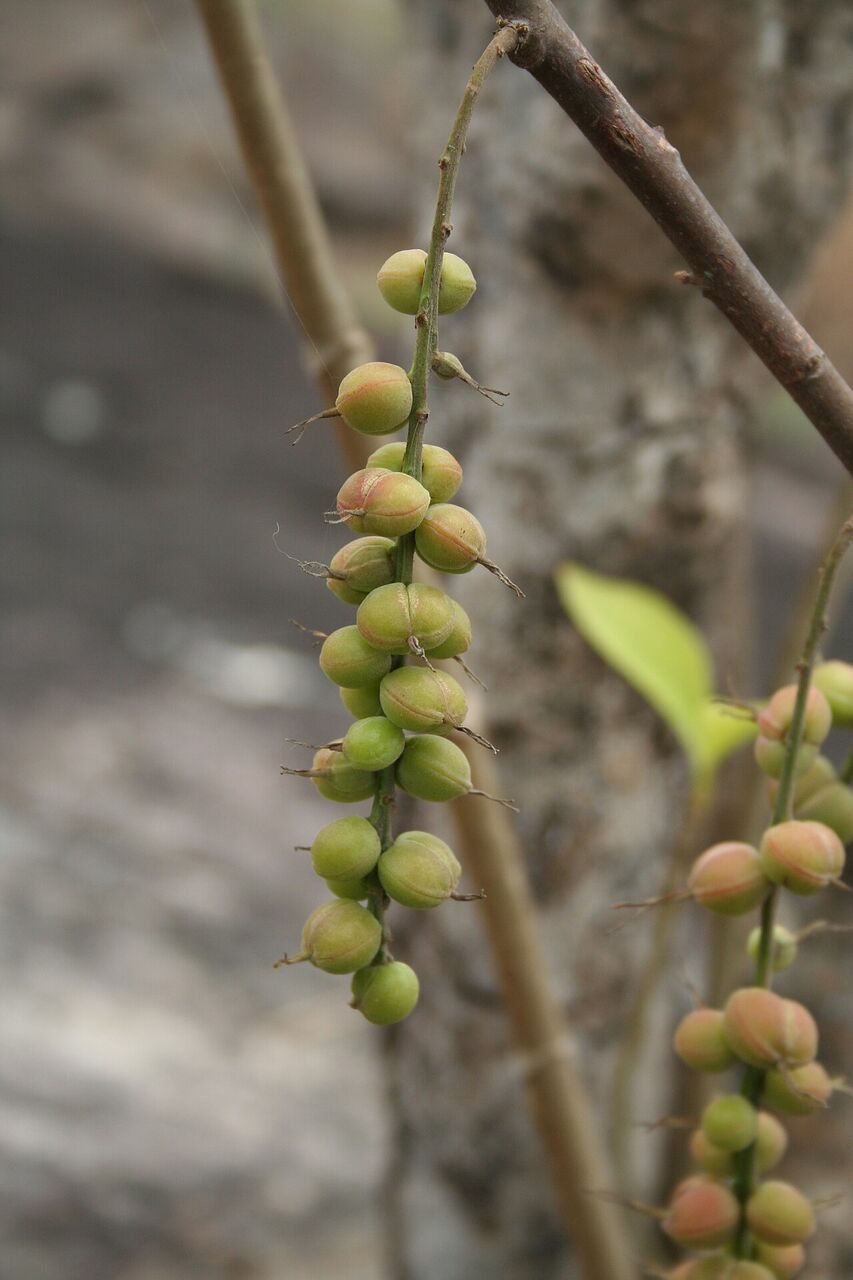
A straggling, loosely branched, evergreen shrub or small tree, up to about 8 metres tall. It is dioecious, so male and female flowers are on separate plants. Leaves are alternate and simple. The stipules are triangular, about 1.5 mm long, pointed and soon falling. The petiole is 3 to 15 cm long. The blade is ovate to elliptical-ovate, 5 to 25 cm long and 3 to 15 cm wide, with a heart-shaped base (cordate), overlapping basal lobes and a pointed to long-pointed tip. The margins are toothed. Young leaves are shortly hairy, becoming almost hairless. There are three to five veins from the base, with four glandular patches in the angles of the veins. Fruits are borne in clusters; mature fruits split open to show flesh-covered seeds.
Where it grows
Widespread in secondary forest and riverine forest, especially in marshy areas but sometimes in drier sites, from sea level up to 1,500 metres.
- Native to
- Senegal east to Kenya and Tanzania, and south through Central Africa to Angola.
- In Nigeria
- Recorded as used by people in five study areas in Lagos State (PMID 35270103). Specific localities are not documented in the sources read.
Scientific details
- Scientific name
- Alchornea cordifolia (Schumach. & Thonn.) Müll.Arg.
- Family
- Euphorbiaceae
- Older names
- Schousboea cordifolia
Sources
Not yet reviewed Drafted with AI from the sources below. Treat with care.
- Useful Tropical Plants: Alchornea cordifolia. Useful Tropical Plants.
- Alchornea cordifolia (PROTA Pl@ntUse). PROTA.
- Ethnobotanical Survey of Local Flora Used for Medicinal Purposes among Indigenous People in Five Areas in Lagos State, Nigeria. Plants, 2022. PMID 35270103.
- The Genus Alchornea (Euphorbiaceae): A Comprehensive Review of Its Taxonomy, Traditional Uses, Phytochemistry, Pharmacological Potential, and Toxicology. Molecules, 2026. PMID 42197280.
- Assessment of toxicity and anti-plasmodial activities of chloroform fractions of Carapa procera and Alchornea cordifolia in murine models. Frontiers in Pharmacology, 2022. PMID 36618915.
- GBIF occurrence search: Alchornea cordifolia, country NG (record count 433). GBIF.