Garlic
- Igbo Ayo-ishi
- Hausa Tafarnuwa
Allium sativum

What it is used for
- Obesity management traditional use
- Blood sugar in diabetes tested in people
- Infections bulb · traditional use
- High blood pressure and high cholesterol tested in people
Tap a use to read how it is prepared and how well it is supported.
How each use is prepared
Parts used: bulb, leaf.
Obesity management
Traditional useOther · as reported in a Nigerian ethnobotanical survey
People use it this way, but it has not been tested.
A 2025 ethnobotanical survey of the North Central zone of Nigeria records garlic (Hausa name Tafarnuwa) among plants used for managing obesity. A survey shows that people use the plant for this purpose. It does not show that garlic reduces weight. The category is "other" because obesity has no category in the schema. The survey's preparation details are not used here because the table layout in the opened text was ambiguous. [3]
Blood sugar in diabetes
Studied in peopleBlood sugar
Tested in at least one human study. Read the note for how strong the result is.
NCCIH reports that garlic supplements may lower blood sugar to a small extent in people with diabetes. The evidence is weak. A 2026 review of antidiabetic plants from the ECOWAS region lists garlic among its remedies. It says most listed remedies showed notable blood-sugar-lowering activity, and that the mechanism has rarely been studied. Do not use garlic in place of prescribed diabetes medicine. [2][4]
Infections
Traditional useInfections · bulb · reported antibiotic property of crushed raw garlic
People use it this way, but it has not been tested.
PROTA reports that crushed raw garlic is strongly antibiotic and that leaves and bulbs have antiseptic and anthelmintic properties. The opened text gives no clinical study for these claims. Garlic is not a substitute for treatment of a bacterial or parasitic infection. [7]
High blood pressure and high cholesterol
Studied in peopleBlood pressure
Tested in at least one human study. Read the note for how strong the result is.
NCCIH reports that garlic supplements may lower total and LDL cholesterol to a small extent in people with high cholesterol, and may lower blood pressure to a small extent in people with high blood pressure, with limited evidence. MSK says the evidence on cholesterol and blood pressure is mixed. A 2025 review reports potential benefits for cholesterol and triglycerides. The evidence is weak and inconsistent. Do not stop prescribed blood pressure or cholesterol medicine because of garlic. [2][1][5]
Safety
Garlic can increase bleeding risk, and it may interact with blood thinners, insulin, cyclosporine and some HIV medicines. Pregnancy and breastfeeding data are limited for amounts above food. Garlic is toxic to dogs, and a fatal case report describes red blood cell damage in a dog.
Side effects
- Reported side effects include headache, fatigue, body and breath odour, stomach upset, diarrhoea and low blood sugar. [1][2]
- Oral garlic can cause abdominal pain, flatulence (gas), nausea and allergic reactions. [2][1]
- Garlic can change how platelets (the cells that help blood clot) work. Bleeding has been reported after excessive supplement use. [1]
- Fresh or crushed raw garlic applied to the skin can cause severe irritation and chemical burns. [2][1]
- Crushed raw garlic has caused chemical burns in the lining of the mouth. [1]
- A liver toxicity case was reported in a transplant patient taking high-dose garlic supplements. [1]
Poisoning and overdose
- Garlic is toxic to dogs. A fatal case report describes haemolytic injury (red blood cell destruction) in a dog that ate about 16 g of raw garlic. The paper reports a toxic dose of 5 g/kg for dogs, and notes the amount recovered was below that dose, which suggests individual susceptibility or incomplete recovery. [6]
- A reference page lists garlic as causing poisoning in some mammals, with dogs especially susceptible. [8]
If you take other medicines
- Surgery: MSK's patient page says to stop garlic 1 to 2 weeks before surgery, and its clinician page says at least 7 days before surgery. [1]
- Warfarin and other blood thinners: garlic may increase bleeding. Ask a doctor before use. [1]
- Anticoagulants and aspirin: NCCIH advises telling a provider, because garlic can add to bleeding risk with these medicines. [2]
- Cyclosporine (a transplant medicine): garlic can reduce its effectiveness. [1]
- Insulin and other diabetes medicines: the dose may need adjusting, because garlic can lower blood sugar. [1]
- Darunavir (an HIV medicine): an interaction was reported in two HIV cases. [1]
Pregnancy and breastfeeding
- NCCIH says garlic may not be safe during pregnancy or breastfeeding when taken orally in amounts greater than those in food. Little is known about topical use. [2]
Children
- The sources read do not give safety data for garlic in children. Data are lacking.
About this plant
Garlic is a cultivated plant that is recorded in traditional use for infection, blood sugar and obesity. Small human studies report modest, mixed effects on cholesterol, blood pressure and blood sugar. It can increase bleeding risk and interact with some medicines, so people on blood thinners, insulin or other prescribed drugs, and anyone due for surgery, should speak to a clinician first.
How to recognise it
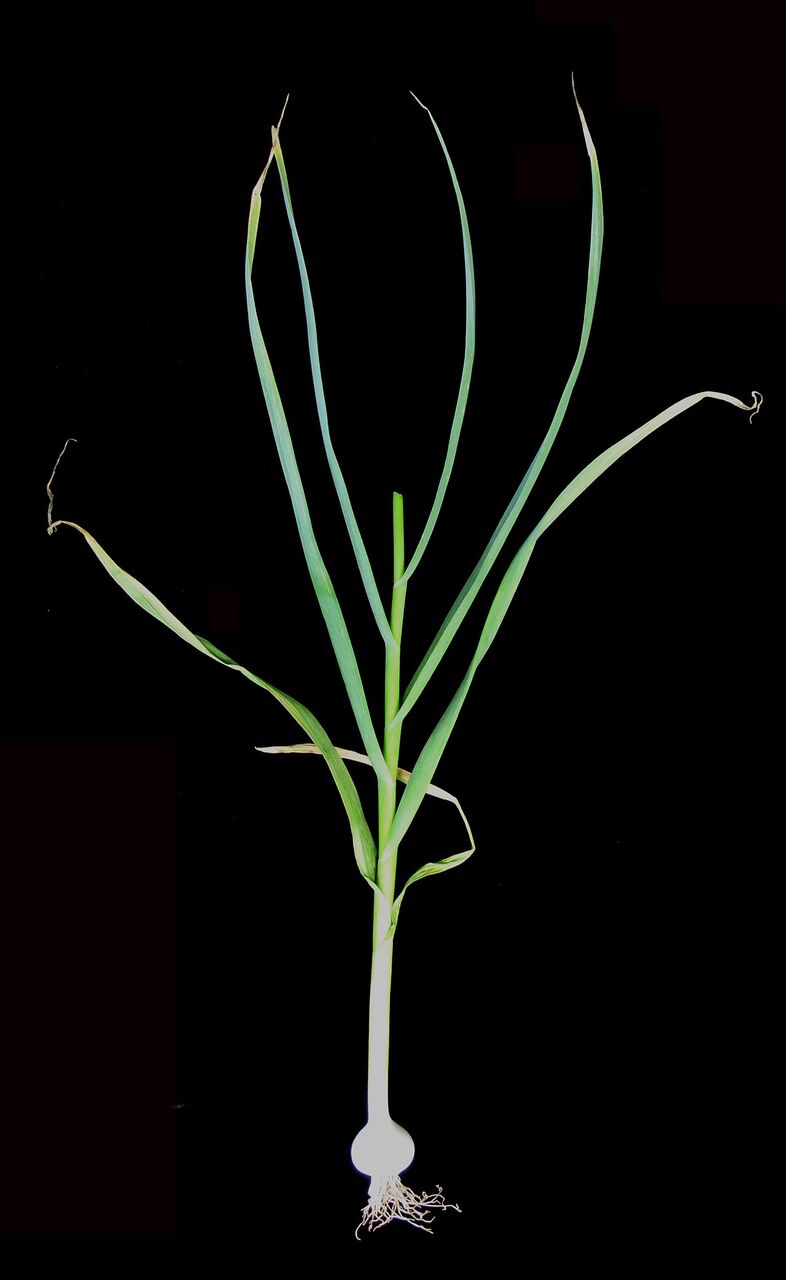
Garlic is a perennial herb (one that lives for more than two years) grown from an underground bulb made of separate cloves, the small segments inside the bulb. The erect plant can reach about 150 cm, with 4 to 10 leaves in the PROTA account (6 to 12 in the Useful Tropical Plants account). The leaves are flat and narrow, shaped like a long strip (linear to oblong). The flowering stem (scape) is 25 to 80 cm tall. Flowers are usually poorly developed or absent in cultivation, so the bulb is the part most people see. The sources read do not describe the fruit or seeds.
Where it grows
Garlic is cultivated. PROTA says it is rarely grown in hot, humid lowlands. Wild populations are not documented in the sources read.
- In Nigeria
- GBIF holds 14 occurrence records from Nigeria for this species. The sources read do not say which Nigerian states or regions grow it.
Scientific details
- Scientific name
- Allium sativum L.
- Family
- Amaryllidaceae
- Main compounds
- organosulfur compounds
Sources
Not yet reviewed Drafted with AI from the sources below. Treat with care.
- Garlic. Memorial Sloan Kettering Cancer Center (page last updated 18 November 2022), 2022.
- Garlic. National Center for Complementary and Integrative Health (NCCIH), NIH (page last updated February 2025), 2025.
- Anyanwu et al.. An Ethnobotanical Survey and Pharmacological and Toxicity Review of Medicinal Plants Used in the Management of Obesity in the North Central Zone of Nigeria. Journal of Obesity, 2025. PMID 40026359.
- Ohouko et al.. Diabetes mellitus in ECOWAS: an overview of the safety and efficacy of medicinal plants used in traditional medicine practices. Tropical Medicine and Health, 2026. PMID 41872917.
- Bedir, Almasri, Azar, et al.. Exploring the Therapeutic Potential of Allium cepa and Allium sativum Extracts: Current Strategies, Emerging Applications, and Sustainability Utilization. Biology, 2025. PMID 40906415.
- Biasibetti et al.. Fatal Garlic (Allium sativum) Toxicosis in a Dog: Gross and Histopathological Findings in a Rare Case of Systemic Hemolytic Injury. Animals (MDPI), 2026. PMID 42278144.
- Allium sativum (PROTA). PROTA (Plant Resources of Tropical Africa), Wageningen.
- Allium sativum - Useful Tropical Plants. Tropical Plants Database (tropical.theferns.info).
- GBIF backbone. Allium sativum L. - GBIF species match (accepted, Amaryllidaceae). Global Biodiversity Information Facility.
- GBIF occurrence search, Allium sativum, country NG (14 records). Global Biodiversity Information Facility.
- Oladele JO, Ajayi EI, Oyeleke OM, Oladele OT, Olowookere BD, Adeniyi BM, Oyewole OI, Oladiji AT. A systematic review on COVID-19 pandemic with special emphasis on curative potentials of Nigeria based medicinal plants. Heliyon, 2020. PMID 32929412.
- Oyedemi SO, Oyedemi BO, Ijeh II, Ohanyerem PE, Coopoosamy RM, Aiyegoro OA. Alpha-Amylase Inhibition and Antioxidative Capacity of Some Antidiabetic Plants Used by the Traditional Healers in Southeastern Nigeria. The Scientific World Journal, 2017. PMID 28367491.