Aloe vera
- Yoruba Ahon erin
Aloe vera · also called Barbados aloe

What it is used for
- Burns leaf gel · tested in people
- Constipation leaf latex · traditional use
- Acne leaf gel · tested in people
- Blood sugar in diabetes leaf · lab tests only
Tap a use to read how it is prepared and how well it is supported.
How each use is prepared
Parts used: leaf gel, leaf latex.
Burns
Studied in peopleWounds · leaf gel
How it is prepared: Applied to the skin. The product form used in the trials is not named in the abstract read.
Tested in at least one human study. Read the note for how strong the result is.
A 2024 systematic review and meta-analysis of nine randomised trials (six with primary-outcome data) found that aloe vera shortened wound-healing time by about 3.8 days compared with other topical treatments. It found no clear difference in infection, and no clear difference in pain, where the authors say the analgesic effect is uncertain. The evidence is limited by the small number of trials. [3]
Constipation
Traditional useStomach and digestion · leaf latex · laxative effect of the latex, taken by mouth
How it is prepared: Dried latex. The EMA report on dried latex gives an adult dose of 10 to 30 mg of hydroxyanthracene derivatives, taken once a day at night. This report is superseded and dates from 2007.
People use it this way, but it has not been tested.
The laxative effect is recognised, but the sources read did not confirm clinical trial results for it, so the evidence is rated traditional. The US Food and Drug Administration (2002 final rule) stopped recognising aloe as safe and effective as a nonprescription laxative. This is a laxative risk, not a treatment claim, and the latex is not for children under 12. [1][5]
Acne
Studied in peopleSkin · leaf gel
How it is prepared: Applied to the skin, usually with other treatments.
Tested in at least one human study. Read the note for how strong the result is.
The NCCIH page cites two small studies of topical aloe gel for acne, used with other treatments, and says these studies are small. [2]
Blood sugar in diabetes
Lab or animal studiesBlood sugar · leaf · taken by mouth
How it is prepared: Taken by mouth. The form of aloe used in the studies is not specified in the page read.
Tested in the laboratory or in animals, not in people.
The NCCIH page says a small amount of research suggests that aloe taken by mouth may reduce blood sugar and HbA1c in people with diabetes. The evidence is small and weak. [2]
Safety
Aloe vera latex, taken by mouth, is the part linked to the most serious risks. It can cause abdominal pain, cramps and diarrhoea, and it is not advised during pregnancy, breastfeeding, or for children under 12 as a laxative. Topical gel is reported to cause occasional skin reactions. Oral use of whole-leaf extracts has been linked to acute hepatitis. Data on long-term safety are lacking.
Side effects
- Oral aloe latex can cause abdominal pain, cramps and diarrhoea. [2]
- Topical aloe has occasional reports of burning, itching, rash and eczema. [2]
- Skin irritation and allergic reactions are described in a narrative review of aloe. [4]
Poisoning and overdose
- Chronic use of latex may lead to disorders in water balance and electrolyte metabolism. [1]
- Oral aloe leaf extracts have been linked to acute hepatitis in people who used them for as little as 3 weeks and as long as 5 years. [2]
- Acute renal failure and liver dysfunction have been reported in a case report after ingestion of Cape aloes. Renal dysfunction was considered a consequence of large doses. [5]
- The IARC classified non-decolorised whole-leaf aloe vera extract as a possible human carcinogen (Group 2B). [2][5]
- The NCCIH page states that short-term use of oral aloe gel for up to 42 days is safe. Data on longer use were not found in the sources read. [2]
If you take other medicines
- Interactions with other medicines were not confirmed from the sources read for this draft. Data lacking.
Pregnancy and breastfeeding
- The EMA report says use of aloe latex during pregnancy and lactation is not recommended. The Guo and Mei review says pregnant women were advised not to take aloe latex, because its laxative effect may trigger uterine contractions. Nursing mothers should not take laxatives because anthraquinones may cause diarrhoea in infants. The NCCIH page says oral aloe may be unsafe during pregnancy and breastfeeding. Data on the gel in pregnancy were not found in the sources read. [1][5][2]
Children
- The EMA report says use of aloe latex as a laxative is contraindicated in children under 12. The Guo and Mei review advises avoiding prolonged oral exposure to the laxative in early childhood. The NCCIH page does not mention children. Data on aloe gel in children were not found in the sources read. [1][5][2]
About this plant
Aloe vera leaves give two products with different uses and different safety concerns: the clear gel, which is mainly used on the skin, and the latex, which has a laxative (cathartic) effect when taken by mouth. The latex carries the more serious safety concerns.
How to recognise it
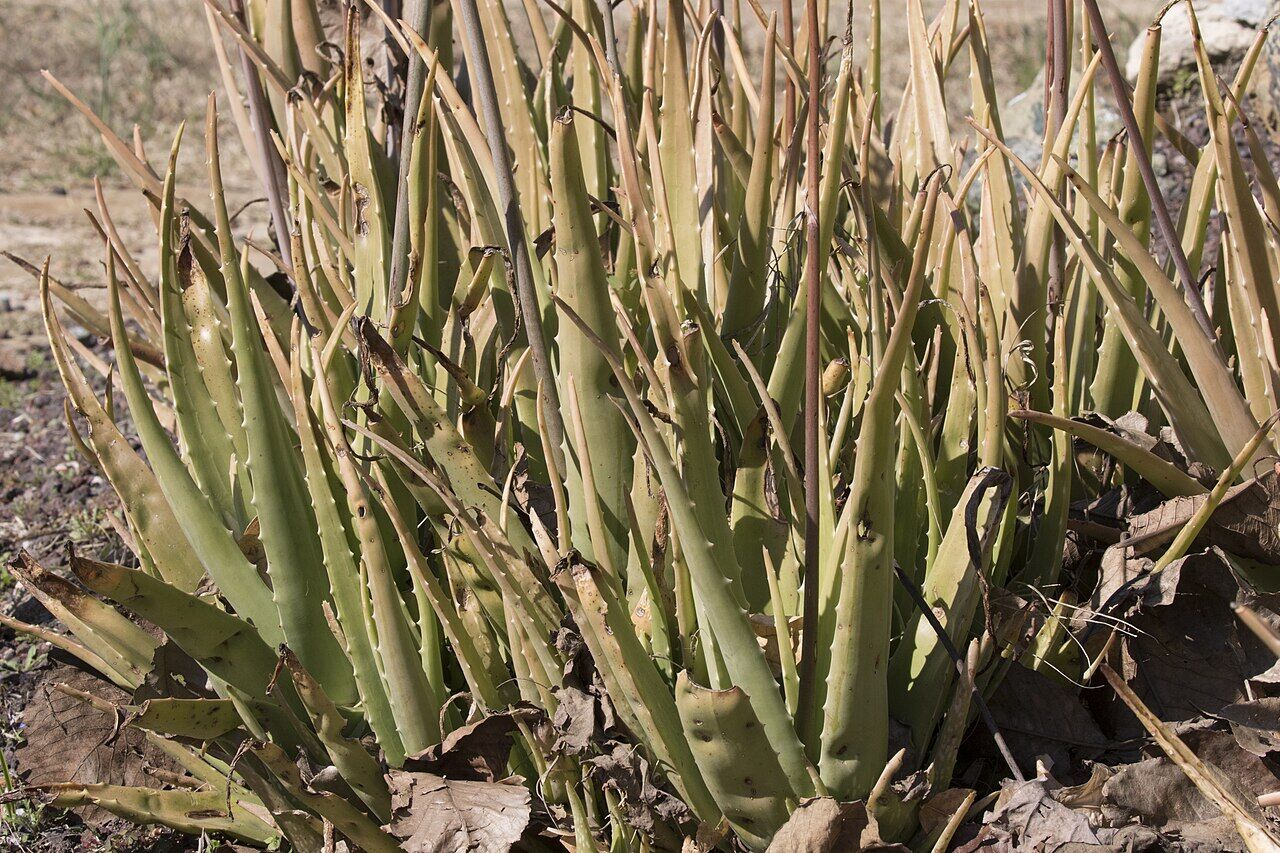
An evergreen succulent perennial herb. It is stemless or has a short stem up to 30 cm long, and it forms dense rosettes of 16 to 20 long, pointed leaves from creeping rhizomes. A flowering stem can reach about 160 cm. The source gives no written description of the flowers.
Where it grows
PROTA describes its habitat as maritime sands and rocks. It grows best where daytime temperatures are 19 to 27 degrees C, prefers a sunny position, and needs well-drained sandy or loamy soil. The source does not mention altitude.
- Native to
- PROTA says aloe vera is known only as a cultivated or naturalised plant, and is generally presumed to have originated in Arabia, Somalia or Sudan. Nigeria and West Africa are not named in that source. POWO was not opened.
Scientific details
- Scientific name
- Aloe vera (L.) Burm.f.
- Family
- Asphodelaceae
- Older names
- Aloe barbadensis Mill., Aloe perfoliata var. vera L., Aloe maculata Forssk., Aloe chinensis
Sources
Not yet reviewed Drafted with AI from the sources below. Treat with care.
- European Medicines Agency, Committee on Herbal Medicinal Products. Assessment report on Aloe barbadensis Miller and Aloe (various species, mainly Aloe ferox Miller and its hybrids). Doc. Ref. EMEA/HMPC/76313/2006 (superseded). European Medicines Agency, 2007.
- National Center for Complementary and Integrative Health (NCCIH). Aloe vera. NCCIH, US National Institutes of Health, 2024.
- Effects of Aloe vera on Burn Injuries: A Systematic Review and Meta-Analysis of Randomized Controlled Trials. Journal of Burn Care & Research, 2024. PMID 38605441.
- Unveiling the Latest Breakthroughs: A Comprehensive Review of the Therapeutic Activity and Safety Profile of Aloe vera. Current Drug Safety, 2024. PMID 38204271.
- Guo X, Mei N. Aloe vera: A review of toxicity and adverse clinical effects. Journal of Environmental Science and Health, Part C, 2016. PMID 26986231.
- PROTA (Plant Resources of Tropical Africa) / Useful Tropical Plants. Aloe vera (Aloe barbadensis) - PROTA / Useful Tropical Plants entry. PROTA / Useful Tropical Plants.
- Ajao AA, Mukaila YO, Sabiu S. Wandering through southwestern Nigeria: An inventory of Yoruba useful angiosperm plants. Heliyon, 2022. PMID 35024488.