Stool wood
- Igbo Egbun
- Yoruba Ahun
Alstonia boonei · also called Cheesewood, Pattern wood

What it is used for
- Malaria stem bark · traditional use
- Breast milk production stem bark · traditional use
- Cough, including bloody cough traditional use
- Muscle spasm stem bark · lab tests only
- Pain, inflammation and fever stem bark · lab tests only
Tap a use to read how it is prepared and how well it is supported.
How each use is prepared
Parts used: stem bark.
Malaria
Traditional useMalaria · stem bark · traditional
How it is prepared: Bark decoction, as reported in PROTA
People use it this way, but it has not been tested.
PROTA says a bark decoction is widely used for malaria, typhoid, gonorrhoea, yaws, asthma and dysentery. The same article says that in tests with mice and rats the bark was 'not efficient in treating malaria'. The use is reported, but the evidence does not support it. [1]
Breast milk production
Traditional useWomen's health · stem bark · galactagogue, traditional
People use it this way, but it has not been tested.
PROTA lists use to increase breast milk. The 2023 antispasmodic study advises that the plant should not be used by nursing mothers, which conflicts with this use. No study that supports the use was read. See the pregnancy and breastfeeding entry. [1]
Cough, including bloody cough
Traditional useCough and breathing · traditional
People use it this way, but it has not been tested.
One Osun State survey lists the plant for coughs, including bloody cough. No experimental support for this use was read. [6]
Muscle spasm
Lab or animal studiesOther · stem bark · antispasmodic effect on rat gut tissue
Tested in the laboratory or in animals, not in people.
A 2023 study found an antispasmodic effect in an ex vivo test on rat ileum (small intestine tissue kept alive outside the body), and supported it with computer modelling. This is a laboratory result and does not show that the plant relaxes muscle spasms in people. [5]
Pain, inflammation and fever
Lab or animal studiesPain and swelling · stem bark · mice and rats
Tested in the laboratory or in animals, not in people.
PROTA reports anti-inflammatory, antipyretic (fever-reducing) and analgesic (pain-relieving) effects of stem bark in mice and rats. This is animal evidence only. [1]
Safety
The latex can cause blindness if it gets into the eyes. A 2023 study advises that the bark should not be used in pregnancy, by nursing mothers or in liver dysfunction, but PROTA lists the bark as a breast-milk stimulant, which conflicts with that advice. Ask a clinician before use.
Poisoning and overdose
- The latex may cause blindness (PROTA). Useful Tropical Plants says the latex is dangerous to the eyes and can cause blindness. [1][2]
Pregnancy and breastfeeding
- The 2023 study advises that the plant should not be used by women who are pregnant, nursing mothers, or who have liver dysfunction. That study cites another reference for this advice, which was not opened. PROTA's breast-milk use conflicts with the advice on nursing mothers. [5]
Children
- Not documented in the sources read.
About this plant
A large tree whose bark is widely used in West and Central African traditional medicine, for malaria, cough and other complaints, and whose wood is used to make stools. Lab and animal studies show some effects, but PROTA says the bark is not efficient in treating malaria, and the latex can cause blindness.
How to recognise it
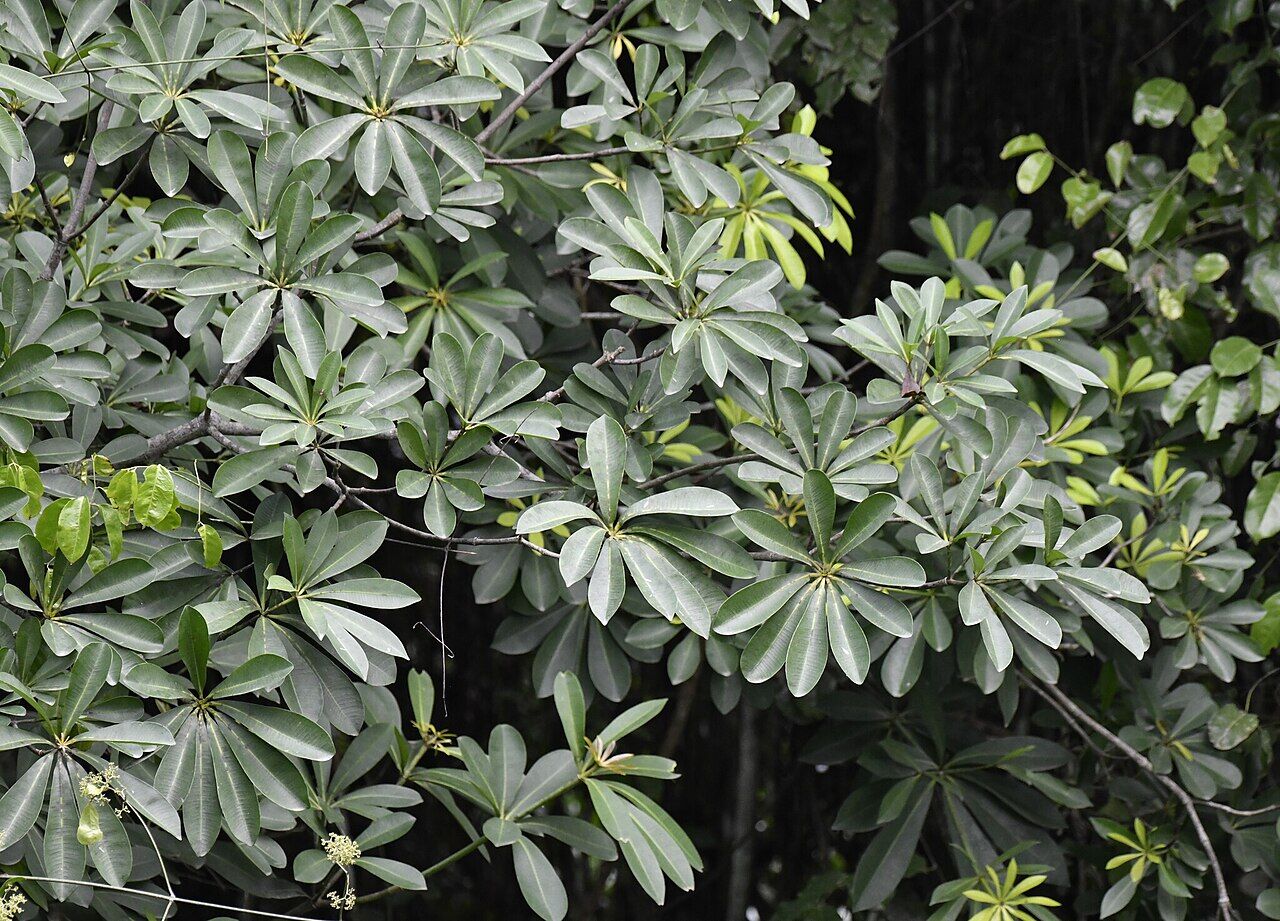
Alstonia boonei is a large deciduous tree that can reach about 45 m, with a trunk that is branchless for up to about 25 m and up to about 1 m across. Its bark is smooth or rough and greyish or pale brown on the outside, and creamy or pale yellow inside; it contains a lot of latex (milky sap) that flows when the bark is cut. The leaves grow in whorls of four to eight around the stem, are leathery, and are broadest towards the tip (obovate), about 6 to 20 cm long and 2.5 to 7.5 cm wide. The flowers are cream or pale yellow. The fruit is a pair of long follicles (pods) about 22 to 57 cm long, which split open to release the seeds.
Plants it can be confused with
- Alstonia congensis: PROTA says A. congensis usually has stalkless (sessile) leaves, hairless sepals and follicles, and a different surface pattern on the lower leaf. Its toxicity is not documented in the sources read.
Where it grows
PROTA lists moist evergreen and dry semi-deciduous forest up to about 1200 m. Useful Tropical Plants describes evergreen and deciduous forest in damp places.
- Native to
- From Senegal and Gambia to western Ethiopia and Uganda (PROTA).
- In Nigeria
- Recorded in ethnobotanical surveys from Osun State and from the North Central zone, and in a Yoruba plant inventory of southwestern Nigeria. GBIF holds 250 occurrence records from Nigeria.
- States
- Osun
Scientific details
- Scientific name
- Alstonia boonei De Wild.
- Family
- Apocynaceae
- Older names
- Alstonia congensis auct. non Engl.
- Main compounds
- echitamine
Sources
Not yet reviewed Drafted with AI from the sources below. Treat with care.
- Alstonia boonei De Wild. (PROTA article, Pl@ntUse, oldid 325922). PROTA (Plant Resources of Tropical Africa), Pl@ntUse.
- Alstonia boonei - Useful Tropical Plants. Tropical Plants Database (tropical.theferns.info).
- GBIF backbone. Alstonia boonei De Wild. - GBIF species match. Global Biodiversity Information Facility.
- GBIF. GBIF occurrence search, Alstonia boonei, country NG. Global Biodiversity Information Facility.
- Akinmurele OJ et al.. Antispasmodic Effect of Alstonia boonei De Wild. and Its Constituents: Ex Vivo and In Silico Approaches. Molecules, 2023. PMID 37894548.
- Lawal IO et al.. Ethnobotanical Survey of Plants Used for Treating Cough Associated with Respiratory Conditions in Ede South Local Government Area of Osun State, Nigeria. Plants (Basel), 2020. PMID 32443771.
- Ajao AA, Mukaila YO, Sabiu S. Wandering through southwestern Nigeria: An inventory of Yoruba useful angiosperm plants. Heliyon, 2022. PMID 35024488.
- Anyanwu GO et al.. An Ethnobotanical Survey and Pharmacological and Toxicity Review of Medicinal Plants Used in the Management of Obesity in the North Central Zone of Nigeria. Journal of Obesity, 2025. PMID 40026359.