Cashew
- Igbo Okpokpo
Anacardium occidentale · also called Cashew tree

What it is used for
- Malaria bark, root, leaf · traditional use
- Cough, asthma and bronchitis bark · traditional use
- High blood pressure seed · traditional use
- Skin problems leaf · traditional use
- Diarrhoea leaf · lab tests only
- Blood sugar enzymes leaf · lab tests only
Tap a use to read how it is prepared and how well it is supported.
How each use is prepared
Parts used: leaf, bark, root, seed.
Malaria
Traditional useMalaria · bark, root, leaf · reported folk use
People use it this way, but it has not been tested.
Ethnobotany surveys in Kwara and Lagos States report cashew as a folk remedy for malaria. These surveys record what people say they use, not whether it works. No clinical trial was found in the sources read. Malaria needs proper testing and treatment, and this plant should not replace antimalarial medicine. [4][7]
Cough, asthma and bronchitis
Traditional useCough and breathing · bark · reported folk use
How it is prepared: Bark made into a herb tea (described for asthma, colds and congestion in the Singapore source)
People use it this way, but it has not been tested.
A survey in Osun State records cashew for asthma and bronchitis. The bark tea preparation comes from a Singapore flora page, not from a Nigerian record. No study of this use was read. [5][2]
High blood pressure
Traditional useBlood pressure · seed · reported folk use
How it is prepared: Decoction of the seed
People use it this way, but it has not been tested.
A survey in Ile-Ife, Osun State, records a seed decoction for high blood pressure, mentioned by 10 informants. Counting mentions shows how common a use is, not whether it lowers blood pressure. No study in people was read, and the decoction is not dosed in the sources. [6]
Skin problems
Traditional useSkin · leaf · reported traditional use
People use it this way, but it has not been tested.
The Agroforestry Database reports that the buds and young leaves are used for skin diseases. The specific skin conditions are not named, and no study of this use was read. [1]
Diarrhoea
Lab or animal studiesStomach and digestion · leaf · laboratory study in rats
Tested in the laboratory or in animals, not in people.
Aqueous and hydroethanolic extracts of cashew leaves reduced diarrhoea in rats given castor oil, in a study from Benin. The study supports the traditional use only in animals; it is not a human trial. The Agroforestry Database also reports the kernel (the edible nut) for diarrhoea as a traditional use, which has not been tested. [8][1]
Blood sugar enzymes
Lab or animal studiesBlood sugar · leaf · laboratory test only
Tested in the laboratory or in animals, not in people.
Fractions of cashew leaf extract slowed two digestive enzymes (alpha-amylase and alpha-glucosidase) in test tubes, with half-inhibition at about 51 and 99 micrograms per mL. These are in vitro results only. They do not show any effect in people or animals, and the same study found toxicity to cultured cancer cells (see toxicity). [9]
Safety
No safe dose or tested preparation of cashew leaf, bark or root for people was found in the sources read, and most of the evidence is from laboratory or animal studies. The raw shell is poisonous and the bark gum can blister the skin, and cashew nut allergy in children can be severe. Pregnant or breastfeeding women, people with a nut allergy, and people taking medicine for diabetes or high blood pressure should not use cashew remedies without advice from a health professional.
Side effects
- Cashew nut allergy is the main documented harm. In a study of 59 children re-tested with a food challenge, 51 remained allergic, and 26 of those 51 (51%) had anaphylaxis during the challenge. This study is about the nut, not the leaves or bark, and whether leaf or bark preparations carry the same risk is not documented in the sources read. [10]
- No other side effects in people were reported in the sources read. This means data are lacking, not that the leaves, bark or root are safe. [1][2]
Poisoning and overdose
- The shell around the seed is poisonous. The Agroforestry Database states that the large curved seed is the edible nut inside a poisonous shell. [1]
- One component of the bark gum acts as a vesicant (it causes blistering) and has insect-repellent properties. [1]
- Useful Tropical Plants states that the shell is poisonous in the same way as poison ivy, and cautions that care should be taken when harvesting the seed. This is a secondary statement, attributed to a book, and was not checked against a primary source. [3]
- In an earlier study cited by a 2026 rat study, a single dose of 2000 mg/kg of an extract caused no deaths in rats. The plant part, the route and the study design are not stated in the paper read, and this does not establish safety in people. [8]
- In the cell test, the leaf extract fractions were also toxic to cultured cervical cancer cells (HeLa), with half-inhibition at about 79 micrograms per mL. This is a laboratory result and does not show human toxicity. [9]
If you take other medicines
- No drug interaction studies were found in the sources read. People taking medicine for diabetes or high blood pressure should ask a pharmacist before using cashew. [1][2]
Pregnancy and breastfeeding
- No pregnancy or breastfeeding safety data were found in the sources read. Avoid use in pregnancy and breastfeeding unless a health professional advises it. [1][2]
Children
About this plant
Cashew is a tropical tree whose leaves, stem bark, roots and seeds are used in folk medicine in parts of Nigeria. Its shell is poisonous and the nut can cause serious allergy, and the sources read do not establish safe doses.
How to recognise it
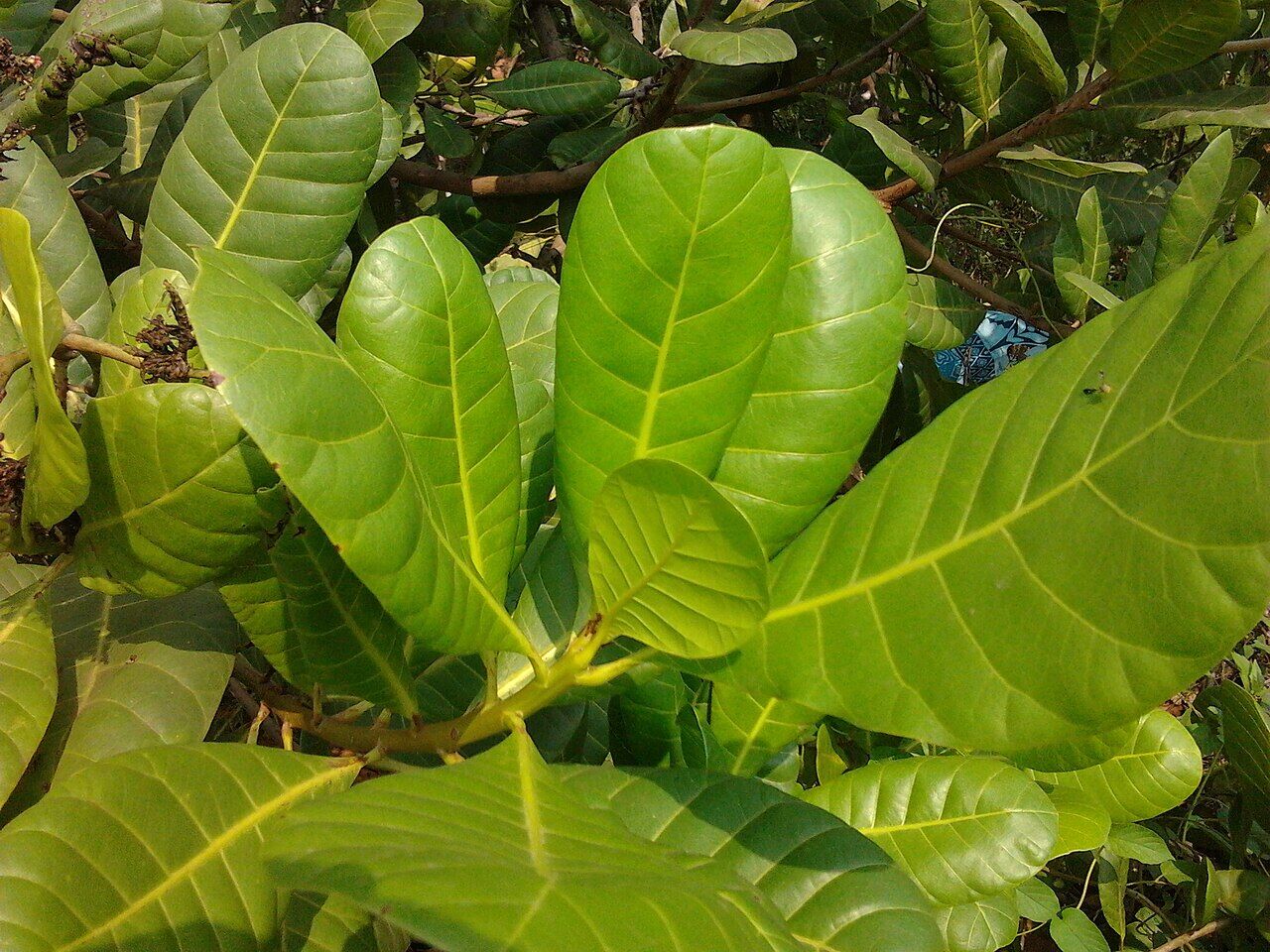
Cashew (Anacardium occidentale) is an evergreen tree that grows up to about 12 m tall and has a wide, dome-shaped crown. Its leaves are simple (one leaf blade per stalk) and grow alternately, one at each point along the twig, and they are leathery (coriaceous) and roughly obovate, meaning broader near the tip than at the base. Mature leaves measure about 10 to 18 cm long and 8 to 15 cm wide, sit on a short stalk, and are dark green; young leaves are pale green or reddish. The flowers are green or reddish, borne in branched clusters called panicles (loose, branching flower heads) that are about 10 to 20 cm long at the branch tips. The seed is a large, curved cashew nut about 2.5 cm long, and it sits inside a shell that is poisonous. When the stem is cut or injured it oozes a clear gum.
Where it grows
The Agroforestry Database describes the tree as needing high temperatures, and frost is harmful to it. Other habitat details are not documented in the sources read.
- Native to
- Tropical America
- In Nigeria
- GBIF holds 145 occurrence records from Nigeria (occurrence search for country NG). The sources read do not name the states or regions where it grows. Ethnobotany surveys in Osun, Lagos and Kwara States record cashew use, but these were places where people were interviewed, not confirmed growing sites.
Scientific details
- Scientific name
- Anacardium occidentale L.
- Family
- Anacardiaceae
Sources
Not yet reviewed Drafted with AI from the sources below. Treat with care.
- Orwa et al.. Anacardium occidentale. Agroforestry Database 4.0. World Agroforestry Centre (ICRAF), 2009.
- Anacardium occidentale (Cashew): Flora & Fauna Web. National Parks Board, Singapore (NParks Flora & Fauna Web).
- Anacardium occidentale. Useful Tropical Plants.
- Evbuomwan IO, Stephen Adeyemi O, Oluba OM, et al.. Indigenous medicinal plants used in folk medicine for malaria treatment in Kwara State, Nigeria: an ethnobotanical study. BMC Complementary Medicine and Therapies, 2023. PMID 37716985.
- Lawal IO, Olufade II, Rafiu BO, et al.. Ethnobotanical Survey of Plants Used for Treating Cough Associated with Respiratory Conditions in Ede South Local Government Area of Osun State, Nigeria. Plants (Basel), 2020. PMID 32443771.
- Mukaila YO, Oladipo OT, Ogunlowo I, et al.. Which Plants for What Ailments: A Quantitative Analysis of Medicinal Ethnobotany of Ile-Ife, Osun State, Southwestern Nigeria. Evidence-Based Complementary and Alternative Medicine, 2021. PMID 34394387.
- Lawal IO, Rafiu BO, Ale JE, et al.. Ethnobotanical Survey of Local Flora Used for Medicinal Purposes among Indigenous People in Five Areas in Lagos State, Nigeria. Plants (Basel), 2022. PMID 35270103.
- Hounsa E, Fagla SM, Agbodjento E, et al.. In-vivo antidiarrheal activity of aqueous and hydroethanolic extracts of Anacardium occidentale and Khaya senegalensis used in Benin (West Africa) in a castor oil-induced diarrhea model traditionally. Frontiers in Pharmacology, 2026. PMID 42358373.
- Pham DC, Truong DH, Tran QH, et al.. Fractionation, identification of chemical constituents, and biological properties of cashew (Anacardium occidentale L.) leaf extracts. Food Science & Nutrition, 2023. PMID 38107119.
- Röntynen P, Kukkonen AK, Savinko T, et al.. Natural Course and Predictors of Clinical Resolution in Pediatric Cashew Nut Allergy. Allergy, 2025. PMID 40678938.
- Oyedemi SO, Oyedemi BO, Ijeh II, Ohanyerem PE, Coopoosamy RM, Aiyegoro OA. Alpha-Amylase Inhibition and Antioxidative Capacity of Some Antidiabetic Plants Used by the Traditional Healers in Southeastern Nigeria. The Scientific World Journal, 2017. PMID 28367491.