Soursop
Annona muricata · also called Graviola, Sapsap

What it is used for
- Inflammation and infection leaf · traditional use
- Diarrhoea and stomach ache leaf · traditional use
- Cancer claims, not proven leaf, fruit, seed · lab tests only
- Malaria leaf · lab tests only
- High blood pressure leaf · lab tests only
- Blood sugar lab tests only
Tap a use to read how it is prepared and how well it is supported.
How each use is prepared
Parts used: leaf, fruit, seed, bark.
Inflammation and infection
Traditional useOther · leaf
How it is prepared: Leaves used as an infusion or tea. The preparation is not specified in the source beyond this description.
People use it this way, but it has not been tested.
MSK says the leaves and stems are used in traditional medicine for symptoms associated with inflammation and infection, without naming a preparation. The BfR/EFSA risk assessment notes that leaf infusions were consumed in the Guadeloupe and Martinique observational studies, where they were linked to parkinsonism-like movement disorders. The leaf tea is therefore best understood as a traditional use with a safety concern, not a proven remedy. [3][4]
Diarrhoea and stomach ache
Traditional useStomach and digestion · leaf
How it is prepared: Leaves made into a decoction and drunk, as listed in the survey table.
People use it this way, but it has not been tested.
Herbalists in Sironko District, Eastern Uganda, listed soursop leaves for diarrhoea and stomach ache in their survey of plants used for gastrointestinal illness. The survey gives no dose, and it was carried out in Uganda, so it is not evidence of use in Nigeria. The survey records reported use only and does not show that soursop works. [9]
Cancer claims, not proven
Lab or animal studiesOther · leaf, fruit, seed
Tested in the laboratory or in animals, not in people.
MSK states that graviola is promoted as an alternative cancer treatment, that there is no proof it benefits cancer patients, and that human studies are lacking for the laboratory anticancer findings. Laboratory and animal studies exist, but no human clinical trial was opened for this record. Claims of cure or cancer prevention are not supported. [3]
Malaria
Lab or animal studiesMalaria · leaf
How it is prepared: Ethanolic leaf extract, given to mice infected with Plasmodium berghei.
Tested in the laboratory or in animals, not in people.
The study tested an ethanolic leaf extract in mice infected with Plasmodium berghei. Parasite levels fell in the treated mice in the suppressive, prophylactic and curative tests. The authors also ran a computer docking analysis against Plasmodium falciparum proteins. The result comes from mice and a computer analysis only. No human study was opened, so it does not show that soursop treats malaria in people. [6]
High blood pressure
Lab or animal studiesBlood pressure · leaf
How it is prepared: Methanol leaf extract and an ethyl acetate fraction, given to rats with hypertension induced by L-NAME.
Tested in the laboratory or in animals, not in people.
The study gave leaf extracts to rats made hypertensive with L-NAME. The authors report that the extract significantly reduced blood pressure in these rats. The result comes from animals only. No human study was opened, so it does not show that soursop lowers blood pressure in people. [7]
Blood sugar
Lab or animal studiesBlood sugar
How it is prepared: Aqueous extract of the peel, given to rats with alloxan-induced diabetes.
Tested in the laboratory or in animals, not in people.
The study gave an aqueous peel extract to diabetic rats and also tested it against carbohydrate-digesting enzymes in the laboratory. The authors report lower fasting blood glucose in the treated rats. The source says peel without naming the fruit part, so no part is recorded. These are animal and laboratory results only, and no human study was opened. The result does not show that soursop controls blood sugar in people. [8]
Safety
Annonaceae products contain acetogenins, including annonacin, which the sources link to nerve damage. Observational studies in the Caribbean and French Guiana associated long-term consumption of fruit, juice and herbal teas with parkinsonism-like disease. There are no human trials showing the plant treats cancer, and the BfR/EFSA assessment found substantial uncertainty about safe use. Do not use soursop leaf tea or supplements in place of treatment, and speak to a clinician first.
Side effects
- The BfR/EFSA assessment cites observational studies that found an increased incidence of movement disorders resembling Parkinson disease, linked to long-term consumption of fruit and leaf infusions. It notes that causality is difficult to prove. [4][5]
- A cross-sectional study of 180 patients with degenerative parkinsonism in Guadeloupe and Martinique found that cumulative Annonaceae consumption, including fruit, juice and herbal tea, was associated with more severe symptoms and cognitive decline. The study has no control group and relies on retrospective self-report, so it cannot show cause. [5]
Poisoning and overdose
- The authors of the Guadeloupe study state that the neurotoxic potential of annonacin, the most abundant acetogenin in A. muricata, has been shown in experimental studies. They describe acetogenins as mitochondrial complex I inhibitors. [5]
- In a 28-day rat study, annonacin caused neuropathological changes in the basal ganglia and loss of nigral and striatal neurons, according to the BfR/EFSA assessment. The assessment says the data give strong indications of neurotoxic potential of some A. muricata preparations. [4]
- MSK notes that in vitro, graviola alkaloids caused movement disorders and myeloneuropathy with symptoms mimicking Parkinson disease. It is unclear whether this neurotoxicity translates to humans. [3]
If you take other medicines
- No interaction study was opened. Because of the neurotoxicity concern, tell a clinician if you take any Annonaceae product, especially alongside other medicines. This is a precaution, not a sourced interaction. [4]
Pregnancy and breastfeeding
- Not documented in the sources read.
Children
- Not documented in the sources read.
About this plant
A small evergreen tree from the West Indies and tropical America, now grown across the tropics. Its leaves are drunk as tea and its fruit is eaten, and it is widely promoted as a cancer treatment. Cancer claims are not supported by human clinical evidence, and the plant contains compounds linked to nerve damage, so it should not be used in place of medical treatment.
How to recognise it
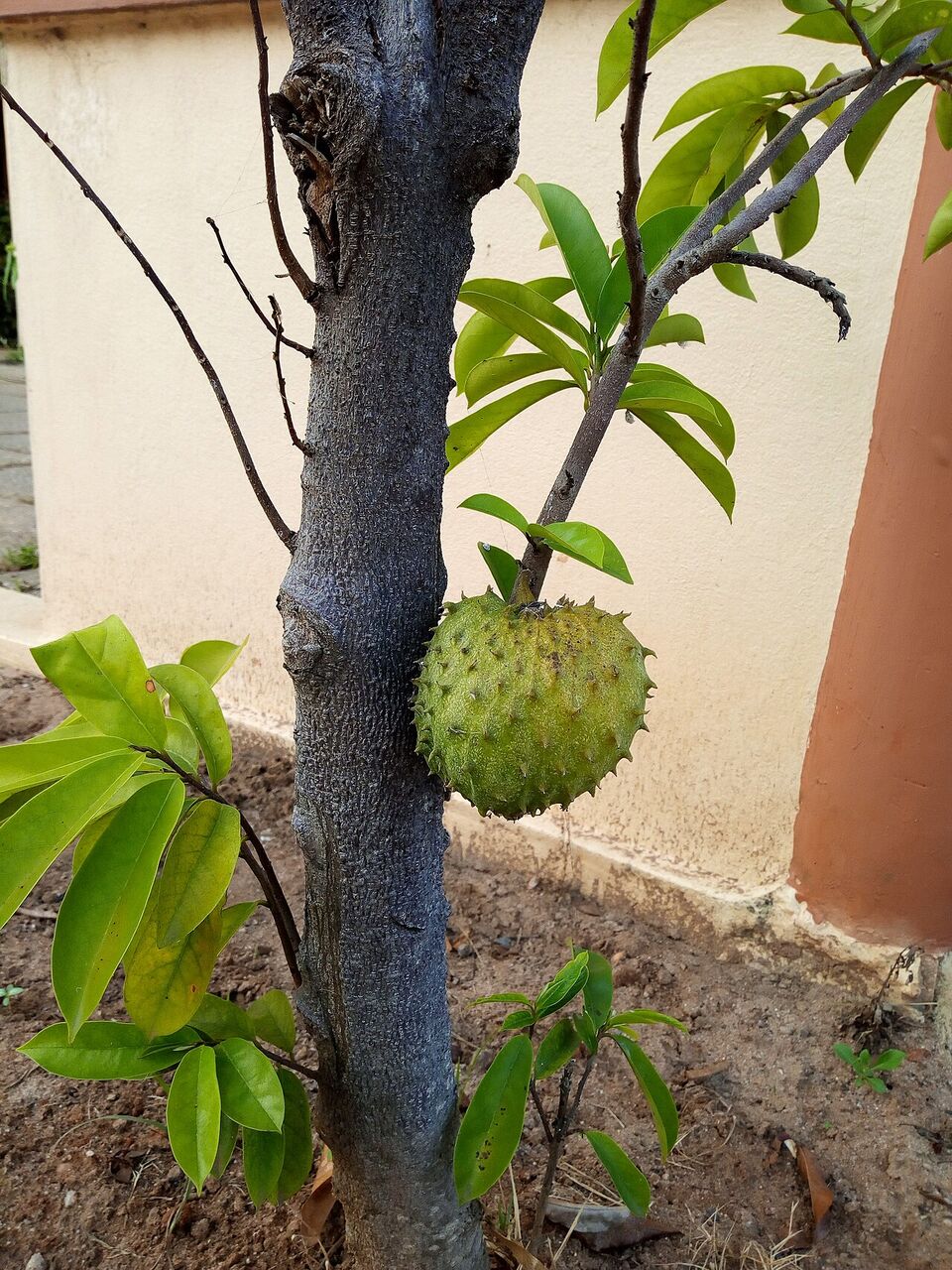
Annona muricata is a slender evergreen tree, usually 5 to 7 m tall and often shorter, with a trunk up to about 30 cm across and low, wide branches that form an open, shady crown. The bark is grey with shallow grooves. The leaves are alternate (one per node), dark green, shiny and leathery, and oval with a sharp tip. They are 8 to 15 cm long. The underside is dull or yellowish, with small pits in the vein axils. Crushed leaves give off a strong, unpleasant smell. The flowers are solitary and large, 2 to 5 cm across, and often hang opposite the leaves. The three outer petals are fleshy, curved and nearly triangular. The three inner petals are yellow-green, thinner and rounded, with overlapping edges. The fruit is kidney- or heart-shaped, up to 25 cm long, often 1 to 4 kg, with a leathery dark green skin covered in soft, curved spines. The white, woolly, fibrous pulp surrounds many large brown-black seeds. The fruit is a compound of fused fruitlets, visible as spine-tipped sections on the skin.
Where it grows
- Native to
- West Indies and tropical America (PROTA)
- In Nigeria
- Listed among the useful angiosperms of southwestern Nigeria in the Yoruba inventory of Ajao et al. (2022), but only as part of a merged row with Annona senegalensis. The survey does not separate the two species, so no Nigerian locality is recorded for A. muricata alone.
Scientific details
- Scientific name
- Annona muricata L.
- Family
- Annonaceae
- Main compounds
- annonacin, acetogenins
Sources
Not yet reviewed Drafted with AI from the sources below. Treat with care.
- PROTA (Plant Resources of Tropical Africa). Annona muricata L. (PROTA species record, Bekele-Tesemma 2007). Pl@ntUse, PROTA, 2007.
- Ajao AA, Mukaila YO, Sabiu S. Wandering through southwestern Nigeria: An inventory of Yoruba useful angiosperm plants. Elsevier, 2022. PMID 35024488.
- Graviola (Memorial Sloan Kettering Cancer Center, About Herbs page). Memorial Sloan Kettering Cancer Center.
- German Federal Institute for Risk Assessment (BfR). Risk assessment regarding the use of Annona muricata in food supplements. EFSA Journal, 2020.
- Cleret de Langavant L, et al.. Annonaceae Consumption Worsens Disease Severity and Cognitive Deficits in Degenerative Parkinsonism. Movement Disorders, 2022. PMID 36210778.
- Nwonuma CO, Balogun EA, Gyebi GA. Evaluation of Antimalarial Activity of Ethanolic Extract of Annona muricata L.: An in vivo and an in silico Approach. Journal of Evidence-Based Integrative Medicine, 2023. PMID 37019435.
- Nsor OO, Alabi BA, Badejo JA, et al.. Soursop leaf extract and fractions protects against L-NAME-induced hypertension and hyperlipidemia. Frontiers in Nutrition, 2024. PMID 39171117.
- Ojo OA, Grant S, Amanze JC, et al.. Annona muricata L. peel extract inhibits carbohydrate metabolizing enzymes and reduces pancreatic β-cells, inflammation, and apoptosis via upregulation of PI3K/AKT genes. PLoS One, 2022. PMID 36301972.
- Walusansa A, Natoli R, Kafeero HM. Diversity and perceptions about side effects of medicinal plants used by herbalists to treat gastrointestinal diseases in Sironko District, Eastern Uganda. Tropical Medicine and Health, 2026. PMID 42104496.