Neem
- Igbo Atu yabasi, Ogwu akom
- Yoruba Dogoyaro
Azadirachta indica

What it is used for
- Skin conditions traditional use
- Oral hygiene traditional use
- Ulcers traditional use
- Cancer lab tests only
Tap a use to read how it is prepared and how well it is supported.
How each use is prepared
Skin conditions
Traditional useSkin
People use it this way, but it has not been tested.
A narrative review of traditional uses (Mehnaz et al., 2024) lists skin conditions first among the traditional uses. The opened text gives no experimental support for this use. [2]
Oral hygiene
Traditional useOther
People use it this way, but it has not been tested.
Listed by MSK as a purported use. No human study that shows it works was opened. [1]
Ulcers
Traditional useOther · type not specified
People use it this way, but it has not been tested.
Listed by MSK as a purported use. The page does not say which kind of ulcer, and no human study that shows it works was opened. [1]
Cancer
Lab or animal studiesOther · purported use, not supported
Tested in the laboratory or in animals, not in people.
MSK says there are no human studies showing neem to be an effective cancer treatment, and that the cancer evidence comes from laboratory and animal studies. Do not use neem in place of cancer treatment. [1]
Safety
Swallowing neem oil has caused severe poisoning in children and adults. Rare reports of side effects include vomiting, drowsiness, seizures and nervous system toxicity. Neem can interact with some medicines in laboratory tests, and the clinical effect is not known.
Side effects
- Rare case reports of oral use include vomiting, drowsiness, diarrhoea, vision loss, nervous system toxicity, poisoning and seizures. Topical use can cause rash and itchy, dry or reddened skin. [1]
Poisoning and overdose
- Swallowing neem oil has caused severe poisoning in both children and adults. [1]
- In a mouse study of 28 days, neem seed oil given alone caused no liver degeneration, but the study was small and the paper has internal inconsistencies, so this is weak animal evidence and not a toxicity assessment. [3]
If you take other medicines
- In laboratory tests a neem extract inhibited several liver enzymes (CYP 3A4/5, 2C8 and 2C9). MSK says the clinical relevance is not known. [1]
Pregnancy and breastfeeding
- No source opened addresses pregnancy. A clinician should advise before use.
Children
- Swallowing neem oil has caused severe poisoning in children. Do not give neem oil by mouth to children. [1]
About this plant
A tree whose parts are used in traditional and Ayurvedic medicine. Human studies on safety and effectiveness are lacking, and swallowing neem oil has caused severe poisoning.
How to recognise it
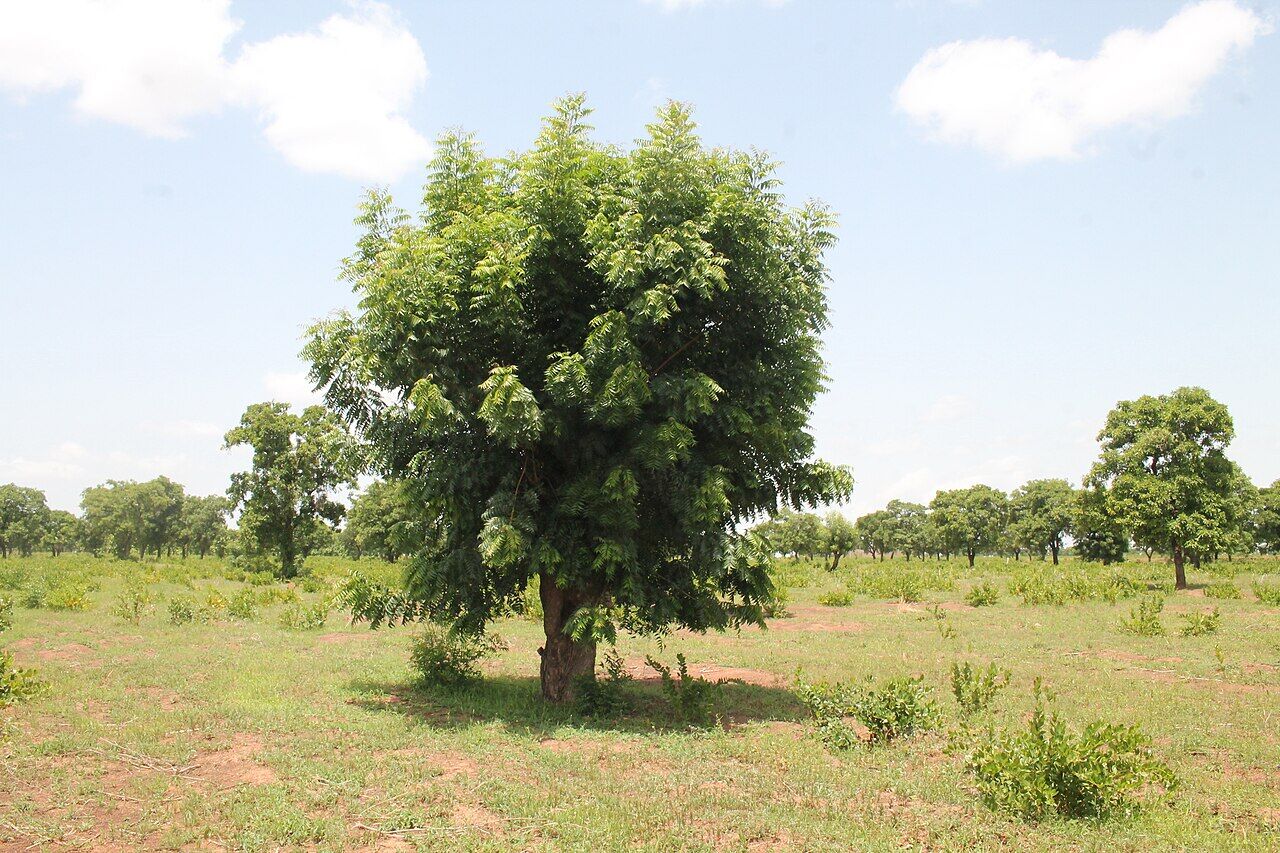
Neem is a mostly evergreen tree that usually grows to about 15 m, occasionally up to 25 m, with a short, straight trunk up to about 100 cm across. Its leaves are pinnate, meaning the leaflets are arranged along both sides of one central stalk; the leaves are alternate (set singly along the branch), crowded near the branch tips, and 20 to 40 cm long. Each leaflet is glossy and has a saw-toothed (serrate) edge. The flowers are small, white or pale yellow, and slightly sweet-smelling. The fruit is an oval drupe (a fleshy fruit around a single hard stone) about 1 to 2 cm long, greenish to yellow when ripe, and holds one or two seeds. The bark is bitter and astringent (it dries the mouth), and on old trees it is deeply cracked and flaky.
Plants it can be confused with
- Melia azedarach (chinaberry): Chinaberry has bipinnate leaves (divided twice, like a feather of feathers), with pointed, toothed-edged leaflets, while neem has simply pinnate leaves with glossy, serrate leaflets. Chinaberry has lilac, purplish, fragrant, star-shaped flowers borne in masses, while neem has small white or pale yellow flowers. Chinaberry bears clusters of yellow, round fruits about 2 cm across. All parts of chinaberry are poisonous: the Flowers of India page warns that eating as few as six berries can cause death, and Useful Tropical Plants says the fruit is highly toxic and that as few as six fruits have caused nausea, spasms and deaths in children. Useful Tropical Plants lists Melia azadirachta as a synonym of neem, so a label using that name may refer to neem; check the leaves and flowers before handling or eating any plant.
Where it grows
In the sources read, neem grows in lowland forest: Useful Tropical Plants lists mixed and evergreen lowland forest. Agroforestree gives evergreen and dry deciduous forest for Africa.
- Native to
- East Asia, India, Bangladesh and Myanmar (Useful Tropical Plants); see notes for a wider list.
- In Nigeria
- The GBIF occurrence search returns 385 records from Nigeria for this species. A 2023 thesis from Kampala International University found that neem outnumbers native trees in Taura Local Government Area, Jigawa State, but that study covers only Taura.
Scientific details
- Scientific name
- Azadirachta indica A.Juss.
- Family
- Meliaceae
Sources
Not yet reviewed Drafted with AI from the sources below. Treat with care.
- Neem. Memorial Sloan Kettering Cancer Center (page last updated 11 April 2023), 2023.
- Mehnaz S, Shamsi Y, Akhtar MW, Mohanty S, Ahmad S. Therapeutic Applications of Neem (Azadirachta indica): A Narrative Review. Advances in Mind-Body Medicine, 2024. PMID 39447127.
- Nikolova G, Ananiev J, Ivanov V, Petkova-Parlapanska K, Georgieva E, Karamalakova Y. The Azadirachta indica (Neem) Seed Oil Reduced Chronic Redox-Homeostasis Imbalance in a Mice Experimental Model on Ochratoxine A-Induced Hepatotoxicity. Antioxidants (Basel), 2022.
- Ajao AA, Mukaila YO, Sabiu S. Wandering through southwestern Nigeria: An inventory of Yoruba useful angiosperm plants. Heliyon, 2022. PMID 35024488.
- Azadirachta indica - Useful Tropical Plants. Tropical Plants Database (tropical.theferns.info).
- Orwa, C., Mutua, A., Kindt, R., Jamnadass, R., Simons, A.. Agroforestree Database: a tree reference and selection guide, version 4.0 (species profile for Azadirachta indica). World Agroforestry Centre, Kenya, 2009.
- GBIF backbone. Azadirachta indica A.Juss. - GBIF species match. Global Biodiversity Information Facility.
- GBIF. GBIF occurrence search, Azadirachta indica, country NG. Global Biodiversity Information Facility.
- Ahmed (full name not seen on page read). Thesis on neem (Azadirachta indica) phenology, distribution and uses in Taura Local Government Area, Jigawa State, Nigeria (title paraphrased; check the repository record). Kampala International University (institutional repository), 2023.
- Melia azedarach - Chinaberry Tree. flowersofindia.net.
- Melia azedarach - Useful Tropical Plants. Tropical Plants Database (tropical.theferns.info).
- Oladele JO, Ajayi EI, Oyeleke OM, Oladele OT, Olowookere BD, Adeniyi BM, Oyewole OI, Oladiji AT. A systematic review on COVID-19 pandemic with special emphasis on curative potentials of Nigeria based medicinal plants. Heliyon, 2020. PMID 32929412.