Spreading hogweed
Boerhavia diffusa · also called Red hogweed, Tar vine, Punarnava

What it is used for
- Threatened miscarriage whole plant · traditional use
- Ulcers, abscesses and Guinea worm disease root · traditional use
- Support during tuberculosis treatment root · tested in people
- Kidney and urinary problems, including urinary stones root, leaf · lab tests only
Tap a use to read how it is prepared and how well it is supported.
How each use is prepared
Parts used: root, leaf, whole plant.
Threatened miscarriage
Traditional useWomen's health · whole plant · Nigeria
People use it this way, but it has not been tested.
The 2014 review lists this as a Nigerian use in a table of traditional uses, citing a survey of herbs used in Enugu State (Akaneme, 2008). That survey was not opened. No study of the plant's effect on pregnancy is cited. See the pregnancy entry under safety before considering any use. [2]
Ulcers, abscesses and Guinea worm disease
Traditional useWounds · root · tropical Africa
How it is prepared: Boiled roots applied to the sore, or used to assist extraction of the worm
People use it this way, but it has not been tested.
Reported in PROTA as a tropical African use. There is no controlled study in the sources read. [1][2]
Support during tuberculosis treatment
Studied in peopleInfections · root
Tested in at least one human study. Read the note for how strong the result is.
The 2014 review reports one trial of 50 newly diagnosed patients in which recovery was faster in the group given the plant with chemotherapy. This is a single small trial, known only as reported in the review, so the evidence is weak. [2]
Kidney and urinary problems, including urinary stones
Lab or animal studiesOther · root, leaf
Tested in the laboratory or in animals, not in people.
The 2014 review reports laboratory work on urinary crystals (less calcium oxalate deposition and smaller crystals with extracts) and a rat study with significant diuretic activity from a root extract. These are not tested in people. [2]
Safety
PROTA describes the root as abortifacient and says it is used to hasten childbirth, and a Nigerian use lists the whole plant for threatened miscarriage. Pregnant women should not use it. No side effects are documented in the sources read, and human safety data are lacking.
Side effects
Poisoning and overdose
- Toxicity in people is not documented in the sources read. PROTA reports that no teratogenic effects were detected in pregnant rats. [1]
If you take other medicines
Pregnancy and breastfeeding
- Data lacking. PROTA reports no teratogenic effects in pregnant rats, but the root is described as abortifacient and the whole plant is used for threatened miscarriage in Nigeria. Avoid in pregnancy. [1][2]
Children
About this plant
A low, spreading weed of roadsides and waste ground across the tropics. Its roots and whole plant are used in traditional medicine in many countries, but the human evidence is thin.
How to recognise it
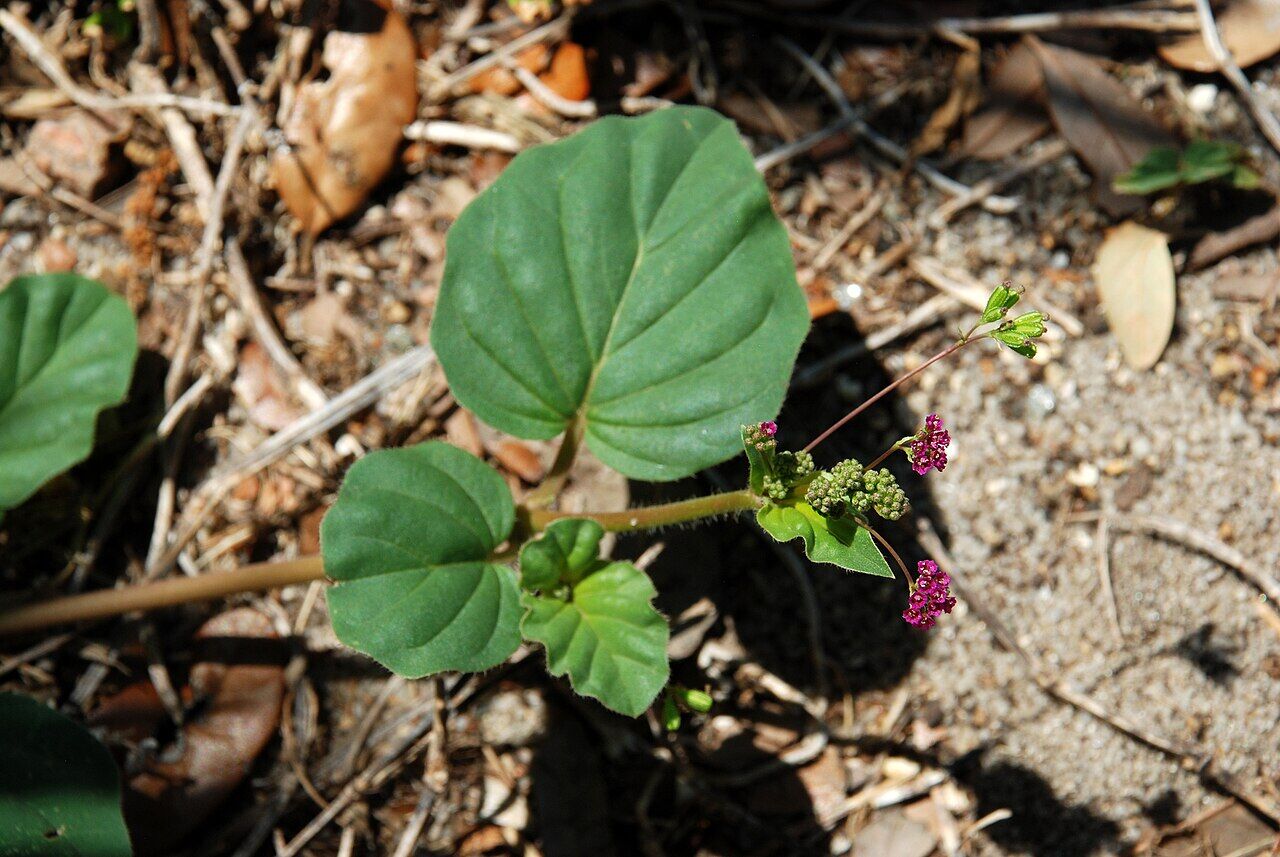
A herb, annual to perennial, up to about 1 m tall, sometimes with a thick taproot. The stems are fleshy and often flushed with red, prostrate when young and upright when flowering, with swollen nodes. Leaves are opposite and stalked (stalk 1 to 2.5 cm), with a blade 1.5 to 6 cm long, pale green to whitish underneath and sometimes with red marginal glands. Small flowers with a red or purple, five-lobed perianth are borne in small clusters that make up a loose panicle up to 40 cm long at the stem tips. Each fruit is club-shaped, about 3 mm long, five-ribbed and covered in glandular hairs, enclosed by the lower part of the flower.
Where it grows
Ruderal places and roadsides, sunny sites, and weedy cultivated land, usually on sandy soils. It is also found in lawns and grazing pasture, from sea level up to 1200 m. It flowers and fruits through the year when there is enough water.
- Native to
- Pantropical. PROTA says it possibly originates from the Old World tropics and occurs throughout tropical Africa.
- In Nigeria
- GBIF lists 81 occurrence records from Nigeria (a record count only, not a survey). PROTA reports that caterpillars of two moth species, Aegocera rectilinea and Hippotion celerio, were found in Nigeria feeding almost solely on this plant.
Scientific details
- Scientific name
- Boerhavia diffusa L.
- Family
- Nyctaginaceae
Sources
Not yet reviewed Drafted with AI from the sources below. Treat with care.
- Schmelzer GH, Gurib-Fakim A (eds). Boerhavia diffusa (PROTA). PROTA (Plant Resources of Tropical Africa), Pl@ntUse.
- Mishra S, et al.. Phytochemical, therapeutic, and ethnopharmacological overview for a traditionally important herb: Boerhavia diffusa Linn.. BioMed Research International, 2014. PMID 24949473.
- GBIF species match: Boerhavia diffusa L.. GBIF.
- GBIF occurrence search, country=NG, Boerhavia diffusa (record count). GBIF.