Pawpaw
- Igbo Okwuru-ezi, Okwuru-bekee, Mgbimgbi
- Yoruba Ibepe
Carica papaya · also called Papaya
.jpg)
What it is used for
- Low platelets in dengue fever leaf · tested in people
- Weight loss fruit · traditional use
- Blood sugar leaf, fruit, seed, latex · traditional use
- Worms traditional use
- High blood pressure fruit · traditional use
- Body fat and weight leaf, fruit, seed, root · lab tests only
Tap a use to read how it is prepared and how well it is supported.
How each use is prepared
Parts used: leaf, fruit, seed, root, latex.
Low platelets in dengue fever
Studied in peopleOther · leaf
Tested in at least one human study. Read the note for how strong the result is.
Two small human trials (one in adults, one in children) and two reviews of trials report possible benefit on platelet counts. The adult pilot trial had 51 people. The children's trial was open-label, which means participants and staff knew who was receiving the extract. The 2019 meta-analysis concludes that current evidence is insufficient to comment on the role of the extract in dengue. The evidence is weak. This is not a proven use and should not replace standard medical care for dengue. [1][2][3][4]
Weight loss
Traditional useOther · fruit
How it is prepared: Fruit blended into a juice and drunk by mouth, about one cup daily, as recorded in a North Central Nigeria survey.
People use it this way, but it has not been tested.
A 2025 ethnobotanical survey of plants used for obesity in Nigeria's North Central zone records papaya juice taken this way. This is a traditional use only. The same review found no human clinical trial of papaya for weight loss, and the juice amount is what the survey reported, not a tested dose. [16]
Blood sugar
Traditional useBlood sugar · leaf, fruit, seed, latex
How it is prepared: Infusion, decoction, juice or powder, as listed in the ECOWAS diabetes review. The review gives no dose for each.
People use it this way, but it has not been tested.
A 2026 review of medicinal plants used for diabetes in ECOWAS countries lists papaya among the species used in traditional medicine, with Nigeria among the countries listed. The review did not find clinical trials showing papaya lowers blood sugar in people. Papaya may interact with blood sugar medicines (see safety). [17]
Worms
Traditional useWorms and parasites
People use it this way, but it has not been tested.
A 2025 scoping review lists papaya among the plants frequently cited for helminth (worm) infections in humans and livestock across 14 African countries, with Nigeria among the countries contributing most studies. The parts and preparations used were not stated in the passages read, so none are given. No opened study tested papaya against worms in people, and the Nigerian and other studies cited in the review were not opened. [18]
High blood pressure
Traditional useBlood pressure · fruit
People use it this way, but it has not been tested.
A 2026 article on the cardioprotective potential of papaya reports that the fruit is used in traditional medicine for blood pressure, possibly through a diuretic (urine-producing) effect. The article attributes this to an earlier study that was not opened. No preparation or dose is sourced, and no human study was found. [19]
Body fat and weight
Lab or animal studiesOther · leaf, fruit, seed, root
Tested in the laboratory or in animals, not in people.
The 2025 review summarises laboratory and animal studies. Leaf and seed water extracts reduced pancreatic lipase in test tubes. Fruit extract lowered body weight and liver triglycerides in rats on a high-fat diet, and root extract reduced fat mass in obese mice. The underlying studies were not opened. No human data were found, so this is not evidence of benefit in people. [16]
Safety
Papaya leaf is not an established medicine. The MSK review judges short-term use of leaf juice or extract appears safe (under 5 days), but human data are limited. Long-term use raises concerns in animal studies, especially in pregnancy and liver disease. Check with a health worker or pharmacist before use, especially if you take blood sugar medicines.
Side effects
- Mild stomach upset (gastrointestinal disturbances) and rash. [1]
- The adult dengue pilot trial reported that the extract was safe and well tolerated, with no significant decrease in mean hospital days. [2]
Poisoning and overdose
- Long-term use: animal studies have raised concerns about possible toxicity, especially in pregnant women and people with liver impairment. Human data on long-term use are lacking. [1]
If you take other medicines
- Preclinical studies suggest possible interactions with blood sugar lowering medicines (hypoglycemics) and with P-glycoprotein substrate drugs. No specific compound has been identified as the cause, and clinical relevance is not yet known. [1]
Pregnancy and breastfeeding
- Pregnant women should use caution (MSK). Animal studies raised concerns about toxicity with long-term use. Data on breastfeeding are lacking. [1]
Children
- Data lacking for safe use in children as a home remedy. One open-label randomized trial in children aged 1 to 12 with dengue was reported, but its safety findings were not captured in this draft, so it should not be read as proof of child safety. [3]
About this plant
Papaya is a fruit tree widely grown in Nigeria. Its leaves are used by some people for dengue fever, but the human studies are small and the evidence is not strong enough to recommend them.
How to recognise it
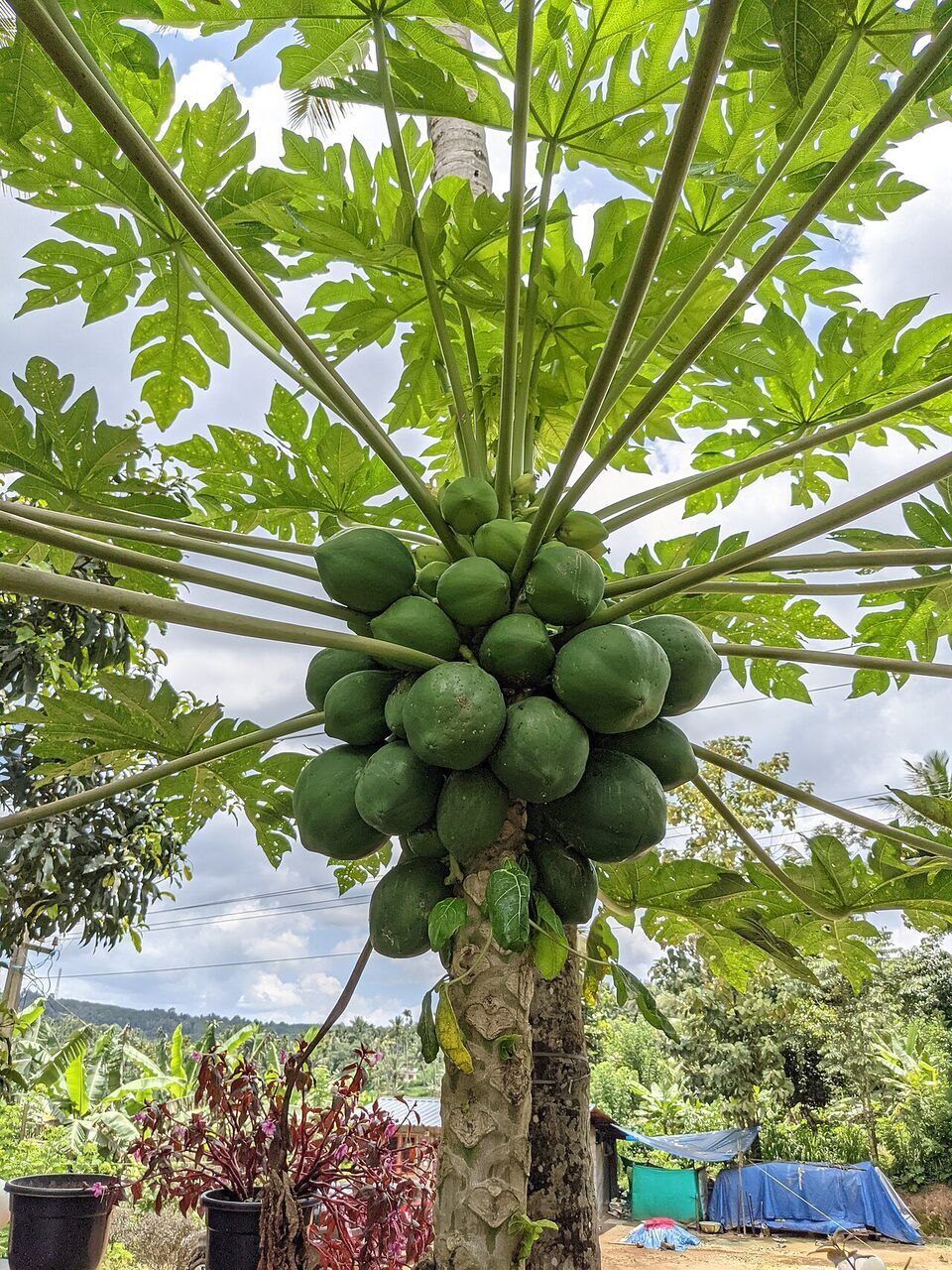
Papaya is a small, fast-growing, short-lived evergreen tree, usually 3 to 10 m tall. Its trunk (bole) is usually unbranched and 10 to 30 cm thick; it is hollow and soft rather than woody. The leaves are grouped in a spiral at the top of the trunk, on hollow stalks up to 1 m long. Each leaf blade is 25 to 75 cm across, palmate (lobes spreading from one point like the fingers of a hand) and deeply cut into 7 lobes. The flowers are tiny and yellow, and plants are male, female or both. The fruit is large, cylindrical or variable in shape, with orange flesh and many small black seeds held in a jelly-like coating. All parts contain latex, a milky sap.
Where it grows
Papaya grows in the tropics and is widely cultivated. Purdue's Duke handbook says it grows best below 1,500 m in well-drained, rich soil; it is killed by frost and does not tolerate shade, waterlogging or strong winds. Agroforestree gives an altitude range of 0-1,600 m.
- Native to
- Central America and southern Mexico (original habitat believed); not known as a truly wild plant
- In Nigeria
- The Agroforestree factsheet lists Nigeria among the countries where papaya is an exotic (introduced from elsewhere) species. GBIF holds 290 occurrence records from Nigeria, but these records do not say where in the country the plant grows or is cultivated.
Scientific details
- Scientific name
- Carica papaya L.
- Family
- Caricaceae
- Main compounds
- carpaine (bitter alkaloid, in leaves; Purdue says young leaves, Useful Tropical Plants says older leaves), carposide (glycoside, in leaves), papain (proteolytic enzyme, in the latex)
Sources
Not yet reviewed Drafted with AI from the sources below. Treat with care.
- Papaya leaf (health professional page). Memorial Sloan Kettering Cancer Center, About Herbs, 2021.
- Sathyapalan T, et al.. Efficacy & safety of Carica papaya leaf extract (CPLE) in severe thrombocytopenia (≤30,000/μl) in adult dengue - Results of a pilot study.. PLoS One, 2020. PMID 32074143.
- An open-label, randomized prospective study to evaluate the efficacy and safety of Carica papaya leaf extract for thrombocytopenia associated with dengue fever in pediatric subjects.. Pediatric Health Medicine and Therapeutics, 2019. PMID 30697093.
- Carica papaya extract in dengue: a systematic review and meta-analysis.. BMC Complementary and Alternative Medicine, 2019. PMID 31601215.
- Efficacy and safety of Carica papaya leaf extract in the dengue: A systematic review and meta-analysis.. International Journal of Applied and Basic Medical Research, 2016. PMID 27857891.
- Nguyen et al.. Anticancer activity of Carica papaya: a review.. Molecular Nutrition & Food Research, 2013. PMID 23212988.
- Carica papaya (taxonomic record, accepted name and authority). International Plant Names Index (IPNI).
- Ajao AA, Mukaila YO, Sabiu S. Wandering through southwestern Nigeria: An inventory of Yoruba useful angiosperm plants. Heliyon, 2022. PMID 35024488.
- Ibrahim MB, Odewo AS, Lawal BA, Oyedeji OF, Balogun NA, Tijani WA, Abdulraheem AS, Shafiyi J, Ilomuanya MO. Traditional contraceptive practices: survey of medicinal plants used to control birth in four states in Nigeria. BMC, 2025. PMID 40490736.
- Carica papaya (Papaya). Useful Tropical Plants.
- Orwa C, Mutua A, Kindt R, Jamnadass R, Anthony S. Carica papaya (papaya) agroforestree factsheet. World Agroforestry Centre (Agroforestry Database 4.0), 2009.
- Duke JA. Carica papaya L. (Papaya), Handbook of Energy Crops. Purdue University, NewCROP (source given as unpublished handbook), 1983.
- GBIF (Global Biodiversity Information Facility). GBIF species match for Carica papaya. Global Biodiversity Information Facility.
- GBIF (Global Biodiversity Information Facility). GBIF occurrence search: Carica papaya, country NG. Global Biodiversity Information Facility.
- Rafiu BO, Omotayo AO, Lawal IO, Aremu AO. Ethnobotanical uses of plants in Nigeria: an analysis of current research trends and patterns. Journal of Ethnobiology and Ethnomedicine (BMC), 2025. PMID 40841969.
- Anyanwu GO, et al.. An Ethnobotanical Survey and Pharmacological and Toxicity Review of Medicinal Plants Used in the Management of Obesity in the North Central Zone of Nigeria. Journal of Obesity, 2025. PMID 40026359.
- Ohouko OFH, et al.. Diabetes mellitus in ECOWAS: an overview of the safety and efficacy of medicinal plants used in traditional medicine practices. Tropical Medicine and Health, 2026. PMID 41872917.
- Megnigueu EM, et al.. African medicinal plants with anthelmintic properties against selected zoonotic helminths: a scoping review. Helminthologia, 2025. PMID 41777285.
- Olas B. Various parts of Carica papaya L. - the cardioprotective potential and prospects for pharmacological use. Frontiers in Molecular Biosciences, 2026. PMID 42422883.