Siam weed
- Igbo Ekamanturu
- Yoruba Ewe Akintola
Chromolaena odorata · also called Awolowo leaf

What it is used for
- Wounds leaf · traditional use
- Cough and flu leaf · traditional use
- Malaria lab tests only
- Bacterial infections leaf · lab tests only
Tap a use to read how it is prepared and how well it is supported.
How each use is prepared
Parts used: leaf.
Wounds
Traditional useWounds · leaf
How it is prepared: Leaf decoction taken by mouth or applied to the skin (Ondo); leaves macerated or powdered and used for cleansing or in a body bath (Oyo, Ogun)
People use it this way, but it has not been tested.
Reported in a Nigerian ethnobotanical review and in UTP. No wound-healing test in people or animals was found in the sources read. [2][3]
Cough and flu
Traditional useCough and breathing · leaf
How it is prepared: Leaves pulverised or infused and taken by mouth (Oyo, Osun)
People use it this way, but it has not been tested.
Reported in a Nigerian ethnobotanical review, which also lists respiratory tract infections in Ondo. No clinical data were found in the sources read. [3]
Malaria
Lab or animal studiesMalaria · traditional use reported; mouse study of an extract
Tested in the laboratory or in animals, not in people.
The review lists a malaria use in Lagos as a single table entry. A mouse study of the ethanolic fraction at 400 mg/kg reported a 97.6 percent reduction in parasite load, against 98.6 percent for chloroquine and 98.8 percent for Coartem (artemether-lumefantrine). This is animal evidence only. It does not show that the plant treats malaria in people, and malaria needs proper medical treatment. [3][4]
Bacterial infections
Lab or animal studiesInfections · leaf · laboratory test only
How it is prepared: Ethanolic leaf extract at 25 to 100 mg/ml tested on agar plates against Salmonella, Klebsiella, E. coli and S. aureus
Tested in the laboratory or in animals, not in people.
In vitro (test-tube) agar well diffusion only, with zones of inhibition compared with commercial antibiotics. No animal or human infection study was found in the sources read, and the zone sizes were not extracted for this draft. This is not evidence of use for people. [5]
Safety
The main safety warning in the sources read is that compounds in Siam weed may kill fish when the plant is used as a green manure in rice paddies. No human safety, pregnancy, breastfeeding or children data were found, so its safety in people has not been established. Anyone considering it should ask a pharmacist or doctor first, especially if pregnant, breastfeeding or caring for a child.
Side effects
Poisoning and overdose
- UTP lists a known hazard: when applied as a green manure in rice paddies, compounds in the plant may kill fish. [2]
- No human toxicity data were found in the sources read. [2][3]
If you take other medicines
Pregnancy and breastfeeding
- Data lacking: no pregnancy or breastfeeding safety data were found in the sources read. [3]
Children
- Data lacking: no safety data for children were found in the sources read. [3]
About this plant
Siam weed is a shrub from the daisy family that is a serious weed in some tropical areas. A Nigerian ethnobotanical review reports leaf preparations used for wounds, cough and malaria, but the laboratory tests found so far were done in mice and on bacteria in dishes, not in people.
How to recognise it
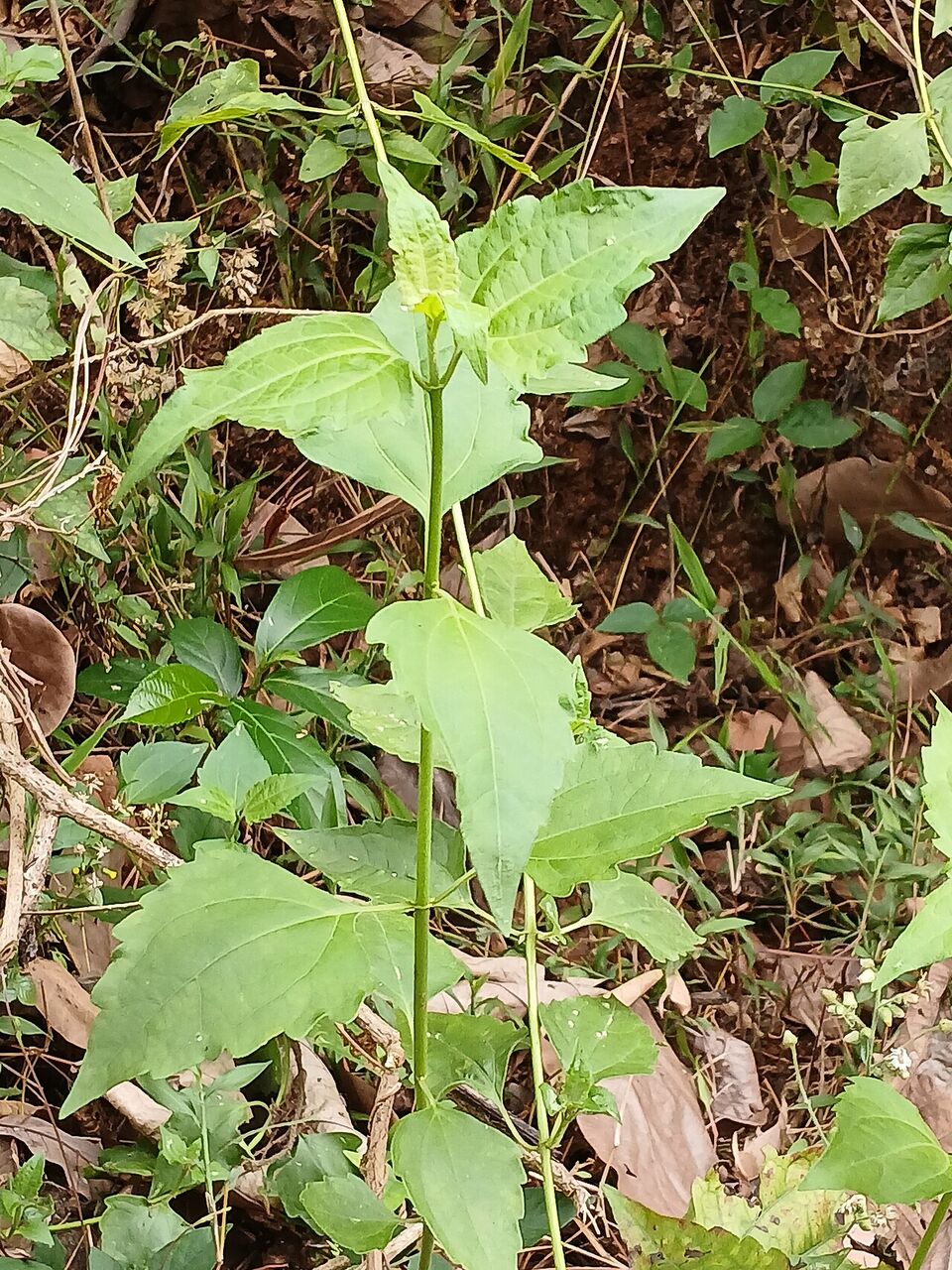
Siam weed is a scrambling, perennial shrub with round stems; it can grow to about 4 m tall and its stems can trail or climb to 7 m or more. The leaves are simple (one blade on each stalk), triangular, and about 4.5 to 12 by 20 to 55 mm; the sources do not say which measurement is length or width, and they do not describe how the leaves are arranged on the stem. The leaf edge is entire or toothed, the upper surface is hairy, and the underside is densely hairy with glands that show under a hand lens; crushed leaves give off a pungent (sharp, strong) smell. The flowers are about 5 mm across, white, pink or purple, and grouped in branched clusters (panicles) at the stem tips or leaf joints; they have no ray florets, the outer petal-like florets seen on daisies. The fruit is a small nut about 4 to 5 mm long with a tuft of pale brown plumes (pappus), and the light, wind-blown seeds help the plant spread.
Where it grows
UTP describes it as an opportunistic plant that invades clearings and river flats in rainforest, appearing early in forest succession and forming dense thickets before fading as the canopy closes. Lucid describes it as found in and on the edges of rainforest, open forest and woodlands, and as an introduced species that is naturalised in north-east Queensland.
- In Nigeria
- GBIF holds 344 occurrence records from Nigeria. This is a count of database records, not a survey of where the plant grows. The sources read do not name Nigerian states for its distribution; the review lists states where it was reported as a remedy (Lagos, Oyo, Osun, Ogun, Ondo and Ekiti).
Scientific details
- Scientific name
- Chromolaena odorata (L.) R.M.King & H.Rob.
- Family
- Asteraceae
- Older names
- Eupatorium odoratum
Sources
Not yet reviewed Drafted with AI from the sources below. Treat with care.
- Lucid Central. Chromolaena odorata (L.) R.M.King & H.Rob. species profile (Siam weed). Lucid Central, CSIRO, 2020.
- Useful Tropical Plants: Chromolaena odorata. Useful Tropical Plants database (last update 2024-10-13), 2024.
- Rafiu BO, et al.. Ethnobotanical uses of plants in Nigeria: an analysis of current research trends and patterns.. Journal of Ethnobiology and Ethnomedicine, 2025. PMID 40841969.
- Elebiyo TC, et al.. Anti-malarial and haematological evaluation of the ethanolic, ethyl acetate and aqueous fractions of Chromolaena odorata.. BMC Complementary Medicine and Therapies, 2023. PMID 37946127.
- Ugochi UJ, et al.. Therapeutic potential of Chromolaena odorata, Vernonia amygdalina, and Cymbopogon citratus against pathogenic Bacteria.. Scientific Reports, 2025. PMID 39747504.
- GBIF species match: Chromolaena odorata (usageKey 3087725, ACCEPTED, EXACT). Global Biodiversity Information Facility, 2026.
- GBIF occurrence search: Chromolaena odorata, Nigeria (344 records). Global Biodiversity Information Facility, 2026.