Kinkeliba
Combretum micranthum · also called Bush tea

What it is used for
- General tonic leaf · traditional use
- Digestive and liver complaints leaf · traditional use
- Fever leaf · traditional use
- Drug dependence root · traditional use
- Colitis, studied in mice leaf · lab tests only
Tap a use to read how it is prepared and how well it is supported.
How each use is prepared
Parts used: leaf, root.
General tonic
Traditional useOther · leaf · "bush tea"
How it is prepared: Bitter leaf infusion drunk as a tea, as reported
People use it this way, but it has not been tested.
Widely drunk across West Africa as a general tonic (PROTA). No controlled study of this use was found in the sources read. [1]
Digestive and liver complaints
Traditional useStomach and digestion · leaf
How it is prepared: Leaf infusion, as reported
People use it this way, but it has not been tested.
PROTA reports the leaves are known across West Africa for digestive properties, and are listed in the French, Spanish and British pharmacopoeias as cholagogue (bile-flow) and antipyretic. Being listed in a pharmacopoeia reflects traditional use, not proof that it works. [1]
Fever
Traditional useFever · leaf
How it is prepared: Leaf infusion, as reported
People use it this way, but it has not been tested.
Described as febrifugal (fever-reducing) in West Africa (PROTA). Traditional use only. Fever can be a sign of malaria or another serious infection, so this use should not replace medical care. [1]
Drug dependence
Traditional useOther · root · reported in Nigeria
How it is prepared: Root taken, as reported
People use it this way, but it has not been tested.
PROTA reports that in Nigeria the root is taken as an antidote to drug habits. No evidence for this was found in the sources read. Do not use it to stop or replace treatment for dependence. [1]
Colitis, studied in mice
Lab or animal studiesStomach and digestion · leaf · inflamed bowel
How it is prepared: Ethanolic extract given to mice
Tested in the laboratory or in animals, not in people.
A 2025 study reports that an ethanolic extract reduced chemically induced colitis in mice. This is an animal study only. The plant part used is not confirmed from the abstract. [6]
Safety
Useful Tropical Plants lists no known hazards for this plant, but that is not a safety study. Animal toxicity tests of extracts exist, but they do not establish that the tea is safe for people. Data on pregnancy, breastfeeding, children and drug interactions are lacking. Do not use it in place of treatment from a health worker.
Side effects
- No side effects are described in the sources read. This does not mean none occur. [2]
Poisoning and overdose
- Useful Tropical Plants lists no known hazards. [2]
- Animal studies of aqueous and ethanolic extracts tested acute and repeated-dose toxicity. Their results are not summarised here and need checking by a reviewer. [4][5]
If you take other medicines
- Drug interactions are not documented in the sources read. [1]
Pregnancy and breastfeeding
- Data lacking. No safety information for pregnancy or breastfeeding was found in the sources read. [1]
Children
- Data lacking. No safety information for children was found in the sources read. [1]
About this plant
A savanna shrub of West Africa whose bitter leaves are brewed into a tea, called kinkeliba or "bush tea", and drunk as a general tonic. The use is traditional. The laboratory and animal studies found so far are early, and no human trial was found in the sources read.
How to recognise it
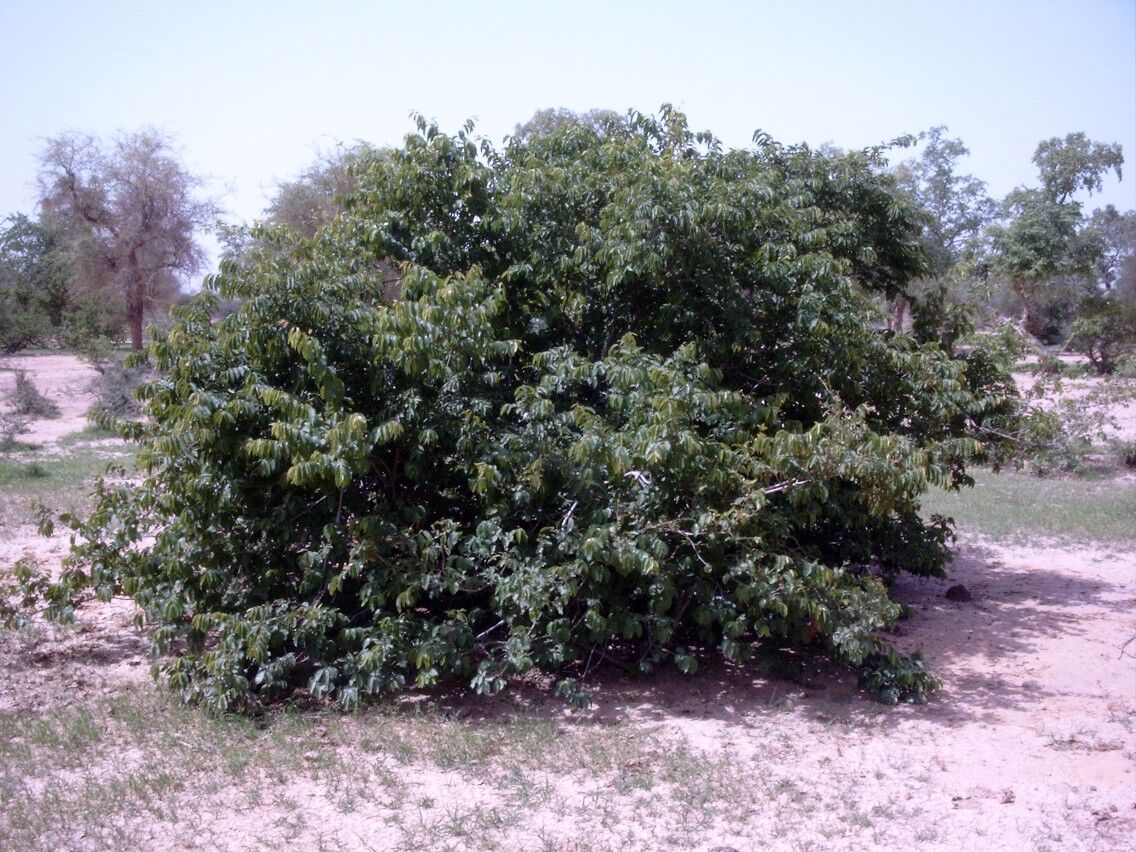
Shrub 2 to 4 m tall (up to 10 m), or a liana up to 20 m. The bark is pale grey and the stems peel in long, red-brown fibrous strips. Leaves grow opposite each other or in whorls of three. Each leaf is a single, untoothed blade, elliptical to ovate, 5 to 11 cm long and 2 to 7 cm wide, with a short point at the tip and a rounded base. The underside is covered in brown scales, and the leaf has 4 to 6 pairs of side veins. Young leaves are scaly, and hairy along the midrib. Flowers are borne in spikes 3 to 5 cm long. The flower and fruit colour are not described in the sources read.
Where it grows
Dry sites in the savannah.
- Native to
- Western Africa, from Senegal and Mauritania to Nigeria and Niger
- In Nigeria
- Recorded in Nigeria (70 GBIF occurrence records). The states where it grows are not documented in the sources read.
Scientific details
- Scientific name
- Combretum micranthum G.Don
- Family
- Combretaceae
- Older names
- Bureava crotonoides, Combretum altum, Combretum floribundum, Combretum raimbaulti
- Main compounds
- combetine (alkaloid, identity disputed)
Sources
Not yet reviewed Drafted with AI from the sources below. Treat with care.
- Combretum micranthum G.Don (PROTA). PROTA (Plant Resources of Tropical Africa).
- Combretum micranthum (Useful Tropical Plants). Useful Tropical Plants.
- GBIF species match: Combretum micranthum G.Don (accepted name, usageKey 3698309). GBIF.
- Acute and Subacute Oral Toxicity Assessment of Kinkeliba (Combretum micranthum G. Don) Ethanolic Extract in BALB/c Mice. Plants (Basel), 2025. PMID 40573764.
- Acute and subchronic toxicity of aqueous extracts of Combretum micranthum (G. Don) and Gardenia sokotensis (Hutch) having ethnobotanical uses in Burkina Faso. Toxicology Reports, 2025. PMID 40778320.
- Ethanolic Extract of Kinkeliba (Combretum micranthum), Rich in Phenolic Compounds Mitigates DSS-Induced Ulcerative Colitis in C57BL/6 Mice via Antioxidation and Microbiota Regulation. International Journal of Molecular Sciences, 2025. PMID 41373462.