Turmeric
- Igbo Boboch
- Hausa Gangamau, Kurkur
Curcuma longa

What it is used for
- Food spice rhizome · traditional use
- Indigestion and abdominal pain rhizome · traditional use
- Common cold rhizome · traditional use
- Skin infections rhizome · traditional use
- Arthritis joint pain rhizome · tested in people
Tap a use to read how it is prepared and how well it is supported.
How each use is prepared
Parts used: rhizome.
Food spice
Traditional useNutrition · rhizome
How it is prepared: Rhizome ground to a powder and added to kunu or pap (local drinks), or used as a spice in food; a teaspoon in a cup of hot water taken twice daily, as recorded in the survey
People use it this way, but it has not been tested.
The Nigerian survey records this food and drink use. It describes use, not a health effect, and the recorded dose is what was reported in the survey, not an endorsed dose. [3]
Indigestion and abdominal pain
Traditional useStomach and digestion · rhizome · traditional
People use it this way, but it has not been tested.
NCCIH lists indigestion and abdominal pain among traditional uses. NCCIH does not give supporting evidence for these traditional uses in the text read. [2]
Common cold
Traditional useCough and breathing · rhizome · traditional
People use it this way, but it has not been tested.
NCCIH lists the common cold among traditional uses. No supporting study for this use was found in the sources read. [2]
Skin infections
Traditional useSkin · rhizome · traditional
People use it this way, but it has not been tested.
NCCIH lists skin infections among traditional uses. No supporting study for this use was found in the sources read. UTP notes that contact with cut roots may cause an allergic skin reaction in some people (see safety). [2]
Arthritis joint pain
Studied in peoplePain and swelling · rhizome
Tested in at least one human study. Read the note for how strong the result is.
NCCIH says the initial evidence for osteoarthritis is positive, but higher-quality evidence is needed. This is weak clinical evidence. NCCIH also lists arthritis among traditional uses. [2]
Safety
NCCIH says oral turmeric is likely safe in recommended amounts for up to two or three months, and common side effects are stomach upset and diarrhoea. Turmeric supplements may raise the risk of kidney stones and bleeding with blood thinners, and liver damage has been reported with some concentrated formulations. Safety in pregnancy, breastfeeding and children is data lacking or unclear, so a clinician should advise before using concentrated products.
Side effects
- NCCIH lists nausea, vomiting, acid reflux, stomach upset, diarrhoea or constipation as side effects. MSK lists abdominal pain or discomfort, skin rash and hives. [2][1]
- If the roots are cut, the yellow colour stains fingers and cloth, and contact may cause an allergic skin reaction in some people. [4]
Poisoning and overdose
- NCCIH reports liver damage in some people who took bioavailable turmeric formulations. This refers to concentrated products, not to food use. [2]
- MSK says taking turmeric supplements may put a person at higher risk of kidney stones. [1]
- Data lacking: the survey row gives no toxicity data for turmeric, and no animal toxicity study was opened.
If you take other medicines
- MSK says turmeric may increase the risk of bleeding with warfarin and other blood thinners. [1]
- MSK reports that in laboratory experiments turmeric stopped some chemotherapy medicines from working against breast cancer cells. This is laboratory evidence only, not a finding in people. [1]
Pregnancy and breastfeeding
- NCCIH says the use of turmeric supplements during pregnancy may be unsafe. NCCIH also says little is known about whether amounts greater than those in food are safe while breastfeeding. [2]
Children
- No source opened gives safety data for turmeric in children. Data lacking.
About this plant
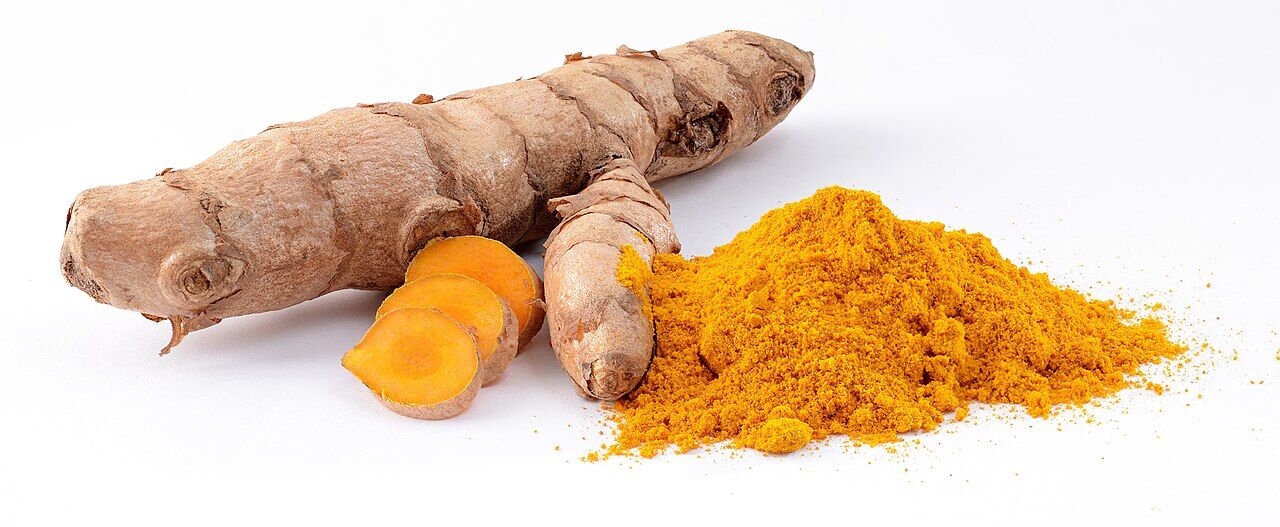
Turmeric (Curcuma longa) is a rhizome (underground stem) used as a spice and added to food and drinks in Nigeria. Traditional use is reported for several complaints, but clinical evidence in the sources read is limited and weak, and turmeric can cause stomach upset in some people.
How to recognise it
Curcuma longa is an erect, strongly tillering, herbaceous perennial about 1 metre tall that grows from an underground rhizome. It has a short stem and 6 to 10 tufted leaves, each about 30 to 50 cm long. The rhizomes are primary, ovate or pear-shaped, 5 to 8 cm long and 1 to 5 cm wide. UTP notes that if the roots are cut, the yellow colour stains fingers and cloth. The sources read do not describe leaf shape or flower colour in detail, and no fruit or seed details are documented in the sources read.
Where it grows
UTP says it is not known in a truly wild state, though it appears naturalized in some areas, such as the teak forests of east Java.
- Native to
- E. Asia - India, Thailand, Vietnam, Malaysia, Indonesia (UTP).
- In Nigeria
- GBIF holds 15 occurrence records from Nigeria. The Nigerian obesity survey of the North Central zone recorded it under Hausa names. The sources read do not name specific Nigerian states where it grows.
Scientific details
- Scientific name
- Curcuma longa L.
- Family
- Zingiberaceae
Sources
Not yet reviewed Drafted with AI from the sources below. Treat with care.
- Turmeric. Memorial Sloan Kettering Cancer Center, About Herbs.
- Turmeric. National Center for Complementary and Integrative Health (NCCIH).
- Anyanwu GO, Anzaku D, Bulus YJ. An Ethnobotanical Survey and Pharmacological and Toxicity Review of Medicinal Plants Used in the Management of Obesity in the North Central Zone of Nigeria. Journal of Obesity, 2025. PMID 40026359.
- Useful Tropical Plants: Curcuma longa. Useful Tropical Plants database.
- GBIF species match: Curcuma longa L. (usageKey 2757624). GBIF.
- GBIF occurrence search: Curcuma longa, country NG (15 records). GBIF.
- Rafiu BO, Omotayo AO, Lawal IO, Aremu AO. Ethnobotanical uses of plants in Nigeria: an analysis of current research trends and patterns. Journal of Ethnobiology and Ethnomedicine (BMC), 2025. PMID 40841969.