Thorn apple
Datura stramonium · also called Jimsonweed

What it is used for
- Narcotic or hallucinogenic use leaf · traditional use
- Added to alcoholic drinks root, seed, leaf · traditional use
- Asthma leaf · traditional use
- Sedative for people with mental illness leaf · traditional use
- Rheumatic pain, wounds and ulcers leaf · traditional use
- Whooping cough leaf · traditional use
- Ending a pregnancy root, leaf · traditional use
- Courage or strength drink traditional use
Tap a use to read how it is prepared and how well it is supported.
How each use is prepared
Parts used: leaf, seed, root, flower, fruit.
Narcotic or hallucinogenic use
Traditional useOther · leaf · leaves smoked or boiled
How it is prepared: Leaves smoked or boiled, as reported
People use it this way, but it has not been tested.
DANGEROUS. Recorded as a narcotic, not a medicine. The sources describe recreational use as a growing problem in Nigeria, with dependence and addiction (Fasakin et al., 2022), and young people are often the ones poisoned. The gap between a dose that has an effect and a toxic dose is very small (Useful Tropical Plants). [1][2][7]
Added to alcoholic drinks
Traditional useOther · root, seed, leaf
How it is prepared: Roots, seeds or leaves put into alcohol, as reported
People use it this way, but it has not been tested.
DANGEROUS. Adding this plant to alcohol adds to the risk of severe poisoning. Alcohol is not a safe carrier for the alkaloids, and the dose cannot be controlled. [1]
Asthma
Traditional useCough and breathing · leaf · smoked as cigarettes
How it is prepared: Leaves smoked as "asthma cigarettes", as reported
People use it this way, but it has not been tested.
DANGEROUS. Smoking the plant exposes the lungs and the rest of the body to the alkaloids, and the dose cannot be controlled. Asthma needs proper medical treatment. France removed Datura cigarettes from its pharmacopoeia in 1992 (Useful Tropical Plants / PROTA). [1]
Sedative for people with mental illness
Traditional useOther · leaf
How it is prepared: Leaf decoction, as reported
People use it this way, but it has not been tested.
DANGEROUS. The sources report this as a sedative given to mental patients. The alkaloids can cause agitation, hallucinations, confusion and coma (Acimovic, 2025). Giving this plant to a person with a mental illness risks serious harm. [1][4]
Rheumatic pain, wounds and ulcers
Traditional usePain and swelling · leaf · leaf dressing
How it is prepared: Crushed or warmed leaves applied to the skin, as reported
People use it this way, but it has not been tested.
DANGEROUS. Applied to broken skin or wounds, the alkaloids may be absorbed and the sources give no safe amount. Wounds and ulcers can become infected or get worse, and these need proper medical care. [1]
Whooping cough
Traditional useCough and breathing · leaf · leaf ash eaten, Burundi
How it is prepared: Ash of the leaves eaten, as reported
People use it this way, but it has not been tested.
DANGEROUS. Eating the ash introduces the alkaloids directly into the body with no way to measure the dose. Whooping cough is a serious illness that needs medical care. [1]
Ending a pregnancy
Traditional useWomen's health · root, leaf · enema, DR Congo
How it is prepared: Root and leaf liquid used as an enema, as reported
People use it this way, but it has not been tested.
DANGEROUS. Using a poisonous plant to end a pregnancy can kill the woman as well as the pregnancy. Never use this. Safe abortion care is available from a health facility. [1]
Courage or strength drink
Traditional useOther · Niger and Nigeria border
How it is prepared: Drink made from the plant, as reported. Exact method and plant part not stated in the source.
People use it this way, but it has not been tested.
DANGEROUS. The drink is reported in Fulfulde-speaking communities on the Niger and Nigeria border. The poisoning risk is the same whatever the reason for taking it. [1]
Safety
DANGEROUS POISON. The plant is reported as very poisonous in all its parts (Useful Tropical Plants), and the seeds have caused serious poisoning in children. The difference between a medicinal and a toxic dose is very small, so there is no safe home use. Poisoning causes a serious anticholinergic illness: a dry mouth, dilated pupils, a racing heart, confusion, agitation, hallucinations and seizures, and it can lead to coma and death. Seek emergency care at once if someone may have eaten or been exposed to this plant. Do not use it as a remedy, a drink, a smoke or a dressing.
Side effects
- Signs of anticholinergic poisoning: dry mouth and throat, eye pain, blurred vision, dilated pupils, flushing, faintness, racing heart, restlessness and dizziness. [1][5]
- Overdose signs: headache, nausea, vomiting, confusion, disorientation, hallucinations, euphoria, short-term memory loss, agitation, seizures and coma. [1][4][6]
- Dangerous heart rhythm (arrhythmia) is described, and tachycardia (fast heart rate) was common in one paediatric series. [1][5]
Poisoning and overdose
- All parts of the plant are very poisonous (Useful Tropical Plants). The alkaloids are hyoscyamine, scopolamine and atropine (Acimovic, 2025). [2][4]
- Seeds have caused serious poisoning in children (Shifa et al., 2024; Tarawneh et al., 2024). Seeds were also used for criminal purposes (PROTA). [1][5][6]
- Hospital admissions and deaths, including of young people, are reported (PROTA). Poisonings occur through misuse and accident (Acimovic, 2025). [1][4]
- Contamination of wheat, rye, buckwheat and linseed with the seeds has caused poisoning (PROTA). Eating contaminated grain is a risk even with no intent to use the plant. [1]
- Mistaking the plant for an edible species, and children's curiosity, are recorded causes of accidental poisoning (Acimovic, 2025). [4]
- Nigerian review: recreational use of the plant is rising, and the plant is reported to be very addictive and to cause dependence (Fasakin et al., 2022). [7]
If you take other medicines
- Drug interactions are not documented in the sources read. Do not combine with alcohol, sedatives or any other medicine. [1]
Pregnancy and breastfeeding
- Dangerous. Used in DR Congo as an enema to end a pregnancy (PROTA). No safe amount is known. Data on safety in pregnancy and breastfeeding are lacking. [1]
Children
About this plant
DANGEROUS POISON. The plant contains strong tropane alkaloids (hyoscyamine, scopolamine and atropine). Poisoning can cause confusion, a racing heart, seizures, coma and death, and children are among those most often harmed. It is not a safe remedy and must never be eaten, drunk, smoked or applied to the body as medicine. The traditional uses listed below are recorded only so that the danger is understood.
How to recognise it
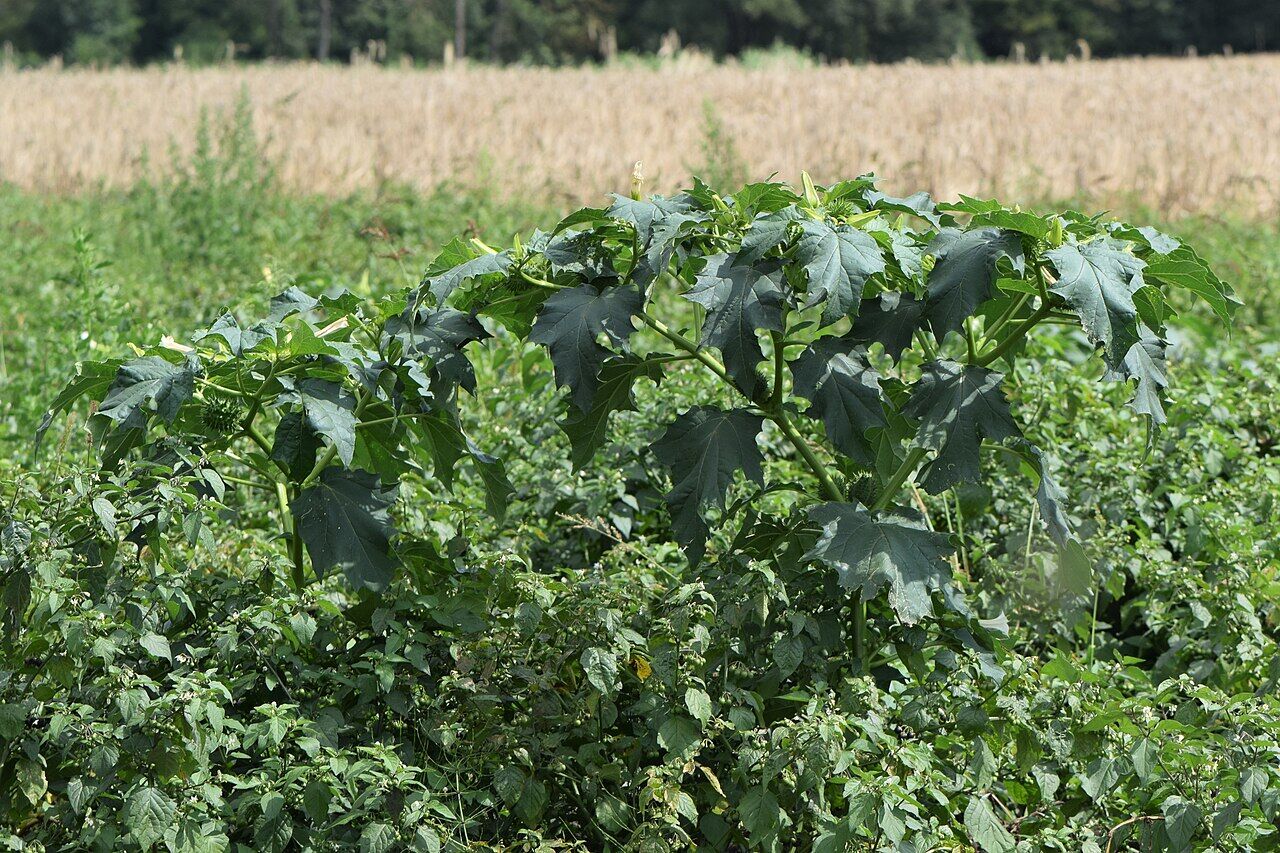
Annual weed with an upright, branching stem. Leaves are alternate, simple, minutely hairy, with an ovate to elliptical blade 3 to 20 cm long and 1 to 15 cm wide. The margin is sharply toothed or nearly smooth, and the veins are pinnate. Flowers grow singly in the leaf axils and have a trumpet-shaped white or faintly purple corolla 6 to 10 cm long. The fruit is a spiny capsule, which gives the name thorn apple. Seeds are found inside the fruit. Poisonings have happened when the plant was mistaken for an edible species (see the safety section).
Where it grows
Dry waste ground and disturbed land. Common in fields, yards and gardens that are not tended.
- Native to
- Americas (origin, per Useful Tropical Plants); now widespread
- In Nigeria
- Recorded in Nigeria (13 GBIF occurrence records). Presence in Nigeria is also reported by Fasakin et al. (2022), who describe recreational use of the plant there. Local states are not documented in the sources read.
Scientific details
- Scientific name
- Datura stramonium L.
- Family
- Solanaceae
- Older names
- Datura bernhardii, Datura tatula, Datura ferox, Datura wallichii, Stramonium vulgare
- Main compounds
- hyoscyamine, scopolamine, atropine (tropane alkaloids)
Sources
Not yet reviewed Drafted with AI from the sources below. Treat with care.
- Datura stramonium L. (PROTA). PROTA (Plant Resources of Tropical Africa).
- Datura stramonium (Useful Tropical Plants). Useful Tropical Plants.
- GBIF species match: Datura stramonium L. (accepted name, usageKey 2928751). GBIF.
- Acimovic M. Datura stramonium - A Dangerous Weed and Alternative Drug of Abuse: An Overview of Poisoning Cases in 21st Century. Planta Medica, 2025. PMID 40086888.
- Tarawneh A, Nafi O, Abdelfattah AS, Al-Tawarah NM. Unveiling the Dark Side of Datura in Pediatric Poisoning With Insights From Jordanian Experience: A Retrospective Clinical Study. Pediatric Emergency Care, 2024. PMID 38718809.
- Shifa DM, Leyew AY, Jufar MT. Datura stramonium seed ingestion leading to unintentional poisoning in a 3-year-old Ethiopian toddler: case report. International Journal of Emergency Medicine, 2024. PMID 39478444.
- Fasakin OW, Oboh G, Ademosun AO. The prevalence, mechanism of action, and toxicity of Nigerian psychoactive plants. Comparative Clinical Pathology, 2022. PMID 35789743.