Oil palm
- Igbo Mkpuruaku
- Yoruba Eyin, Ope
- Hausa Kwakwa, Banje, Farakaye
Elaeis guineensis · also called African oil palm

What it is used for
- Gonorrhoea palm heart · traditional use
- Heavy menstrual bleeding palm heart · traditional use
- Abdominal pain around childbirth palm heart · traditional use
- Constipation, vomiting and urine flow palm heart · traditional use
- Skin affections leaf · traditional use
- Pain relief root · traditional use
- Cough and respiratory tract infection seed, bark, fruit · traditional use
Tap a use to read how it is prepared and how well it is supported.
How each use is prepared
Parts used: palm heart, leaf, root, seed, bark, fruit, oil.
Gonorrhoea
Traditional useInfections · palm heart
How it is prepared: Preparations made from the palm heart (PROTA does not give the form)
People use it this way, but it has not been tested.
PROTA reports this traditional use across Africa. No experimental support was opened, and no sexually transmitted infection study was opened. [1]
Heavy menstrual bleeding
Traditional useWomen's health · palm heart · menorrhagia
How it is prepared: Preparations made from the palm heart (PROTA does not give the form)
People use it this way, but it has not been tested.
PROTA reports this traditional use. No experimental support was opened. [1]
Abdominal pain around childbirth
Traditional useWomen's health · palm heart
How it is prepared: Preparations made from the palm heart (PROTA does not give the form)
People use it this way, but it has not been tested.
PROTA reports this traditional use. No experimental support was opened. Pregnancy safety is not sourced, so see the safety section before any use around pregnancy. [1]
Constipation, vomiting and urine flow
Traditional useStomach and digestion · palm heart
How it is prepared: Preparations made from the palm heart (PROTA does not give the form)
People use it this way, but it has not been tested.
PROTA says these preparations are considered laxative, anti-emetic and diuretic. These are traditional beliefs. No study was opened that tests them. [1]
Skin affections
Traditional useSkin · leaf
How it is prepared: Leaf sap, in preparations (PROTA does not give the form)
People use it this way, but it has not been tested.
PROTA reports the leaf sap in preparations for skin conditions. No experimental support was opened. [1]
Pain relief
Traditional usePain and swelling · root · analgesic
People use it this way, but it has not been tested.
PROTA reports the roots as analgesic. The preparation is not given. No experimental support was opened. [1]
Cough and respiratory tract infection
Traditional useCough and breathing · seed, bark, fruit
How it is prepared: Infusion or decoction, taken by mouth
People use it this way, but it has not been tested.
Recorded in a compiled table of Nigerian ethnobotanical uses (Rafiu et al., 2025) from Oyo and Osun States. The table names the local words Kwakwa, Banje or Farakaye (Hausa), Eyin or Ope (Yoruba) and Mkpuruaku (Igbo) for this species. No experimental support was opened. [3]
Safety
Oil palm parts are used in traditional medicine for infections, women's health, digestion and skin. The sources read give no human safety data for any part of the plant, including the palm heart, leaf sap, roots and palm wine. Do not use it in pregnancy or for children without advice from a clinician.
Side effects
- No human side-effect data for oil palm medicinal use were opened. Data are lacking.
Poisoning and overdose
- No poisonous part of the oil palm is named in the sources read, and no human toxicity data were opened.
- Palm wine turns alcoholic and sour within hours and spoils within about 24 hours at room temperature (Olanbiwoninu et al., 2026). This is about spoilage of the drink, not a toxicity study. [7]
If you take other medicines
- No source opened addresses interactions with medicines. Data are lacking.
Pregnancy and breastfeeding
- No source opened addresses use of oil palm parts in pregnancy or breastfeeding. One traditional use is for abdominal pain around childbirth, but no safety data were found. Do not use without advice from a clinician. [1]
Children
- No source opened addresses use of oil palm parts in children. Data are lacking.
About this plant
An African palm whose oil, palm heart, leaf sap, roots, seeds and bark are used in traditional medicine. The sources read give no human safety data for any part of the plant.
How to recognise it
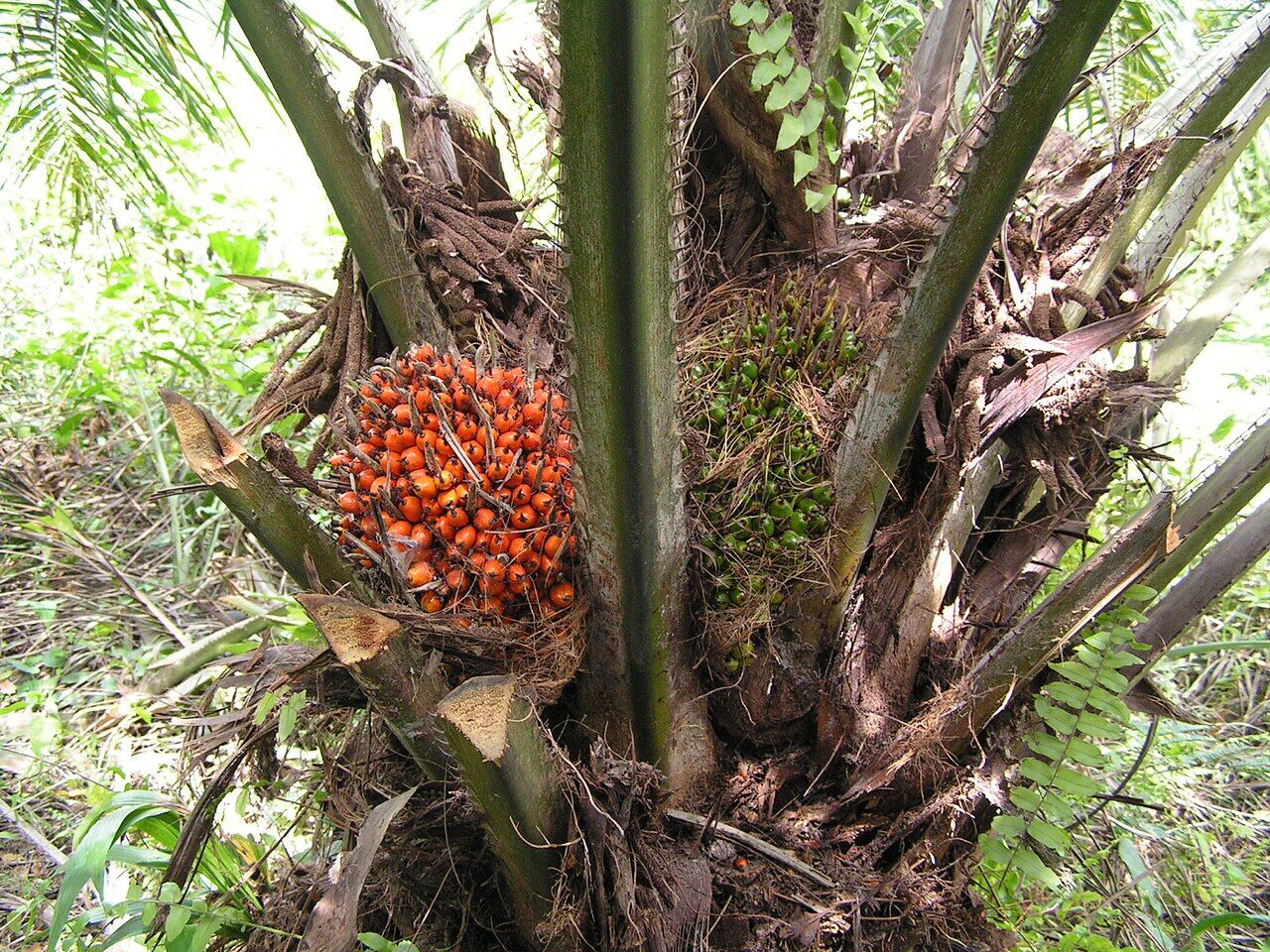
An unbranched palm up to about 30 m tall, with a crown of large pinnate leaves. Each palm bears male and female flowers on the same tree, and the fruit grows in dense bunches (clusters) of many small oil-rich fruits. When cut, the stem releases a sap that is tapped for palm wine. Palm wine is a major drink in Nigeria, and it turns alcoholic and sour within hours and spoils within about 24 hours at room temperature (Olanbiwoninu et al., 2026).
Where it grows
PROTA describes oil palm as a light-loving plant of the humid tropical lowlands. It is most common at the edges of swamps and along river banks, where faster-growing trees do not crowd it out.
- Native to
- Tropical rainforest belt of West and western Central Africa, from Guinea to northern Angola (PROTA).
- In Nigeria
- The GBIF occurrence search returns 334 records from Nigeria for this species, a record count and not a survey. PROTA estimates that wild and semi-wild oil palm groves cover about 2.5 million ha in Nigeria, and says the greatest genetic variation is found in south-eastern Nigeria. The Nigerian ethnobotany table in Rafiu et al. (2025) records the cited respiratory use from Oyo and Osun States.
- States
- Oyo, Osun
Scientific details
- Scientific name
- Elaeis guineensis Jacq.
- Family
- Arecaceae
- Older names
- Elaeis melanococcana
Sources
Not yet reviewed Drafted with AI from the sources below. Treat with care.
- Elaeis guineensis Jacq. (PROTA, Plant Resources of Tropical Africa, Pl@ntUse). PROTA.
- Elaeis guineensis - Useful Tropical Plants. Tropical Plants Database (tropical.theferns.info).
- Rafiu BO, Omotayo AO, Lawal IO, Aremu AO. Ethnobotanical uses of plants in Nigeria: an analysis of current research trends and patterns. Journal of Ethnobiology and Ethnomedicine (PMCID PMC12369106), 2025. PMID 40841969.
- Elaeis guineensis Jacq. - GBIF species match (accepted name, usageKey 2731882). Global Biodiversity Information Facility.
- GBIF occurrence search, Elaeis guineensis, country NG (record count only). Global Biodiversity Information Facility.
- Gruca M, Blach-Overgaard A, Balslev H. African palm ethno-medicine. Journal of Ethnopharmacology, 2015. PMID 25749399.
- Olanbiwoninu AA, Awotundun TA, Afolabi JF, Fashogbon RO, Fagunwa O. Ethnogeographic Distribution of Nigerian Fermented Foods and the Prospects for Bioeconomy Improvements. Foods (MDPI, PMCID PMC13564609), 2026. PMID 42737331.