Asthma weed
- Igbo Oba ala
- Yoruba Emile, Ewe emile
- Hausa Nóónòn kúrcíyáá
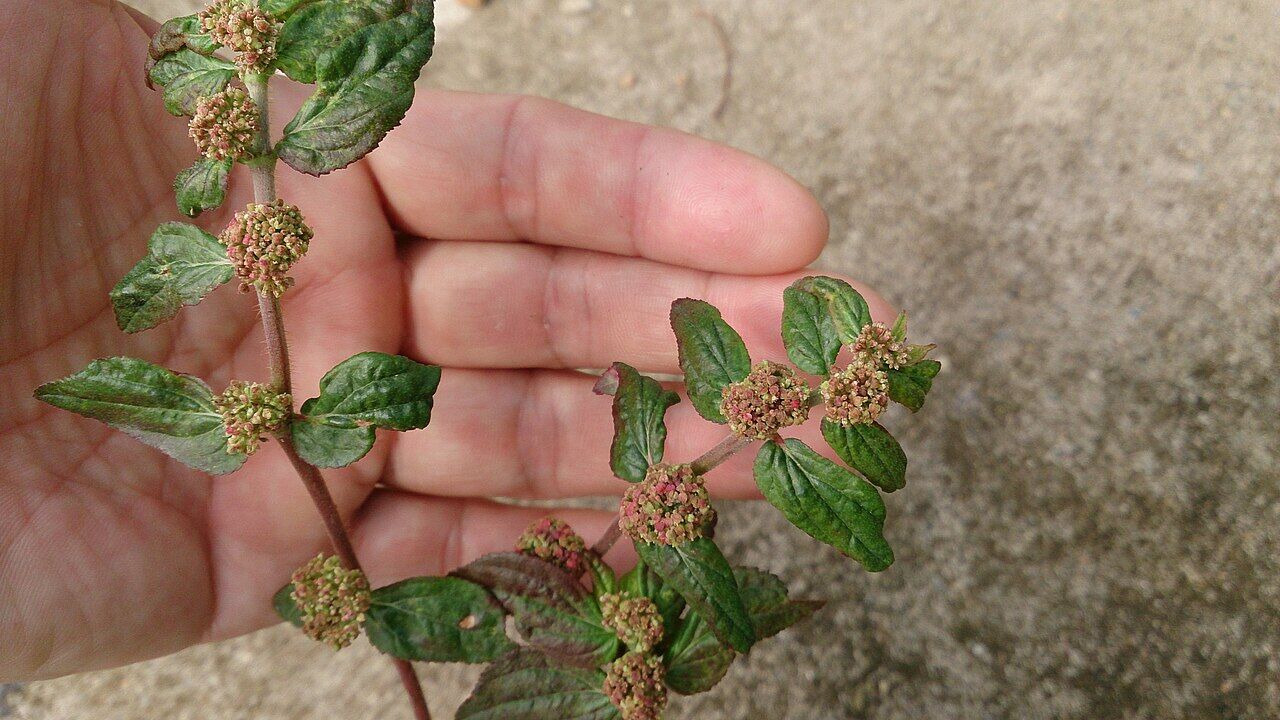
Euphorbia hirta · also called Asthma plant
_1.jpg)
What it is used for
- Asthma, bronchitis and cough leaf, whole plant · traditional use
- Skin problems such as eczema and wounds leaf · traditional use
- Breast milk leaf, whole plant · traditional use
- Diarrhoea and dysentery whole plant · lab tests only
Tap a use to read how it is prepared and how well it is supported.
How each use is prepared
Parts used: leaf, whole plant.
Asthma, bronchitis and cough
Traditional useCough and breathing · leaf, whole plant
How it is prepared: Decoction or infusion, as reported by PROTA
People use it this way, but it has not been tested.
PROTA reports decoctions or infusions used for asthma, bronchitis, hay fever, coughs and colds. A southwestern Nigerian (Yoruba) plant inventory lists it as an anti-asthma plant. No clinical trial or laboratory study of asthma was found in the sources read, so the evidence is traditional only. [2][4]
Skin problems such as eczema and wounds
Traditional useSkin · leaf
How it is prepared: Infusion applied to the skin, as reported
People use it this way, but it has not been tested.
A survey from Ondo State records a leaf infusion applied to the skin for eczema and wounds. A laboratory study on human skin cells (keratinocytes) found that a leaf ethanol extract reduced an inflammatory response in those cells. That is a cell study only, not a test in people with skin disease, so the evidence for skin use remains traditional. [5][7]
Breast milk
Traditional useWomen's health · leaf, whole plant · lactation
How it is prepared: Decoction or infusion, as reported
People use it this way, but it has not been tested.
PROTA describes it as widely used to increase milk (a galactagogue) and notes it is sold for this purpose in Nigeria. It is also listed for improving lactation in a Yoruba plant inventory and in a survey from Ogun and Delta states. No human or laboratory study of breast milk was found in the sources read. [2][4][5]
Diarrhoea and dysentery
Lab or animal studiesStomach and digestion · whole plant
How it is prepared: Decoction or infusion, as reported by PROTA
Tested in the laboratory or in animals, not in people.
PROTA reports traditional use for diarrhoea, intestinal parasites and amoebic dysentery. In a mouse study, an aqueous extract reduced diarrhoea induced by castor oil in a dose-dependent way. The mouse study does not show that it works in people, and no human trial was found. [2][6]
Safety
The milky sap of Euphorbia hirta is poisonous if swallowed, irritates the skin and eyes, and can make the skin react to sunlight. Its toxicity can remain high even when the plant is dried. No safety studies in pregnancy, breastfeeding or children were found in the sources read, so its safety in these groups is unknown and it should not be used there without advice from a health worker.
Side effects
- Contact with the sap can cause skin reactions sensitive to sunlight and severe inflammation, especially if it gets into the eyes or open cuts. [1]
- Tender shoots may cause intestinal upset when eaten. [2]
Poisoning and overdose
- The sap is toxic if swallowed and highly irritant to the skin; toxicity can remain high in dried plant material. [1]
- PROTA reports few documented toxic effects, but an aqueous crude extract caused testicular degeneration in sexually mature male rats, and other oral extracts caused dullness, loss of appetite and a 20% death rate in rats. [2]
- PROTA reports phorbol-type diterpene esters and the highly toxic compound tinyatoxin in the plant. [2]
Pregnancy and breastfeeding
- Traditionally taken for pains during pregnancy, and in Uganda whole plants are chewed to induce labour (PROTA). It is also used to increase breast milk. No safety studies in pregnancy or breastfeeding were found; data are lacking, so avoid use unless a health worker advises it. [2][4]
Children
- No safety data for children were found in the sources read. Because the sap is poisonous if swallowed, keep the plant away from children. [1]
About this plant
A small annual herb of roadsides, gardens and waste ground. In Nigerian folk use it is taken for asthma, cough, diarrhoea and to increase breast milk, but its milky sap is poisonous if swallowed.
How to recognise it
Euphorbia hirta is an annual herb, about 15 to 50 cm tall, that branches from the base. Its stems lie along the ground or rise up, with branches up to 50 cm long, and all parts are finely hairy. Cut stems and leaves ooze a milky sap (latex). The leaves grow in opposite pairs, meaning two leaves face each other at each node, and lie in two flat rows along the stem. Each leaf is a simple, oval blade 1 to 4 cm long and 0.5 to 2 cm wide, with an uneven base, a finely toothed edge and often a purple blotch near the midrib. The tiny flowers are grouped in small cup-like clusters called cyathia, and several cyathia are packed together into a dense cluster. The flowers are either male or female. The fruit is a small three-lobed capsule about 1 mm across, holding three seeds.
Where it grows
Grows in cultivated fields, gardens, roadsides and waste places, from sea level up to 2000 m altitude (PROTA).
- Native to
- Native to Central America; now a very common weed of the tropics and subtropics, occurring throughout tropical Africa and in South Africa (PROTA).
- In Nigeria
- GBIF holds 280 occurrence records from Nigeria. An ethnobotanical survey records use of the plant in Ogun, Delta and Ondo states; PROTA reports it occurs throughout tropical Africa.
Scientific details
- Scientific name
- Euphorbia hirta L.
- Family
- Euphorbiaceae
- Main compounds
- isoquercitrin, quercitrin, phorbol-type diterpene esters, tinyatoxin
Sources
Not yet reviewed Drafted with AI from the sources below. Treat with care.
- Euphorbia hirta. Useful Tropical Plants.
- Euphorbia hirta (PROTA). Pl@ntUse (PROTA).
- GBIF species match: Euphorbia hirta. GBIF.
- Ajao et al.. Wandering through southwestern Nigeria: An inventory of Yoruba useful angiosperm plants. Heliyon, 2022. PMID 35024488.
- Rafiu et al.. Ethnobotanical uses of plants in Nigeria: an analysis of current research trends and patterns. Journal of Ethnobiology and Ethnomedicine, 2025. PMID 40841969.
- Wu et al.. Bioactivity-guided isolation of potential antidiarrheal constituents from Euphorbia hirta L. and molecular docking evaluation. Frontiers in Veterinary Science, 2024. PMID 39268517.
- Gil et al.. Euphorbia hirta Leaf Ethanol Extract Suppresses TNF-α/IFN-γ-Induced Inflammatory Response via Down-Regulating JNK or STAT1/3 Pathways in Human Keratinocytes. Life (Basel), 2022. PMID 35455080.