Bitter leaf
- Igbo Onugbu
- Yoruba Ewuro, Ewuro-jije
Gymnanthemum amygdalinum

What it is used for
- Vegetable traditional use
- Fever root, leaf · traditional use
- Stomach ache stem, leaf · traditional use
- Malaria leaf · tested in people
- Diabetes root, leaf · traditional use
- Oral hygiene traditional use
- Dandruff leaf · traditional use
- General remedy leaf · traditional use
- Constipation leaf · traditional use
- Blood sugar leaf · lab tests only
- Liver protection leaf · lab tests only
Tap a use to read how it is prepared and how well it is supported.
How each use is prepared
Parts used: leaf.
Vegetable
Traditional useOther
People use it this way, but it has not been tested.
The Yoruba inventory lists Ewuro, as this plant is called in Yoruba, among plants used as food (vegetables). No preparation is stated in the source. No washing or bitterness-reduction step is stated for this use in the opened text. [4]
Fever
Traditional useOther · root, leaf
How it is prepared: Infusion, taken by mouth
People use it this way, but it has not been tested.
A Tanzanian ethnobotany study of the Luguru people records this plant for fever, with an infusion taken by mouth. The Yoruba inventory also lists fever among its medicinal uses. These are reports of traditional use and do not show that the plant works. [17][4]
Stomach ache
Traditional useStomach and digestion · stem, leaf
How it is prepared: Stem or leaves pounded and taken by mouth
People use it this way, but it has not been tested.
A Nigerian ethnobotany analysis (rafiu2025) records this plant for typhoid, stomachache, diarrhoea and stomach pain in Kano and Borno, with the stem or leaves pounded and taken by mouth. The Yoruba inventory also lists stomachache. These are reports of traditional use only. [11][4]
Malaria
Studied in peopleMalaria · leaf
How it is prepared: Infusion of fresh leaves, as given in the trial
Tested in at least one human study. Read the note for how strong the result is.
One small trial (Challand and Willcox, 2009) in patients aged 12 and over with uncomplicated malaria. An infusion of fresh leaves gave an adequate clinical response in most patients, but complete parasite clearance was limited and many of those who cleared later relapsed. This is weak evidence from a single study and does not show that the plant is a reliable malaria treatment. [1]
Diabetes
Traditional useBlood sugar · root, leaf
How it is prepared: Leaf infusion or decoction, or leaf juice squeezed, taken by mouth
People use it this way, but it has not been tested.
The Luguru study records this plant for diabetes mellitus, given as an infusion by mouth, and the Nigerian analysis (rafiu2025) records diabetes with leaves used as a decoction, infusion or squeezed juice, taken by mouth. These are reports of traditional use and do not show that the plant lowers blood sugar in people. [17][11]
Oral hygiene
Traditional useOther
How it is prepared: Used as a chewing stick
People use it this way, but it has not been tested.
The Yoruba inventory lists this plant among those used as chewing sticks for oral hygiene. The source names no preparation beyond the chewing stick. [4]
Dandruff
Traditional useOther · leaf
How it is prepared: Leaves pounded and squeezed; the liquid is applied to the affected area of the skin
People use it this way, but it has not been tested.
An Ethiopian study records this plant for dandruff. The leaves are pounded and squeezed, and the liquid is applied to the affected skin. This is a report of traditional use only. [18]
General remedy
Traditional useOther · leaf
How it is prepared: Infusions, juices, cataplasms (poultices) and powders, as reported in a Nigerian survey
People use it this way, but it has not been tested.
A cross-sectional survey in Nigeria reports that bitter leaf is used in infusions, juices, cataplasms and powders for various ailments. The survey does not list which ailments or give doses, so this entry records use only and not effectiveness. [14]
Constipation
Traditional useStomach and digestion · leaf
People use it this way, but it has not been tested.
The introduction of the Nigerian survey states that the plant has laxative activity, citing other studies. This is background and not a finding of the survey. No preparation or dose was found in the sources read. [14]
Blood sugar
Lab or animal studiesBlood sugar · leaf
How it is prepared: Crude extract and phenol-rich fractions, 50 mg/kg in streptozotocin-diabetic rats for 28 days (laboratory dose, not a human dose)
Tested in the laboratory or in animals, not in people.
A rat study reported lower blood glucose and HbA1c and better liver, lipid and oxidative markers in streptozotocin-diabetic rats. A review of Nigerian and ECOWAS diabetes plants places the species among those studied for diabetes. These are animal results only and do not show a benefit in people. [12][13]
Liver protection
Lab or animal studiesStomach and digestion · leaf
How it is prepared: Crude extract and phenol-rich fractions, 50 mg/kg in diabetic rats (laboratory dose)
Tested in the laboratory or in animals, not in people.
The same rat study reports that the leaf extract reduced hepatic (liver) injury and oxidative-inflammatory markers. This is a single animal study and is not evidence of liver protection in people. [12]
Safety
The only human data opened for this draft is one small malaria trial, which reported no significant side effects, and surveys of traditional use. Rat studies and review summaries reported low toxicity at the doses given, but these are animal results and do not establish that the plant is safe in people. Malaria should be diagnosed and treated by a health worker.
Side effects
- The one small human trial reported no significant side effects. [1]
Poisoning and overdose
- In a review of diabetes plants, rats given leaf extracts at 100 to 300 mg/kg had no deaths and no significant biochemical change. Bark extracts were cytotoxic (toxic to cells) in vitro in that review. [13]
- A paediatric review's table lists bitter leaf as showing no toxicity in rats given 150 to 1200 mg/kg for 28 days. This is stated in the table only and was not checked against the primary study. [15]
Pregnancy and breastfeeding
- A Nigerian women's health review lists bitter leaf among plants used in pregnancy for emesis, fever, constipation and loss of appetite. No safety data for use in pregnancy were found in the sources read. [16]
Children
- No sourced guidance.
About this plant
A plant of the daisy family whose leaves are used in traditional medicine. One small human trial tested a leaf infusion for malaria, but the evidence is not enough to show that it works as a treatment.
How to recognise it
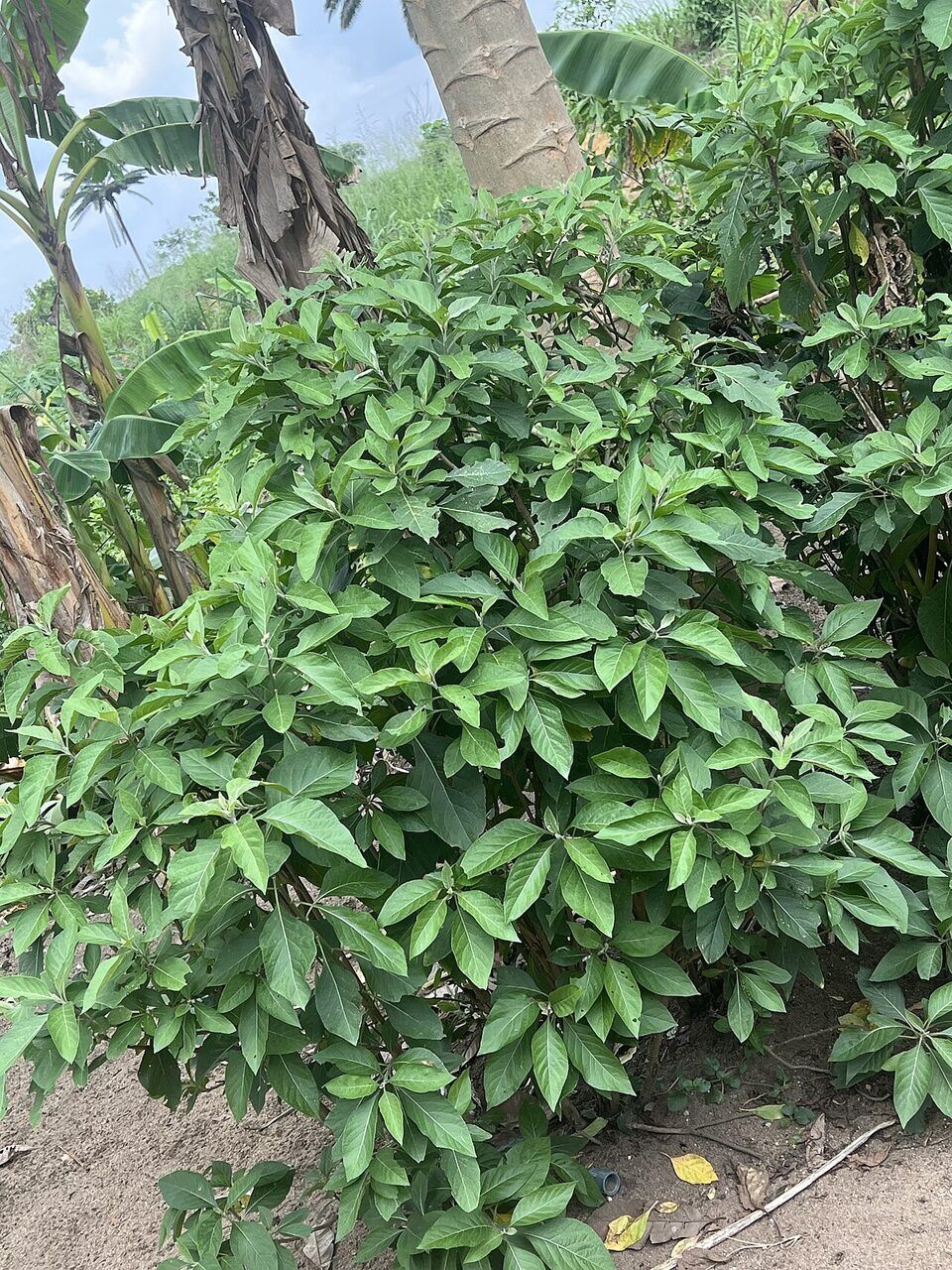
Bitter leaf is an evergreen shrub or small tree. Sources give a height of 2 to 5 m (NParks) or up to 10 m (Useful Tropical Plants), with a trunk up to 40 cm across on larger plants. The leaves are green, smooth, glossy and elliptic (oval), with a plain edge (no teeth) and a pointed tip, and they are arranged alternately along the stem on short stalks. The leaves are often very bitter, though some forms are almost free of bitterness. The flowers are creamy white, look like small thistle heads, and are gathered into flat-topped clusters about 15 cm across; they are fragrant. The fruit is a dry nutlet (a small, hard, one-seeded fruit) covered in tiny glands and bristly hairs. The bark is light grey or brown.
Where it grows
Grows along rivers and lakes, at forest margins, in woodland and grassland, and on disturbed land, up to about 2000 m (Useful Tropical Plants). It is cultivated in parts of Africa and sold as an edible leaf (Useful Tropical Plants).
- Native to
- Guinea to Mali, south to Angola, Botswana, Zimbabwe and Mozambique (Useful Tropical Plants).
- In Nigeria
- The GBIF occurrence search returns 183 records from Nigeria for this species, and the GBIF distribution record (Catalogue of Life dataset) includes Nigeria. NParks Flora & Fauna Web lists Nigeria as the native range. No opened source states where in Nigeria it grows or is cultivated.
Scientific details
- Scientific name
- Gymnanthemum amygdalinum (Delile) Sch.Bip. ex Walp.
- Family
- Asteraceae
- Older names
- Vernonia amygdalina Delile
Sources
Not yet reviewed Drafted with AI from the sources below. Treat with care.
- Challand S, Willcox M. A clinical trial of the traditional medicine Vernonia amygdalina in the treatment of uncomplicated malaria. Journal of Alternative and Complementary Medicine, 2009. PMID 19922255.
- GBIF species record 3130899 (accepted name Gymnanthemum amygdalinum). GBIF.
- IPNI record n/210886-1 (Vernonia amygdalina Delile, basionym; Gymnanthemum amygdalinum). International Plant Names Index.
- Ajao AA, Mukaila YO, Sabiu S. Wandering through southwestern Nigeria: An inventory of Yoruba useful angiosperm plants. Heliyon, 2022. PMID 35024488.
- Ibrahim MB, Odewo AS, Lawal BA, Oyedeji OF, Balogun NA, Tijani WA, Abdulraheem AS, Shafiyi J, Ilomuanya MO. Traditional contraceptive practices: survey of medicinal plants used to control birth in four states in Nigeria. BMC, 2025. PMID 40490736.
- Gymnanthemum amygdalinum - Useful Tropical Plants. Tropical Plants Database (tropical.theferns.info).
- Gymnanthemum amygdalinum - Flora & Fauna Web. National Parks Board, Singapore (NParks).
- GBIF backbone. Gymnanthemum amygdalinum (Delile) Sch.Bip. ex Walp. - GBIF species match. Global Biodiversity Information Facility.
- Catalogue of Life (as served by GBIF). Gymnanthemum amygdalinum - GBIF distributions. Global Biodiversity Information Facility.
- GBIF. GBIF occurrence search, Gymnanthemum amygdalinum, country NG. Global Biodiversity Information Facility.
- Rafiu BO, Omotayo AO, Lawal IO, Aremu AO. Ethnobotanical uses of plants in Nigeria: an analysis of current research trends and patterns. Journal of Ethnobiology and Ethnomedicine (BMC), 2025. PMID 40841969.
- Crude Extract and Phenol-Rich Fractions from Vernonia amygdalina Leaves Ameliorates Streptozotocin-Induced Type 1 Diabetes in Rats by Mitigating Hepatic Injury, Dyslipidemia, and Production of Oxido-Inflammatory Markers. Journal of Xenobiotics, 2026. PMID 41874124.
- Diabetes mellitus in ECOWAS: an overview of the safety and efficacy of medicinal plants used in traditional medicine practices. Tropical Medicine and Health, 2026. PMID 41872917.
- Awareness, knowledge and belief regarding bitter leaf use: A cross-sectional study in Nigeria. PLOS One, 2025. PMID 40460074.
- A scoping review on ethnobotanical uses, pharmacological and toxicological profiles of traditional medicinal plants in paediatric healthcare across Sub-Saharan Africa and South Asia. BMC Complementary Medicine and Therapies, 2026. PMID 41862891.
- Benefits of Traditional Medicinal Plants to African Women's Health: An Overview of the Literature. Diseases, 2025. PMID 40422592.
- Ethnobotanical Study of Medicinal Herbs Used by the Luguru Tribe Against Various Human Ailments in Morogoro Rural District, Tanzania. The Scientific World Journal, 2025. PMID 40689214.
- Traditional medicinal plant based remedies for common ailments in Menz Keya Gebreal District, North Shewa Zone, Ethiopia. BMC Complementary Medicine and Therapies, 2025. PMID 41194202.