Zobo
- Hausa Zobo
Hibiscus sabdariffa · also called Roselle

What it is used for
- Zobo drink calyx · traditional use
- High blood pressure calyx · tested in people
- Cholesterol and blood sugar calyx · tested in people
- Tonic for digestion and kidneys leaf, flower · traditional use
Tap a use to read how it is prepared and how well it is supported.
How each use is prepared
Parts used: calyx, leaf, flower.
Zobo drink
Traditional useNutrition · calyx
How it is prepared: Calyces boiled, sweetened with sugar, and ginger added, as described in UTP
People use it this way, but it has not been tested.
UTP describes this as a popular beverage. It is a food use and no health claim is made. The Hausa name zobo appears in the survey, but the survey's zobo row gives different plant parts and preparation from the calyx drink (see review notes). [6][1]
High blood pressure
Studied in peopleBlood pressure · calyx
Tested in at least one human study. Read the note for how strong the result is.
A meta-analysis of 13 randomised trials (1205 participants) found systolic and diastolic pressure lower than placebo (mean difference -6.67 and -4.35 mm Hg). The effect was not significant against antihypertensive drugs or other herbal controls, nor in people with metabolic syndrome. An umbrella review of 26 trials (1797 participants) rated the evidence moderate in credibility for a reduction above 10 mmHg in some subgroups. Evidence is weak to moderate and mostly short-term. The trial preparations and plant part are not stated in the abstracts read, so the part listed here is unconfirmed. [5][4]
Cholesterol and blood sugar
Studied in peopleOther · calyx
Tested in at least one human study. Read the note for how strong the result is.
The umbrella review abstract reports lower total cholesterol, LDL cholesterol and fasting blood glucose, and higher HDL cholesterol, in trials. These are measured markers, not proven health outcomes. The abstract does not state how strong each finding is, and the trial preparations and plant part are not stated. [4]
Tonic for digestion and kidneys
Traditional useStomach and digestion · leaf, flower
How it is prepared: Leaves and flowers used internally as a tonic tea, as reported in UTP
People use it this way, but it has not been tested.
UTP reports this use, citing Flora of the USSR. No clinical study supporting it was cited. Rat studies of heavy intake linked this plant to kidney changes (see safety), so this use should be checked with a clinician. [6]
Safety
The umbrella review says the plant is generally considered safe, with one minor and clinically insignificant rise in a liver enzyme reported. Rat studies of heavy, long-term intake linked it to kidney and heart changes, so high or long-term use needs caution. Safety in pregnancy, in children and alongside medicines is data lacking.
Side effects
- The umbrella review reports a minor, clinically insignificant rise in the liver enzyme AST that did not raise the risk of adverse events. The specific symptoms people reported are not listed in the abstract read. [4]
Poisoning and overdose
- In one rat study, 21 rats were given a 6% infusion of Hibiscus sabdariffa for one month. Kidney signals rose, and kidney blood-vessel relaxation and energy production in kidney mitochondria fell. The authors link this to excess hydrogen sulphide. Animal doses are not directly comparable with tea intake. [2]
- In a second rat study, 24 male rats were given a 6% infusion for two months. They showed higher systolic pressure, raised coronary (heart artery) resistance, slow heart rate with pauses, and collagen deposits in heart tissue. [3]
- UTP notes that the oil of this plant might contain toxic substances. The source does not say which oil or give details. [6]
If you take other medicines
- No source opened documents interactions between this plant and medicines. Data lacking.
Pregnancy and breastfeeding
- No source opened addresses pregnancy or breastfeeding. Data lacking; a clinician should advise before use.
Children
- No source opened addresses use in children. Data lacking.
About this plant
Hibiscus sabdariffa, known as roselle, is an erect plant whose calyces (the outer whorl around the flower) are boiled to make the drink zobo. Trials report a small blood-pressure lowering effect, but the evidence is weak and the sources read do not show it replaces prescribed medicine.
How to recognise it
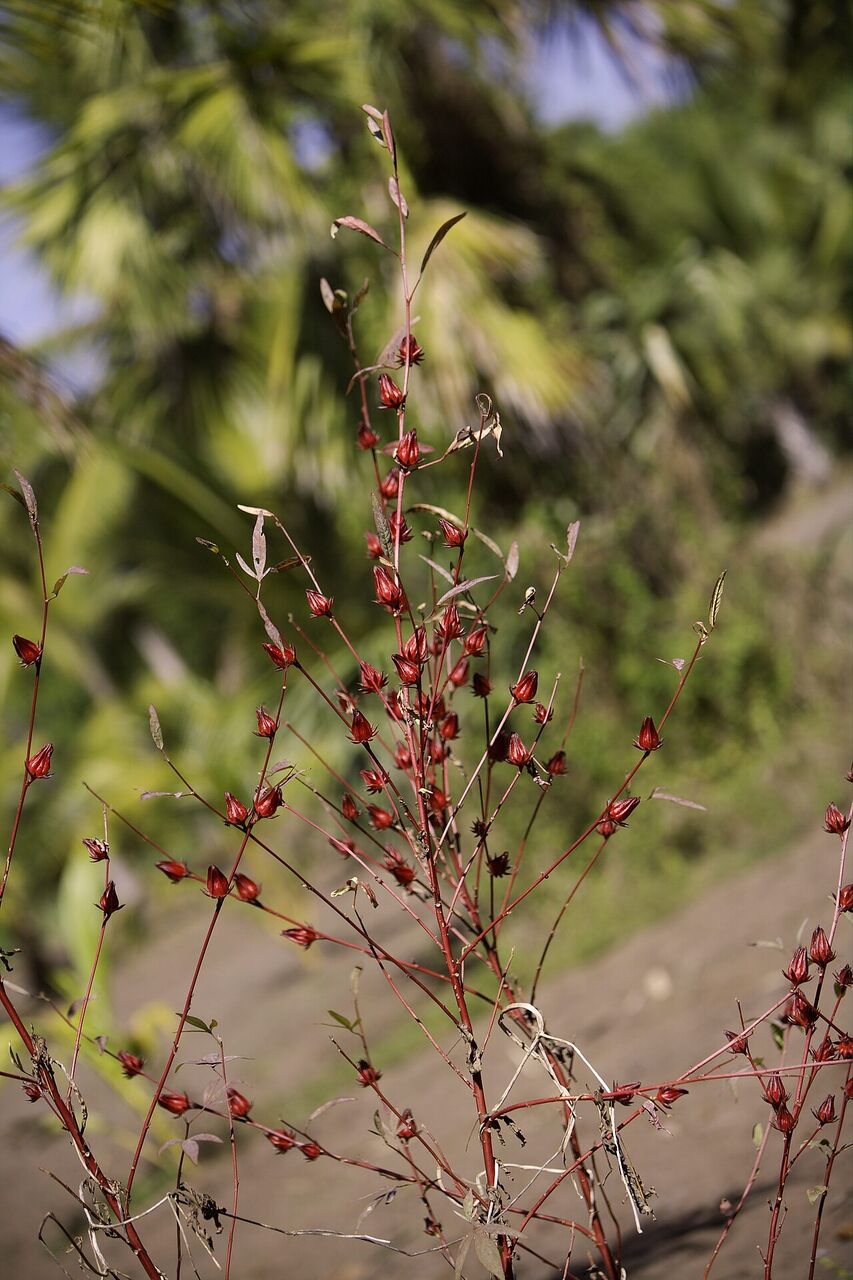
Hibiscus sabdariffa is an erect, mostly branched plant that is annual to perennial and can grow up to 4.5 metres tall. Its tender young leaves and stems are eaten raw or cooked. The calyx is the cup-like outer whorl around the flower; UTP says there are green and red types, and the fresh calyx is fleshy and eaten raw or cooked. The calyx is rich in pectin (a gel-forming substance) and citric acid. The sources read do not describe leaf shape, leaf edges or flower colour, and fruit and seed details are not documented in the sources read.
Where it grows
UTP lists the habitat as disturbed ground.
- Native to
- Probably tropical central or western Africa (UTP).
- In Nigeria
- GBIF holds 88 occurrence records from Nigeria. The sources read do not name Nigerian states or regions where it grows.
Scientific details
- Scientific name
- Hibiscus sabdariffa L.
- Family
- Malvaceae
- Main compounds
- pectin, citric acid
Sources
Not yet reviewed Drafted with AI from the sources below. Treat with care.
- Anyanwu GO, Anzaku D, Bulus YJ. An Ethnobotanical Survey and Pharmacological and Toxicity Review of Medicinal Plants Used in the Management of Obesity in the North Central Zone of Nigeria. Journal of Obesity, 2025. PMID 40026359.
- Manzano-Pech L, Soto ME, Castrejon-Tellez V. The Chronic Elevated Consumption of Hibiscus sabdariffa Linnaeus Results in Kidney Damage Associated with Excess H(2)S.. International Journal of Molecular Sciences, 2026. PMID 41828415.
- Manzano-Pech L, Soto ME, Torres-Narvaez JC. Physiological Changes During Ischemia-Reperfusion Indicating Myocardial Damage Induced by Chronic and Excessive Consumption of Hibiscus sabdariffa L.. Toxics, 2026. PMID 42646954.
- Norouzzadeh M, Hasan Rashedi M, Azizi MH. Efficacy and safety of Hibiscus sabdariffa in cardiometabolic health: An overview of reviews and updated dose-response meta-analysis.. Complementary Therapies in Medicine, 2025. PMID 39870328.
- Abdelmonem M, Ebada MA, Diab S. Efficacy of Hibiscus sabdariffa on Reducing Blood Pressure in Patients With Mild-to-Moderate Hypertension: A Systematic Review and Meta-Analysis of Published Randomized Controlled Trials.. Journal of Cardiovascular Pharmacology, 2022. PMID 34694241.
- Useful Tropical Plants: Hibiscus sabdariffa. Useful Tropical Plants database.
- GBIF species match: Hibiscus sabdariffa L. (usageKey 3152582). GBIF.
- GBIF occurrence search: Hibiscus sabdariffa, country NG (88 records). GBIF.