Ogbono
- Igbo Ugiri
- Yoruba Apon
Irvingia gabonensis · also called Dika nut, Dika bread tree

What it is used for
- Soup thickener seed · traditional use
- Weight loss seed · tested in people
- Blood lipids seed · tested in people
- Metabolic syndrome seed · tested in people
Tap a use to read how it is prepared and how well it is supported.
How each use is prepared
Parts used: seed.
Soup thickener
Traditional useNutrition · seed
How it is prepared: Kernels are taken from the seed, dried and used to thicken soups and stews.
People use it this way, but it has not been tested.
A food use reported in PROTA and Useful Tropical Plants. The kernels are often sold in local markets. This is not a medical use. [1][2]
Weight loss
Studied in peopleOther · seed · trial reports
How it is prepared: Irvingia gabonensis extract. Doses in the trials were 150 mg twice daily for 90 days, and 300 mg daily for 12 weeks.
Tested in at least one human study. Read the note for how strong the result is.
Weak evidence. A systematic review (Onakpoya 2013) and a meta-analysis (Lee 2020) of five trials report weight and waist reductions against placebo. The trials were poorly reported, four of the five had a high risk of bias, and the authors of the 2020 review describe the efficacy as limited. Onakpoya 2013 calls the weight-loss effect unproven and says it cannot be recommended as a weight-loss aid. A 12-week trial at 300 mg daily (Nonsa-Ard 2022) found no between-group differences in metabolism, inflammation or aerobic capacity, and it did report higher plasma vitamin C and adiponectin in the extract group. [6][7][9]
Blood lipids
Studied in peopleOther · seed · cholesterol and triglycerides
How it is prepared: Irvingia gabonensis extract, in the same trials as the weight-loss use.
Tested in at least one human study. Read the note for how strong the result is.
Weak evidence. Lee 2020 pooled trials that report improved total cholesterol, LDL, HDL and triglycerides, and Onakpoya 2013 also reports positive lipid results. The one low risk-of-bias trial showed only a trend (higher HDL and lower triglycerides, not statistically clear). Most of the trials had high risk of bias, so the lipid results cannot be relied on. [6][7]
Metabolic syndrome
Studied in peopleOther · seed · waist, triglycerides and blood glucose
How it is prepared: Irvingia gabonensis extract, 150 mg twice daily for 90 days in the trial.
Tested in at least one human study. Read the note for how strong the result is.
Weak evidence. One randomised trial of 24 people with metabolic syndrome (Mendez-Del Villar 2018) found reductions in waist size, triglycerides and glucose against placebo. Remission of metabolic syndrome was 58.3% with the extract and 16.7% with placebo. This is a single small trial and needs confirmation. [8]
Safety
The kernels are eaten as food in West and Central Africa. The trial data on weight and cholesterol are small and poor in quality. The sources read report only minor side effects, such as headache and sleep difficulty. They do not report studies in pregnancy, in children or on drug interactions.
Side effects
- Headache and difficulty sleeping were the adverse events reported in the systematic review of trials. Lee 2020 describes the adverse events as minor. [6][7]
Poisoning and overdose
- No toxicity studies were found in the sources read. The pulp of the closely related I. wombolu is bitter and inedible, so the two should not be treated as the same food. [1][4]
If you take other medicines
Pregnancy and breastfeeding
Children
About this plant
A large West and Central African tree whose seed kernels are used to thicken soups and stews, including ogbono soup. Trials of the kernel extract for weight and cholesterol are few, small and poorly reported, so the results are not conclusive.
How to recognise it
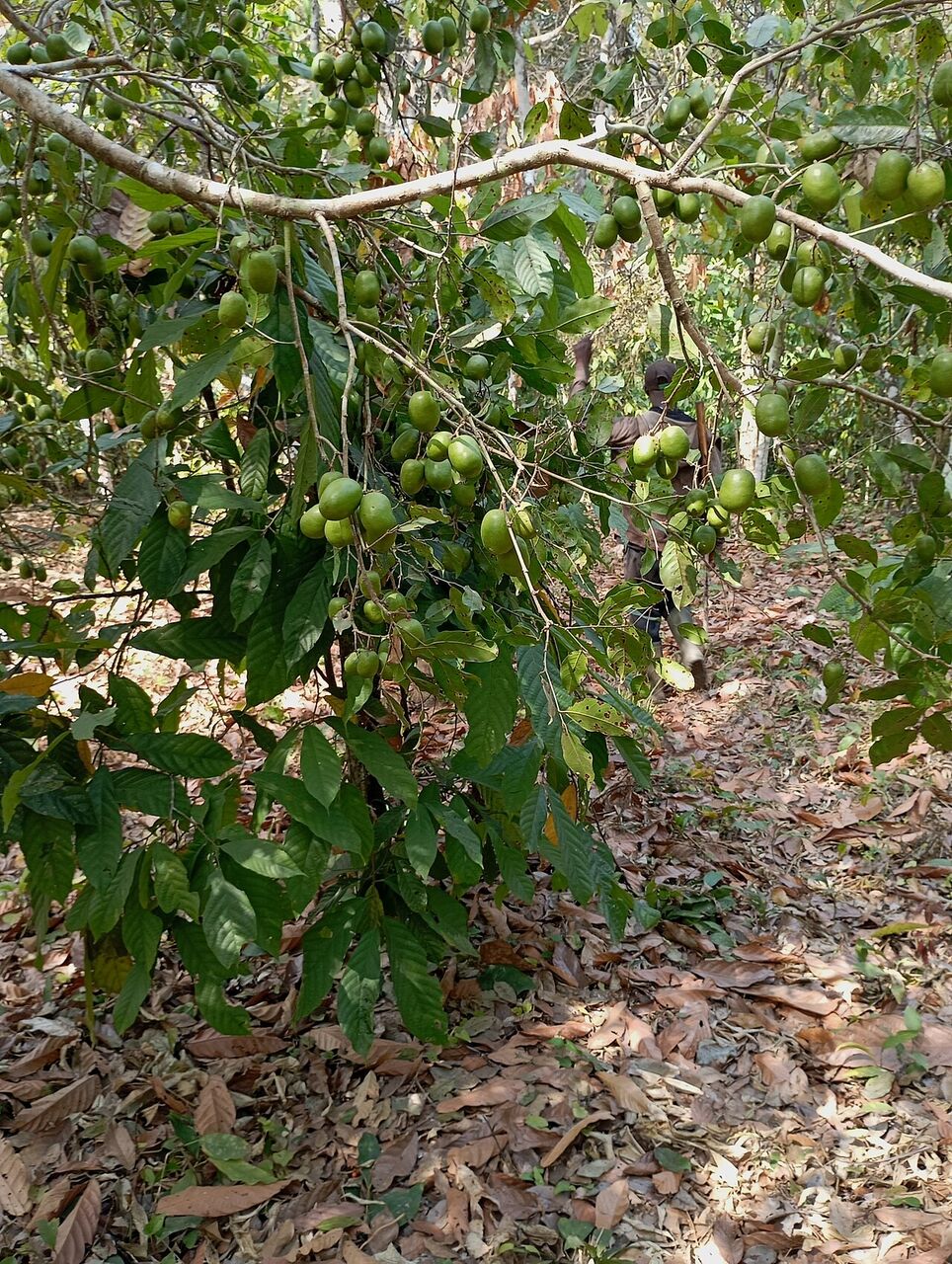
A large evergreen tree, up to about 40 m tall, often with a dense crown and buttresses at the base of the trunk. Leaves are alternate, simple and entire. The blade is elliptical, about 4.5 to 8 cm long and 2 to 4 cm wide, thinly leathery, with pinnate veins. The stipules are up to 4 cm long and fall early, and the petiole is up to 5 mm long. Small yellowish-white flowers are borne in axillary panicles up to 9 cm long. The fruit is an ellipsoid-cylindrical drupe 4 to 6.5 cm long with an orange pulp that is sweet to slightly bitter. Each fruit has a single seed inside a woody stone.
Plants it can be confused with
- Irvingia wombolu: Closely related and hard to tell apart. GBIF lists I. wombolu as a synonym of Irvingia tenuinucleata, not of I. gabonensis. PROTA reports that its pulp is bitter and inedible and that its kernels give less drawability (the thick, stringy texture in soup). Do not assume the two are interchangeable.
Where it grows
- Native to
- Tropical Africa, from Nigeria to the Central African Republic, south to the Congo, DR Congo and Angola
- In Nigeria
- Planted in south-western Nigeria (PROTA). Nigeria lies within the native range given by Useful Tropical Plants. GBIF holds 168 occurrence records for the species in Nigeria; this is a record count, not a survey.
Scientific details
- Scientific name
- Irvingia gabonensis (Aubry-Lecomte ex O'Rorke) Baill.
- Family
- Irvingiaceae
Sources
Not yet reviewed Drafted with AI from the sources below. Treat with care.
- PROTA (Plant Resources of Tropical Africa). Irvingia gabonensis (PROTA). Pl@ntUse, PROTA.
- Irvingia gabonensis. Useful Tropical Plants.
- GBIF species match: Irvingia gabonensis (accepted name). Global Biodiversity Information Facility.
- GBIF species match: Irvingia wombolu (synonym of I. tenuinucleata). Global Biodiversity Information Facility.
- GBIF occurrence search, Nigeria (record count only). Global Biodiversity Information Facility.
- Onakpoya I, et al.. Effect of Irvingia gabonensis on weight loss and lipid profile: a systematic review. Journal of Dietary Supplements, 2013. PMID 23419021.
- Lee et al.. Irvingia gabonensis for weight loss and metabolic health: systematic review and meta-analysis of randomised trials. Journal of the American College of Nutrition, 2020. PMID 31855111.
- Mendez-Del Villar et al.. Irvingia gabonensis in metabolic syndrome: randomised placebo-controlled trial. Journal of Medicinal Food, 2018. PMID 29336718.
- Nonsa-Ard et al.. Irvingia gabonensis 300 mg daily for 12 weeks: randomised trial of metabolic and inflammatory markers. Nutrients, 2022. PMID 36364907.