Physic nut
- Yoruba Botuje, Lapalapa funfun
Jatropha curcas

What it is used for
- Wounds root, bark, latex · traditional use
- Cough fruit · traditional use
- Skin conditions, including ringworm and eczema latex · traditional use
Tap a use to read how it is prepared and how well it is supported.
How each use is prepared
Parts used: root, bark, latex, fruit.
Wounds
Traditional useWounds · root, bark, latex · folk use
How it is prepared: Applied to the skin.
People use it this way, but it has not been tested.
The 2025 Nigerian study lists root, stem bark and exudate applied to the skin for wounds in Oyo and Ogun states. PROTA reports that the latex has a reputation for healing wounds and is applied to infected wounds and ulcers. The plant is poisonous, so the sources do not support using it on broken skin without advice. No study of wound healing was found. [2][4]
Cough
Traditional useCough and breathing · fruit · folk use
How it is prepared: Decoction of the fruit, taken by mouth.
People use it this way, but it has not been tested.
The 2025 Nigerian study lists a fruit decoction taken by mouth for cough. All parts of the plant are poisonous, and the study does not give a safe dose. No study of cough treatment was found. [4]
Skin conditions, including ringworm and eczema
Traditional useSkin · latex · folk use
How it is prepared: Latex applied to the skin.
People use it this way, but it has not been tested.
PROTA reports the latex applied externally for ringworm and eczema, and the 2025 Nigerian study lists latex for ringworm in Borno state. No study of these skin uses was found. PROTA notes that skin use of the oil may cause an irritative rash. [2][4]
Safety
All parts of Jatropha curcas are poisonous, and the seeds are the most dangerous part. The sources read report accidental poisoning in animals and humans, mainly from seeds, and the seed toxins (phorbol esters and curcin) cannot be removed by heating. No safe dose is documented, so the plant should not be taken by mouth without a clinician's advice.
Side effects
- PROTA reports that the leaves and bark are purgative when taken internally, and that purgative use often causes strong irritation of the gut or poisoning. [2]
Poisoning and overdose
- The seeds are poisonous. Useful Tropical Plants says all parts of the plant are extremely purgative and poisonous. [1]
- PROTA says the seeds are often a source of accidental poisoning in both animals and humans. [2]
- The toxic compounds in the seed and seed oil are phorbol esters. PROTA reports up to 2.7 mg/g in toxic cultivars and 0.1 mg/g in non-toxic ones, and says heating does not detoxify them. [2]
- The seeds also contain curcin, a toxic protein that inhibits protein synthesis in laboratory tests. [2]
- EFSA reports phorbol esters of 2.2 to 2.7 mg/g in non-edible kernels, including a Nigerian sample. [6]
- A 2025 toxicological assessment of seed oil found phorbol esters in the oil and reports reference doses. It does not report poisoning cases. [3]
If you take other medicines
- No source opened documents drug interactions. Data are lacking.
Pregnancy and breastfeeding
- PROTA reports that the oil is applied internally as an abortifacient (a substance that ends a pregnancy). No source opened gives safety data in pregnancy, so the plant should be avoided. [2]
Children
- In a 2017 study of 325 children with plant poisoning in rural Sri Lanka, Jatropha curcas was the commonest plant poison (81 cases, 49.1 percent, in the table read). The text read does not confirm whether those cases involved seeds. A 2018 systematic review of child medicinal plant poisoning reports that ingestion of seeds or fruits is an important cause of acute plant poisoning in Thailand and Paris, but the sentence does not give the ages of those cases. No child case report of seed poisoning was opened for this record. [7][8]
About this plant
Physic nut is used in some Nigerian folk medicine, but all parts of the plant, including the seeds and the latex, are poisonous. The uses found are traditional reports, and no safe dose is documented, so the plant should not be taken by mouth without a clinician's advice.
How to recognise it
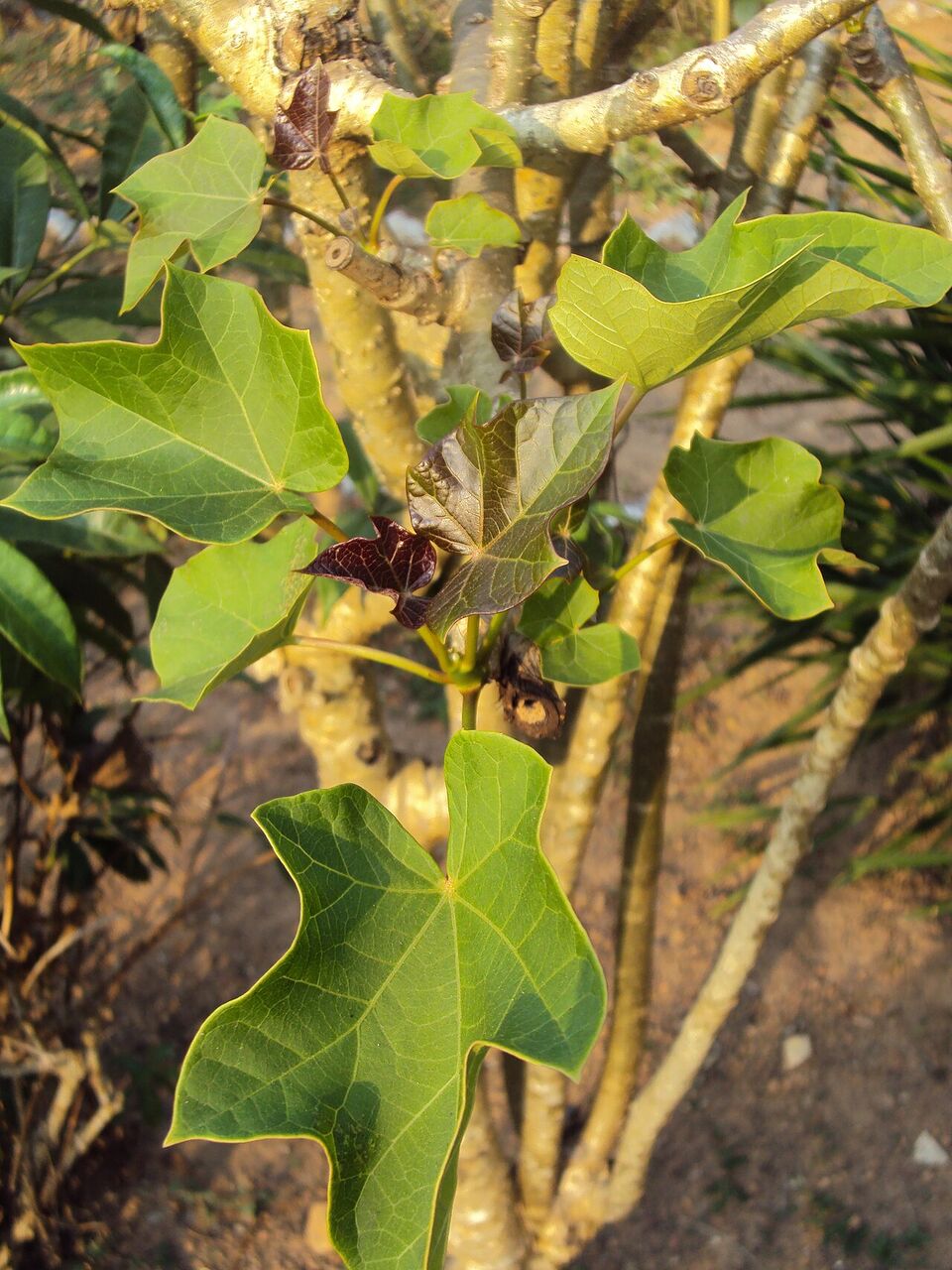
Physic nut is a monoecious shrub or small tree, deciduous or evergreen, that Useful Tropical Plants gives as growing up to 6 m tall. The bark is smooth, grey or reddish and shiny, and it peels. It produces a latex (milky sap). The leaves are simple (one blade, not divided into leaflets) and alternate (set singly along the stem), with a blade about 7 to 14 cm long that is usually shallowly lobed into five parts. The flowers are greenish-yellow and unisexual (male and female flowers are separate, on the same plant). The fruit is a capsule about 2.5 to 3 cm long, green at first and then yellow, and it holds seeds. Native range is not documented in the sources read.
Where it grows
PROTA describes warm subtropical climates with mean daily temperatures of 20 to 30 degrees C and annual rainfall of 300 to 600 mm. It does not withstand frost, but PROTA reports it is resistant to drought for periods of up to seven months.
- In Nigeria
- GBIF holds 138 occurrence records from Nigeria for this species. A 2025 ethnobotanical study of Nigerian plants records the plant in use in Oyo, Ogun, Osun and Borno states.
Scientific details
- Scientific name
- Jatropha curcas L.
- Family
- Euphorbiaceae
Sources
Not yet reviewed Drafted with AI from the sources below. Treat with care.
- Jatropha curcas (Useful Tropical Plants database entry). Useful Tropical Plants.
- Jatropha curcas L. (PROTA, Plant Resources of Tropical Africa, on Pl@ntUse). PROTA (Plant Resources of Tropical Africa).
- Cao X, et al.. Jatropha curcas seed oil for possible human consumption: A toxicological assessment of its phorbol esters. Toxicology Reports, 2025. PMID 39802603.
- Rafiu BO, et al.. Ethnobotanical uses of plants in Nigeria: an analysis of current research trends and patterns. Journal of Ethnobiology and Ethnomedicine, 2025. PMID 40841969.
- Ibrahim MB, et al.. Traditional contraceptive practices: survey of medicinal plants used to control birth in four states in Nigeria. 2025. PMID 40490736.
- Safety of hydrothermally treated kernels from edible Jatropha curcas L. (Chuta) as a novel food pursuant to Regulation (EU) 2015/2283. EFSA Journal, 2022. PMID 35079277.
- Dayasiri MB, et al.. Plant Poisoning among Children in Rural Sri Lanka. International Journal of Pediatrics, 2017. PMID 28377789.
- Plant toxins and acute medicinal plant poisoning in children: A systematic literature review. 2018. PMID 29692823.