Miracle leaf
- Yoruba Odundun
Kalanchoe pinnata

What it is used for
- Passing urine traditional use
- Wounds and burns leaf · traditional use
- Liver protection leaf · lab tests only
- Stomach ulcers leaf · lab tests only
- Kidney stones lab tests only
Tap a use to read how it is prepared and how well it is supported.
How each use is prepared
Parts used: leaf.
Passing urine
Traditional useOther
People use it this way, but it has not been tested.
Recorded once in a Yoruba inventory of useful plants, which lists the plant as medicinal (diuretic). No preparation, dose or study for this use was found in the sources read, so the use is weakly documented. [3]
Wounds and burns
Traditional useWounds · leaf
How it is prepared: Internal or external use of crude extract or plant juice
People use it this way, but it has not been tested.
The genus review lists K. pinnata among plants used to treat wounds and burns. The review gives no dose or species-level study for this use, so it is traditional only. [2]
Liver protection
Lab or animal studiesStomach and digestion · leaf
How it is prepared: Aqueous and ethanolic leaf extracts
Tested in the laboratory or in animals, not in people.
The genus review reports leaf extracts as hepatoprotective in laboratory work. The review cites the primary paper, which was not opened, so no dose or model is given here. This is not evidence of benefit in people. [2]
Stomach ulcers
Lab or animal studiesStomach and digestion · leaf
How it is prepared: Aqueous leaf extract
Tested in the laboratory or in animals, not in people.
The genus review reports an aqueous leaf extract tested for ulcer healing and stomach protection in laboratory work. The primary paper was not opened, so the model and dose are unknown. This is not evidence of benefit in people. [2]
Kidney stones
Lab or animal studiesOther
How it is prepared: Hydroalcoholic extract, 50 to 200 mg/kg by mouth for 14 days in rats (laboratory dose, not a human dose)
Tested in the laboratory or in animals, not in people.
In a rat study, the extract reduced sodium oxalate-induced kidney stone formation in a dose-dependent way. The result is from animals and does not show effect or safety in people. [7]
Safety
Kalanchoe pinnata contains bufadienolides, which can affect the heart and carry a risk of cardiotoxic (heart-damaging) effects. The sources read say the toxicity of plant extracts containing these compounds has not been adequately evaluated, so no safe dose is known. Do not take it for heart problems or alongside heart medicines, and do not use it in pregnancy or for children without advice from a health worker.
Poisoning and overdose
- Kalanchoe pinnata is listed among species that contain bufadienolide orthoesters, compounds with a narrow therapeutic index and a risk of cardiotoxic effects. [4]
- The toxicity of bufadienolide-containing plant extracts is inadequately evaluated. [4]
Pregnancy and breastfeeding
- Data are lacking. No pregnancy or breastfeeding studies of this plant were found in the sources read. [4]
Children
- Data are lacking. No studies of use in children were found in the sources read. [4]
About this plant
Kalanchoe pinnata is a fleshy-leaved succulent herb known in Yoruba as odundun, and it has a long record of folk use. It contains bufadienolides, compounds that act on the heart and can be dangerous, so it should not be taken without advice from a health worker.
How to recognise it
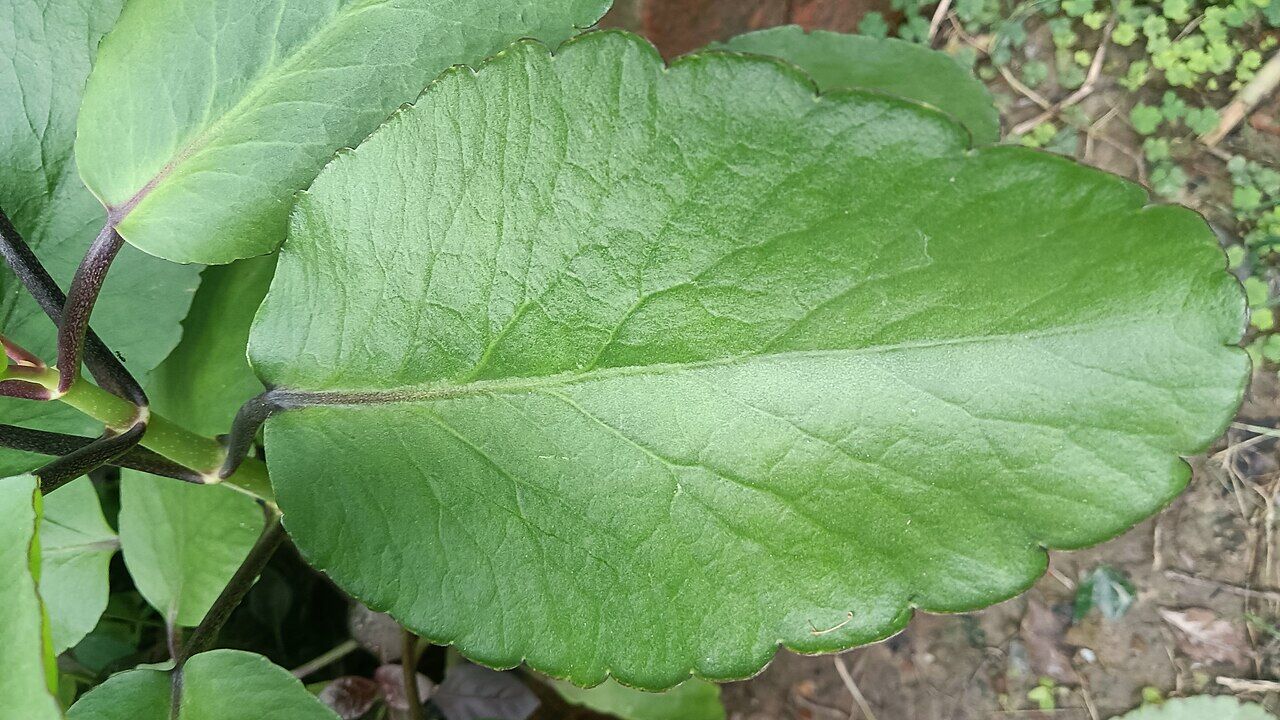
Kalanchoe pinnata is an erect, evergreen, succulent herb, usually unbranched and smooth, that grows 40 to 200 cm tall; its stems are woody near the base. Its leaves are thick and fleshy (succulent) and sit opposite each other on the stem; in the genus the leaf blades are oval with scalloped (crenate) edges and about 10 to 20 cm long. Small plantlets, called bulbils, form along the leaf edges and can grow into new plants when they fall, which is how the plant spreads so easily. The flowers hang downwards (pendant) and are up to 5 cm long. Leaf shape and size are described for the genus in the review, not for this species alone.
Where it grows
Open settled areas, dry second-growth forest and roadsides (Useful Tropical Plants).
- Native to
- Africa: Madagascar and Mauritius are listed as its range. It is widely naturalised throughout the tropics.
- In Nigeria
- GBIF holds 64 occurrence records from Nigeria. The Yoruba plant inventory records it among useful plants of southwestern Nigeria; no state is named.
Scientific details
- Scientific name
- Kalanchoe pinnata (Lam.) Pers.
- Family
- Crassulaceae
- Older names
- Bryophyllum pinnatum (Lam.) Oken
- Main compounds
- bufadienolides
Sources
Not yet reviewed Drafted with AI from the sources below. Treat with care.
- Kalanchoe pinnata - Useful Tropical Plants. Useful Tropical Plants database.
- A Review of the Popular Uses, Anatomical, Chemical, and Biological Aspects of Kalanchoe (Crassulaceae): A Genus of Plants Known as 'Miracle Leaf'. Molecules, 2023.
- Wandering through southwestern Nigeria: An inventory of Yoruba useful angiosperm plants. Heliyon, 2022. PMID 35024488.
- Bufadienolides of Kalanchoe species: an overview of chemical structure, biological activity and prospects for pharmacological use. Phytochemistry Reviews, 2017. PMID 29200987.
- GBIF species match: Kalanchoe pinnata (Lam.) Pers. (usageKey 2985930). Global Biodiversity Information Facility.
- GBIF occurrence search: Kalanchoe pinnata, country NG (count 64). Global Biodiversity Information Facility.
- Anti-urolithiatic activity of Bryophyllum pinnatum Lam. hydroalcoholic extract in sodium oxalate-induced urolithiasis in rats. Journal of Traditional and Complementary Medicine, 2021. PMID 34765518.