African mahogany
- Igbo Onu
Khaya senegalensis · also called Dry-zone mahogany

What it is used for
- Fever caused by malaria bark · traditional use
- Stomach complaints, diarrhoea and dysentery bark · traditional use
- Skin problems, wounds and ulcers bark · traditional use
- Menstrual pain bark · tested in people
- Menopausal symptoms bark · tested in people
- Malaria bark · lab tests only
Tap a use to read how it is prepared and how well it is supported.
How each use is prepared
Parts used: bark.
Fever caused by malaria
Traditional useMalaria · bark
People use it this way, but it has not been tested.
PROTA reports that bark decoctions (water-based teas made by boiling) are used against fever caused by malaria. This is a traditional use. Laboratory evidence is described under the separate malaria entry below. [1]
Stomach complaints, diarrhoea and dysentery
Traditional useStomach and digestion · bark
People use it this way, but it has not been tested.
PROTA lists bark decoctions as taken against stomach complaints, diarrhoea and dysentery. No experimental or clinical study of this use was found in the sources read. [1]
Skin problems, wounds and ulcers
Traditional useSkin · bark
People use it this way, but it has not been tested.
PROTA reports the bark applied to skin complaints, rash, scabies, wounds, ulcers and boils, and as a disinfectant on inflamed skin. No experimental or clinical study of these uses was found in the sources read. [1]
Menstrual pain
Studied in peopleWomen's health · bark
Tested in at least one human study. Read the note for how strong the result is.
A randomised, double-blind, placebo-controlled trial of 84 women with menstrual pain gave a standardised preparation from dry stem bark (Khapregesic) at 3 grams daily for one menstrual cycle. The preparation reduced daily pain ratings more than placebo (p=0.033) and reduced overall menstrual distress more than placebo (p=0.042). This is a single small, short trial, so the evidence is weak. Pregnant and breastfeeding women were excluded. [5]
Menopausal symptoms
Studied in peopleWomen's health · bark
Tested in at least one human study. Read the note for how strong the result is.
A 28-day randomised, placebo-controlled trial of 140 peri- and postmenopausal women gave 2 grams daily of the same preparation. The authors describe the secondary analyses as tentative. The primary outcome result is not confirmed in this record and must be read in the full paper before any claim of effect is made. This is one small trial, so the evidence is weak. [6]
Malaria
Lab or animal studiesMalaria · bark · laboratory test
Tested in the laboratory or in animals, not in people.
A laboratory study of a capsule that combined Khaya senegalensis with neem (Azadirachta indica) found moderate activity against malaria parasites in a test tube (in vitro). The Khaya component had an IC50 (the concentration that stops half the parasites) of about 24 micrograms per millilitre. This is a test-tube result from a combined product; it is not a human trial and does not show that the capsule works in people. [1][7]
Safety
Traditional use is widespread, but the sources read contain only one small human trial of the bark preparation, and it was short. Trials excluded pregnant and breastfeeding women, and PROTA lists the bark among traditional abortifacients (substances used to end a pregnancy), so it should be avoided in pregnancy and breastfeeding unless a health worker advises otherwise. The bark also has an animal toxicity figure, but no data show that it is safe for children or safe to combine with other medicines.
Side effects
- The trial reported blood safety measures, but the side effects were not extracted in the sources read. No side effects are listed in the sources read. [5]
Poisoning and overdose
- In an animal study cited by a 2025 paper, the extract had a median lethal dose (LD50, the single dose that kills half the animals) greater than 5000 mg/kg after one dose. The same paper says that long-term use can be toxic and that the toxicity is organ-specific. These figures come from a secondary citation (Onu et al., 2013) and were not checked against the original paper. [9]
If you take other medicines
- Data lacking. No drug interaction studies were found in the sources read.
Pregnancy and breastfeeding
- Avoid unless a health worker advises otherwise. PROTA lists the bark among traditional abortifacients, and pregnant women were excluded from the trials. No safety data for pregnancy were found in the sources read. [1][5]
Children
- Data lacking. No safety data on children were found in the sources read.
About this plant
A large savannah tree found from Senegal east to northern Uganda. Its bark is widely used in traditional medicine for malaria fever, stomach upsets, skin problems and wounds. One small clinical trial in women with menstrual pain reported benefit over placebo, but no safety data for pregnancy, children or drug use were found in the sources read, so it should not be taken in place of tested treatment.
How to recognise it
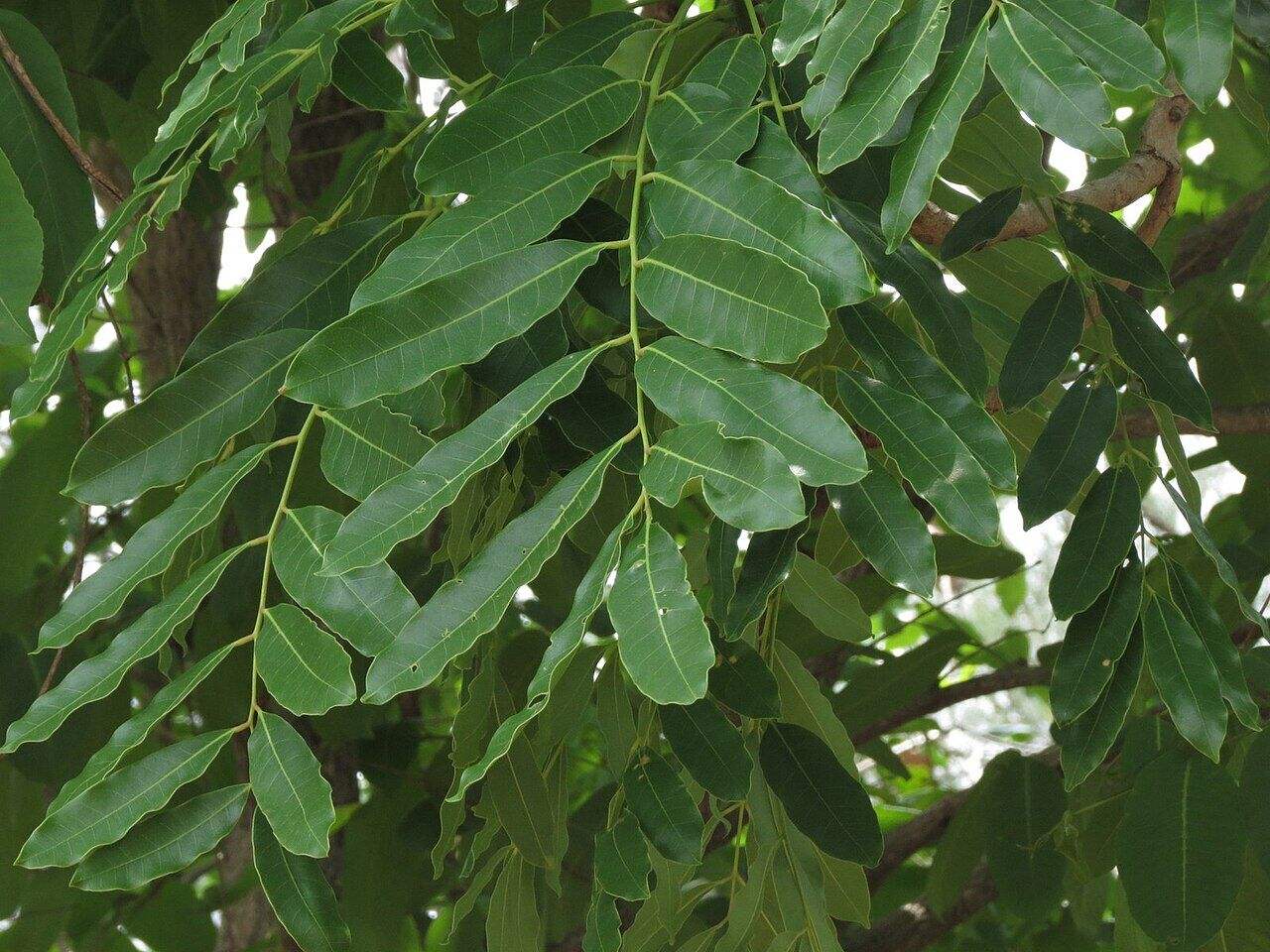
Khaya senegalensis is a large tree that can reach about 30 metres tall, and PROTA gives 30 to 35 metres. Its bark is grey to dark grey or greyish-brown and tastes bitter. Each leaf is compound, meaning it is made of several smaller leaflets on one shared stalk, and it has no single leaflet at its tip. Each leaf has 3 to 5 pairs of leaflets, and its stalk and central stem can be up to 25 centimetres long. The leaves are spirally arranged along the branch but clustered near the branch ends, and the leaflets are usually opposite or nearly opposite each other, elliptical to oblong (about twice as long as wide), 5 to 12 centimetres long and 2.5 to 5 centimetres wide. The whitish, sweet-scented flowers grow in branched clusters (panicles) up to 20 centimetres long, and the fruit is an upright, nearly round woody capsule 4 to 6 centimetres across that splits into four parts to release many seeds.
Where it grows
The Useful Tropical Plants entry describes it as a dry-zone tree. The sources read give no further detail on habitat, soils or altitude.
- Native to
- Occurs from Mauritania and Senegal east to northern Uganda (PROTA).
- In Nigeria
- GBIF holds 178 occurrence records from Nigeria for this species. The sources read name no Nigerian states or regions for it.
Scientific details
- Scientific name
- Khaya senegalensis (Desv.) A.Juss.
- Family
- Meliaceae
- Older names
- Swietenia senegalensis
Sources
Not yet reviewed Drafted with AI from the sources below. Treat with care.
- Khaya senegalensis - PROTA (Plant Resources of Tropical Africa), Medicinal and other uses. PROTA via Pl@ntUse.
- Khaya senegalensis - Useful Tropical Plants. Tropical Plants Database (tropical.theferns.info).
- Khaya senegalensis (Desv.) A.Juss. - GBIF species match (ACCEPTED). Global Biodiversity Information Facility.
- GBIF occurrence search, Khaya senegalensis, country NG. Global Biodiversity Information Facility.
- An Examination into the Safety and Efficacy of Khapregesic(R), a Khaya Senegalensis Preparation, on Women Experiencing Menstrual Pain and Menstrual Distress: A Randomized, Double-Blind, Placebo-Controlled Trial. Europe PMC full text (PMC12266064). PMID 40672875.
- An examination into the safety and efficacy of Khapregesic, a Khaya senegalensis preparation, on physical and psychological wellbeing in women experiencing menopausal symptoms: a randomised, double-blind, placebo-controlled trial. Europe PMC full text (PMC13269224). PMID 42312188.
- Formulation and Evaluation of Capsules From Azadirachta indica and Khaya senegalensis for Malaria Treatment. Europe PMC full text (PMC13094358). PMID 42017189.
- Phytochemistry, Antimicrobial, Analgesic, Antibiofilm, Diuretic Activities, and Acute Toxicity of Bark Extracts From Three Plants (Khaya senegalensis, Ocimum americanum, and Cassytha filiformis) Collected in Benin. Europe PMC full text (PMC12930297). PMID 41743325.
- Potential of Khaya senegalensis to mitigate epileptogenesis and cognitive dysfunction on kainate-induced post-status epilepticus model. Europe PMC full text (PMC11750482). PMID 39844945.
- Rafiu BO, Omotayo AO, Lawal IO, Aremu AO. Ethnobotanical uses of plants in Nigeria: an analysis of current research trends and patterns. Journal of Ethnobiology and Ethnomedicine (BMC), 2025. PMID 40841969.