Sausage tree
- Igbo Amo-ibi, Uturubien
- Yoruba Pandoro
Kigelia africana

What it is used for
- Skin conditions fruit · traditional use
- Skin infections such as ringworm bark, leaf, fruit · traditional use
- Antimicrobial skin cream bark · traditional use
Tap a use to read how it is prepared and how well it is supported.
How each use is prepared
Parts used: fruit, bark, leaf.
Skin conditions
Traditional useSkin · fruit
How it is prepared: Commercial products made with fruit extracts, applied to the skin. The formulation is not specified in the source.
People use it this way, but it has not been tested.
PROTA reports that commercial products are used for symptomatic relief or cure of these skin conditions. Traditional medicines containing the fruit are also used for dermal complaints and infections such as whitlows, cysts, acne and boils. No clinical trial was opened. The claims are traditional and commercial, not proven. [1]
Skin infections such as ringworm
Traditional useSkin · bark, leaf, fruit
How it is prepared: Bark-macerated water used as a wash. Leaf and fruit preparations applied locally, as reported in PROTA.
People use it this way, but it has not been tested.
PROTA says fungal infections such as ringworm, mycosis and athlete's foot are treated by washing with bark-macerated water, and that leaf and fruit preparations are applied locally. These are traditional uses only and no laboratory or clinical test was opened for them. [1]
Antimicrobial skin cream
Traditional useInfections · bark
People use it this way, but it has not been tested.
PROTA describes a cream made from the stem bark as reputedly effective against a number of common microbial infections. The word reputedly signals that this is a reported effect. No study was opened for this record. [1]
Safety
The fruit pulp is described as inedible and toxic, and PROTA says it can cause blistering of the tongue and skin. Do not eat the fruit. The skin products are described as traditional or commercial use with no clinical trial opened, so test a small area first and stop if irritation occurs.
Side effects
- PROTA says the fruit pulp may cause blistering of the tongue and skin. The source does not give a dose or frequency. [1]
Poisoning and overdose
- PROTA says the fruit pulp is said to be inedible and toxic. The same page also contains a contradictory sentence, saying acute toxicity tests of the fruits indicate they are non-toxic, which is incomplete in the source. The record treats the fruit as toxic and does not assume it is safe after processing. [1]
If you take other medicines
- No interaction study was opened. This is a precaution, not a sourced interaction. [1]
Pregnancy and breastfeeding
- Not documented in the sources read.
Children
- Not documented in the sources read. Keep the fruit away from children, since the pulp is described as toxic. [1]
About this plant
A large tree from tropical Africa, known for its long, sausage-shaped fruit that hangs from the crown. Its fruit pulp is described as inedible and toxic, and its fruit, bark and leaves are used in skin preparations. The sources read give no clinical evidence that these preparations treat skin disease, so they should be used with care and not as a substitute for medical advice.
How to recognise it
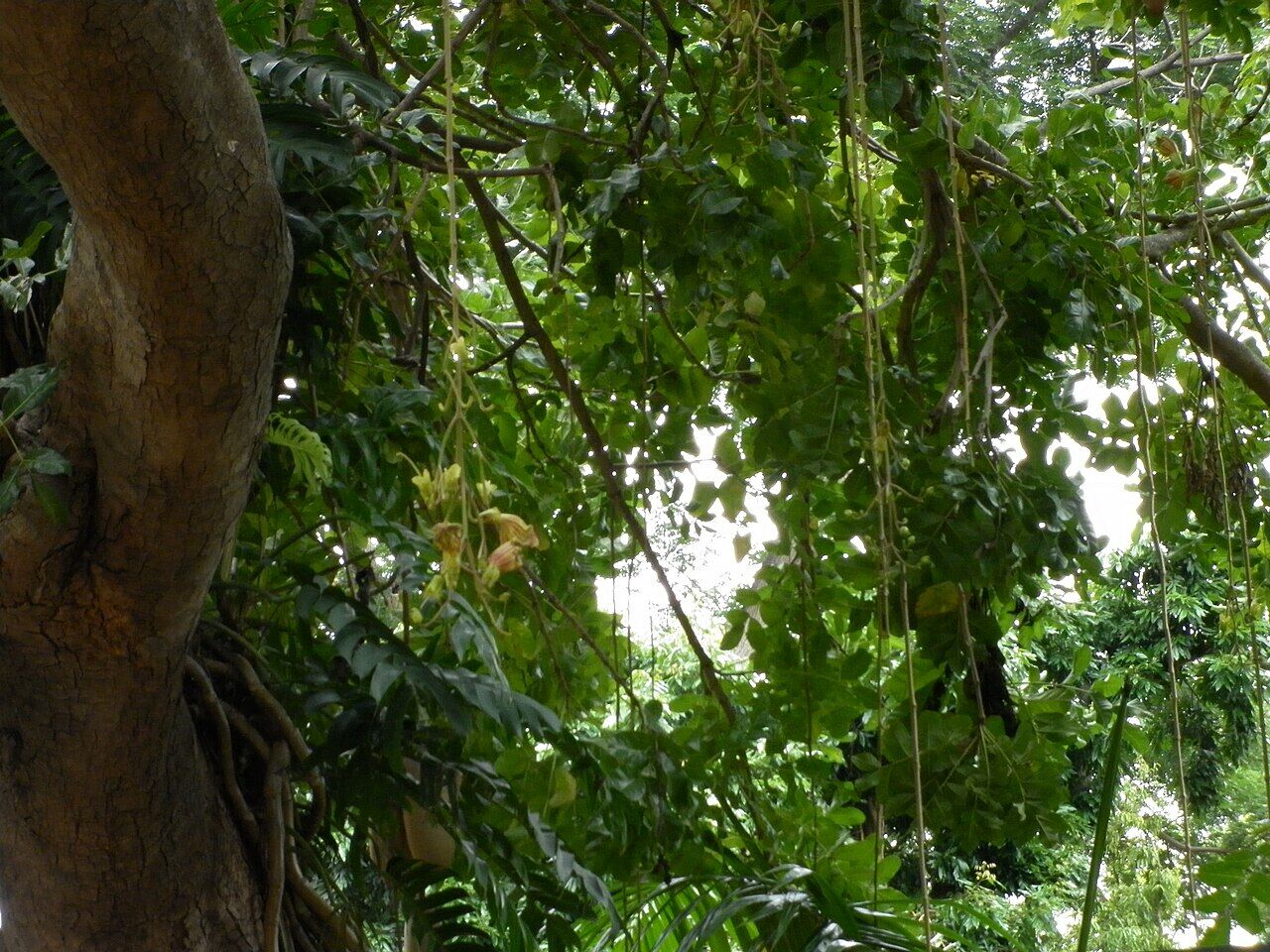
Kigelia africana is a large tree whose leaves are compound and odd-pinnate, up to 50 to 60 cm long, and arranged opposite or in whorls of three to four, crowded toward the tips of the branches (NParks; PROTA). Each leaf has 7 to 11 leaflets (NParks) or 5 to 13 leaflets (PROTA). The leaflets are elliptic to oblong, about 20 cm long and 6 cm wide (NParks). The flowers are borne in hanging, branched clusters (panicles) about 10 cm long at the branch tips. Each panicle holds 6 to 12 showy, trumpet-shaped flowers with deep red to purple petals, each 5 to 10 cm long. The flowers open in the evening, last one night and have a reportedly unpleasant scent (NParks). The calyx is first yellowish and later reddish to purplish (PROTA). The fruit is a large, sausage-shaped, pendulous, woody berry that does not split open. It is 25 to 50 cm long and 7.5 to 15 cm wide, and can weigh up to 10 kg (NParks). PROTA gives a larger maximum of up to 100 cm long, 18 cm wide and 12 kg.
Where it grows
- Native to
- Tropical Africa (NParks; PROTA)
- In Nigeria
- Listed among the useful angiosperms of southwestern Nigeria with the Yoruba name Pandoro in Ajao et al. (2022). The survey text read does not give a finer locality.
Scientific details
- Scientific name
- Kigelia africana (Lam.) Benth.
- Family
- Bignoniaceae
Sources
Not yet reviewed Drafted with AI from the sources below. Treat with care.
- PROTA (Plant Resources of Tropical Africa). Kigelia africana (Lam.) Benth. (PROTA species record). Pl@ntUse, PROTA.
- Sausage tree, Kigelia africana (NParks Flora and Fauna Web). National Parks Board, Singapore.
- Ajao AA, Mukaila YO, Sabiu S. Wandering through southwestern Nigeria: An inventory of Yoruba useful angiosperm plants. Elsevier, 2022. PMID 35024488.
- Rafiu BO, Omotayo AO, Lawal IO, Aremu AO. Ethnobotanical uses of plants in Nigeria: an analysis of current research trends and patterns. Journal of Ethnobiology and Ethnomedicine (BMC), 2025. PMID 40841969.