Mango
- Igbo Mangoro
- Yoruba Mongoro
- Hausa Mangwaro
Mangifera indica · also called Mango tree

What it is used for
- Cough bark · traditional use
- Diarrhoea and dysentery bark · traditional use
- Skin irritation leaf · traditional use
- Malaria lab tests only
- Diabetes leaf · lab tests only
Tap a use to read how it is prepared and how well it is supported.
How each use is prepared
Parts used: leaf, bark.
Cough
Traditional useCough and breathing · bark
How it is prepared: Decoction of the bark, taken by mouth (as reported)
People use it this way, but it has not been tested.
Reported in a survey of Nigerian ethnobotanical uses. The survey lists the use but does not report any study of its effect on cough. The evidence is traditional only. [1]
Diarrhoea and dysentery
Traditional useStomach and digestion · bark
People use it this way, but it has not been tested.
Bark is reported in traditional use for haemorrhage, diarrhoea and throat problems, and a review also lists fever, diarrhoea and dysentery. No clinical study of these uses was found in the sources read. [2][3]
Skin irritation
Traditional useSkin · leaf
People use it this way, but it has not been tested.
Leaf use for skin irritation is reported in a compilation of traditional uses. No study of this use was found in the sources read. [2]
Malaria
Lab or animal studiesMalaria · laboratory and animal studies only
Tested in the laboratory or in animals, not in people.
A review reports that the strongest evidence for antiparasitic activity is for malaria and helminths, from laboratory and animal studies. No human trial was found in the sources read, so this is not evidence of treatment in people. [3]
Diabetes
Lab or animal studiesBlood sugar · leaf · laboratory and animal studies; traditional use
How it is prepared: Leaf infusion (as reported)
Tested in the laboratory or in animals, not in people.
Leaf infusions are reported in traditional use for diabetes, among other conditions. A review of medicinal plants in the ECOWAS region rates mango's in vitro and in vivo evidence as solid and recommends pilot clinical trials. No human trial was found in the sources read. [2][4]
Safety
Mango safety data are incomplete. Skin contact with the juice or eating the fruit may cause a rash in sensitive people. A review says safety cannot be assumed at therapeutic doses or when concentrated extracts are administered systemically. Data on pregnancy, breastfeeding, children and drug interactions were not found in the sources read.
Side effects
- Eating the fruit, or skin contact with the juice, may cause a rash like that of poison ivy in sensitive people. This is recorded from a botanical database that cites a World Agroforestry source. Frequency is not documented. [2]
Poisoning and overdose
- A review says safety cannot be assumed at therapeutic doses, or when concentrated extracts are given systemically. The review classes mango toxicity as 'Mixed (nontoxic except in high doses in vitro)'. [4][3]
If you take other medicines
Pregnancy and breastfeeding
Children
About this plant
Mango leaves and stem bark are used in traditional medicine in several countries. Laboratory and animal studies have looked at malaria-parasite and blood-sugar effects. Human evidence and complete safety data were not found in the sources read.
How to recognise it
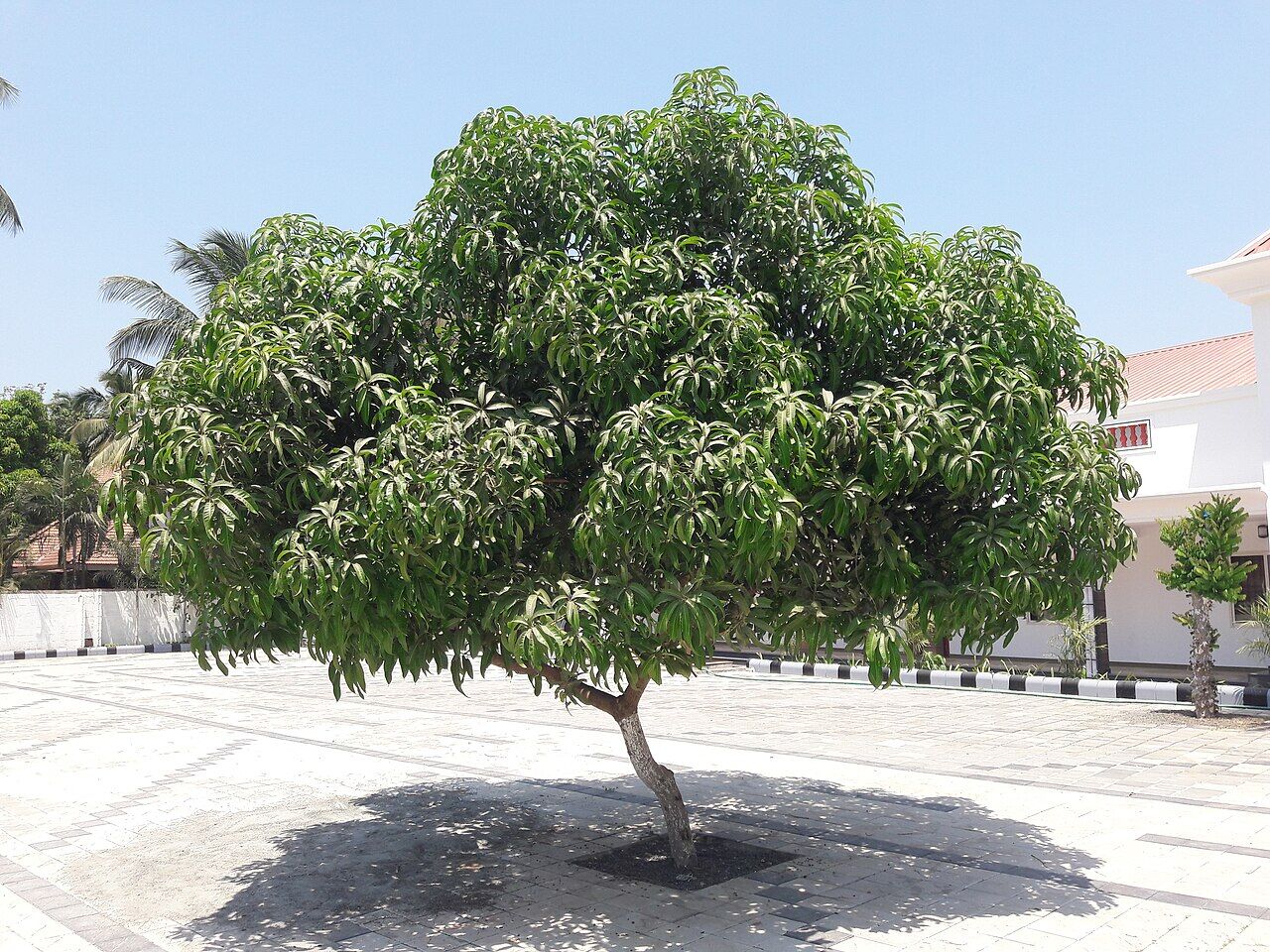
Mango is a large evergreen tree, 10 to 45 metres tall, with a dark green, umbrella-shaped, spreading crown. The trunk (bole) can be 60 to 120 cm across, and the tree has a deep taproot. The bark is astringent (it contracts tissue when applied). Leaf shape, arrangement and size are not documented in the sources read.
Where it grows
A mid-canopy tree in humid tropical forests, usually at elevations below 500 metres. It is now grown across tropical regions and frost-free subtropics, according to Useful Tropical Plants.
- Native to
- East Asia, the Indian subcontinent and Myanmar, according to Useful Tropical Plants.
- In Nigeria
- GBIF holds 192 occurrence records from Nigeria. A Nigerian ethnobotanical survey recorded use of the plant in Oyo and Osun states.
- States
- Oyo, Osun
Scientific details
- Scientific name
- Mangifera indica L.
- Family
- Anacardiaceae
Sources
Not yet reviewed Drafted with AI from the sources below. Treat with care.
- Ethnobotanical uses of plants in Nigeria: an analysis of current research trends and patterns. Journal of Ethnobiology and Ethnomedicine (via Europe PMC full text), 2025. PMID 40841969.
- Useful Tropical Plants: Mangifera indica. Useful Tropical Plants database.
- A Review on Phytochemistry, Ethnopharmacology, and Antiparasitic Potential of Mangifera indica L.. Pharmaceuticals (via Europe PMC full text), 2025. PMID 41155688.
- Diabetes mellitus in ECOWAS: an overview of the safety and efficacy of medicinal plants used in traditional medicine practices. Tropical Medicine and Health (via Europe PMC full text), 2026. PMID 41872917.
- GBIF Backbone Taxonomy: species match for Mangifera indica (accepted name, usageKey 3190638). Global Biodiversity Information Facility.
- GBIF occurrence search: Nigeria records for Mangifera indica (taxonKey 3190638). Global Biodiversity Information Facility.