Mitracarpus
Mitracarpus hirtus

What it is used for
- Old ulcers leaf · traditional use
- Eczema and other skin conditions in people leaf · traditional use
- Fungal skin infection leaf · tested in people
- Bovine dermatophilosis leaf · lab tests only
Tap a use to read how it is prepared and how well it is supported.
How each use is prepared
Parts used: leaf.
Old ulcers
Traditional useWounds · leaf
How it is prepared: Dried leaves, as reported in the Useful Tropical Plants entry, which cites Uphof (1959)
People use it this way, but it has not been tested.
Reported in a historical pharmacopoeia, as summarised by Useful Tropical Plants. No study of this use was found in the sources read. [1]
Eczema and other skin conditions in people
Traditional useSkin · leaf
People use it this way, but it has not been tested.
Stated in a laboratory paper on plants used for cattle dermatophilosis (Ndhlovu and Masika, 2017), which cites Imam et al. (2008) for the human use. The Imam paper was not opened, so this is second-hand. No study tested this use. [5]
Fungal skin infection
Studied in peopleSkin · leaf · dermal mycosis
How it is prepared: 5% ointment made from an 80% methanolic leaf extract, applied 3 times a day for 7 days, then 7 more days of maintenance
Tested in at least one human study. Read the note for how strong the result is.
The only human test found was a pilot study in 20 volunteers (Cimanga et al., 2026). It was read from the abstract only, is very small and short, and the evidence is weak. The study used the synonym M. scaber, so confirm the plant identity. [4]
Bovine dermatophilosis
Lab or animal studiesSkin · leaf · a skin infection of cattle
Tested in the laboratory or in animals, not in people.
A laboratory and animal study (Ali-Emmanuel et al., 2003) tested extracts against the bacterium that causes this infection in cattle. The study used the synonym M. scaber, so confirm the plant identity. This was not tested in people. [3]
Safety
Human safety data are very limited. The only human study was a 7-day topical pilot in 20 volunteers with no unwanted effects reported. Use on broken skin, in pregnancy or in children has not been studied, so avoid it in these cases.
Side effects
- No unwanted effects were reported in the 7-day topical pilot in 20 volunteers. The study was small and short. [4]
Poisoning and overdose
- Useful Tropical Plants lists no known hazards. This is not a toxicity study. [1]
If you take other medicines
Pregnancy and breastfeeding
Children
About this plant
A small annual weed of disturbed ground and roadsides, found across the tropics and sometimes called a weed. Leaves have been used in folk medicine for skin complaints, but the evidence is limited to a few small studies.
How to recognise it
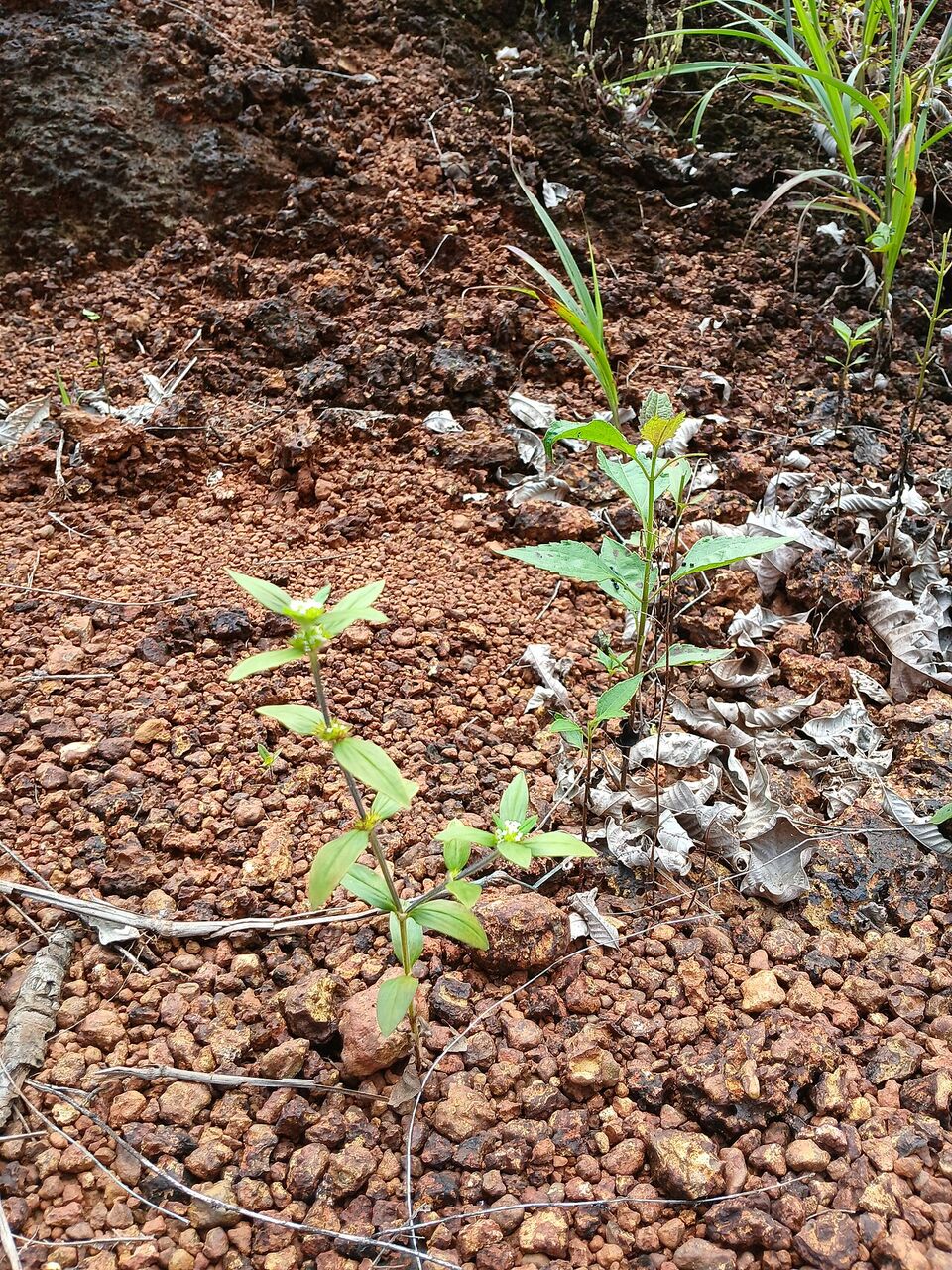
An annual herb with erect or spreading stems, 20 to 60 cm long, covered in rough (scabrid) hairs, which gives the species the names hirtus (hairy) and scaber (rough). The leaves are narrow, 2 to 6 cm long and 0.5 to 1.5 cm wide, with a rough upper surface and almost no stalk. Small flowers with a white corolla 2 to 3 mm long are borne in dense clusters in the leaf axils. Each fruit is a tiny, nearly round capsule about 1 mm long. The botanical description comes from an Australian key, not Nigerian material, so check it against a local specimen.
Where it grows
Usually a weed in waste or cultivated ground. It also grows in pastures, on banks and in thickets. In Australia it is a common roadside weed.
- Native to
- Tropical and subtropical Americas, from Argentina, Paraguay and Uruguay north through Central America to Mexico and the Caribbean. It has spread to other tropical regions as a weed.
- In Nigeria
- GBIF lists 153 occurrence records from Nigeria (a record count only, not a survey). No Nigerian locality is named in the sources read.
Scientific details
- Scientific name
- Mitracarpus hirtus (L.) DC.
- Family
- Rubiaceae
- Older names
- Mitracarpus scaber
Sources
Not yet reviewed Drafted with AI from the sources below. Treat with care.
- Mitracarpus hirtus (Useful Tropical Plants). Useful Tropical Plants.
- Mitracarpus hirtus, Australian Tropical Rainforest Plants identification key. Australian Tropical Rainforest Plants (Lucid key).
- Ali-Emmanuel N, Moudachirou M, Akakpo JA, Quetin-Leclercq J. Treatment of bovine dermatophilosis with Senna alata, Lantana camara and Mitracarpus scaber leaf extracts. Journal of Ethnopharmacology 86(2-3):167-71, 2003. PMID 12738081.
- Cimanga RK, Mukumbayi PM, Pieters L, Tuenter E, et al.. Phytochemical characterization and antidermatophytic activity of a leaf extract from Mitracarpus scaber. Journal of Ethnopharmacology 355(Pt A):120601 (abstract read only), 2026. PMID 40945880.
- Ndhlovu DN, Masika PJ. In vitro efficacy of extracts from plants used by small-holder farmers in the treatment of dermatophilosis in cattle. African Journal of Traditional, Complementary and Alternative Medicines 14(2):263-272, 2017. PMID 28573243.
- GBIF species match: Mitracarpus hirtus (L.) DC.. GBIF.
- GBIF occurrence search, country=NG, Mitracarpus hirtus (record count). GBIF.