Bitter melon
- Igbo Akban ndene
- Yoruba Ejinrin
- Hausa Garafuni
Momordica charantia · also called Bitter gourd, Bitter cucumber, Balsam pear

What it is used for
- Diabetes root, leaf · tested in people
- Cough and respiratory complaints leaf · traditional use
- Painful menstruation leaf · traditional use
- Obesity and weight management fruit · traditional use
Tap a use to read how it is prepared and how well it is supported.
How each use is prepared
Parts used: leaf, root, fruit.
Diabetes
Studied in peopleBlood sugar · root, leaf · blood sugar
How it is prepared: Decoction of the root or leaf, as reported in the Oyo and Osun survey
Tested in at least one human study. Read the note for how strong the result is.
A 2025 umbrella review of herbal medicines for glycaemic control in type 2 diabetes includes bitter melon meta-analyses. Across five randomised trials (243 people), HbA1c fell by a weighted mean of 0.26 percentage points, and fasting blood glucose fell by 0.72 mmol/L across five trials (231 people). The review rates the evidence as low certainty and covers herbal medicines in general, not bitter melon alone. This is weak clinical evidence, and MSK says bitter melon is not a replacement for insulin or diabetes medicines. [4][5]
Cough and respiratory complaints
Traditional useCough and breathing · leaf
How it is prepared: Leaf decoction, as reported in the Oyo and Osun survey
People use it this way, but it has not been tested.
Reported in an ethnobotanical survey of Oyo and Osun states. The survey gives no experimental support for this use. [5]
Painful menstruation
Traditional useWomen's health · leaf · dysmenorrhea
How it is prepared: Leaf decoction, as reported in the Oyo and Osun survey
People use it this way, but it has not been tested.
Reported in an ethnobotanical survey of Oyo and Osun states. The survey gives no experimental support for this use. [5]
Obesity and weight management
Traditional useOther · fruit
How it is prepared: Raw fruit or fruit juice, as reported in a survey of the North Central zone
People use it this way, but it has not been tested.
Reported in a 2025 ethnobotanical survey of medicinal plants used for obesity in the North Central zone of Nigeria. The survey reports the fruit being eaten raw or as juice. It is a survey of use and does not show that the fruit works for weight loss. No human trial of bitter melon for obesity was opened. [6]
Safety
Bitter melon should be avoided in pregnancy, because animal studies suggest it can cause developmental abnormalities. Its seeds contain vicine, which can cause a favism-type reaction (headache, fever, abdominal pain, and in severe cases coma). It can add to the blood-sugar-lowering effect of insulin and diabetes medicines, so blood sugar should be watched closely.
Poisoning and overdose
- The seeds contain vicine, which can cause favism (headache, fever, abdominal pain, and in severe cases coma). [1]
If you take other medicines
- Bitter melon has additive effects with insulin and diabetes medicines, which can increase the risk of low blood sugar. MSK says it is not a replacement for insulin or hypoglycaemic drugs. [1]
Pregnancy and breastfeeding
- Bitter melon should be avoided if you are pregnant, as animal studies suggest it can cause developmental abnormalities. [1]
Children
- Not documented in the sources read.
About this plant
A climbing vine whose bitter fruit and leaves are eaten as a vegetable and used in traditional medicine, including for diabetes. The sources read rate the human evidence for blood-sugar lowering as low certainty, and bitter melon can be dangerous in pregnancy and for people with favism.
How to recognise it
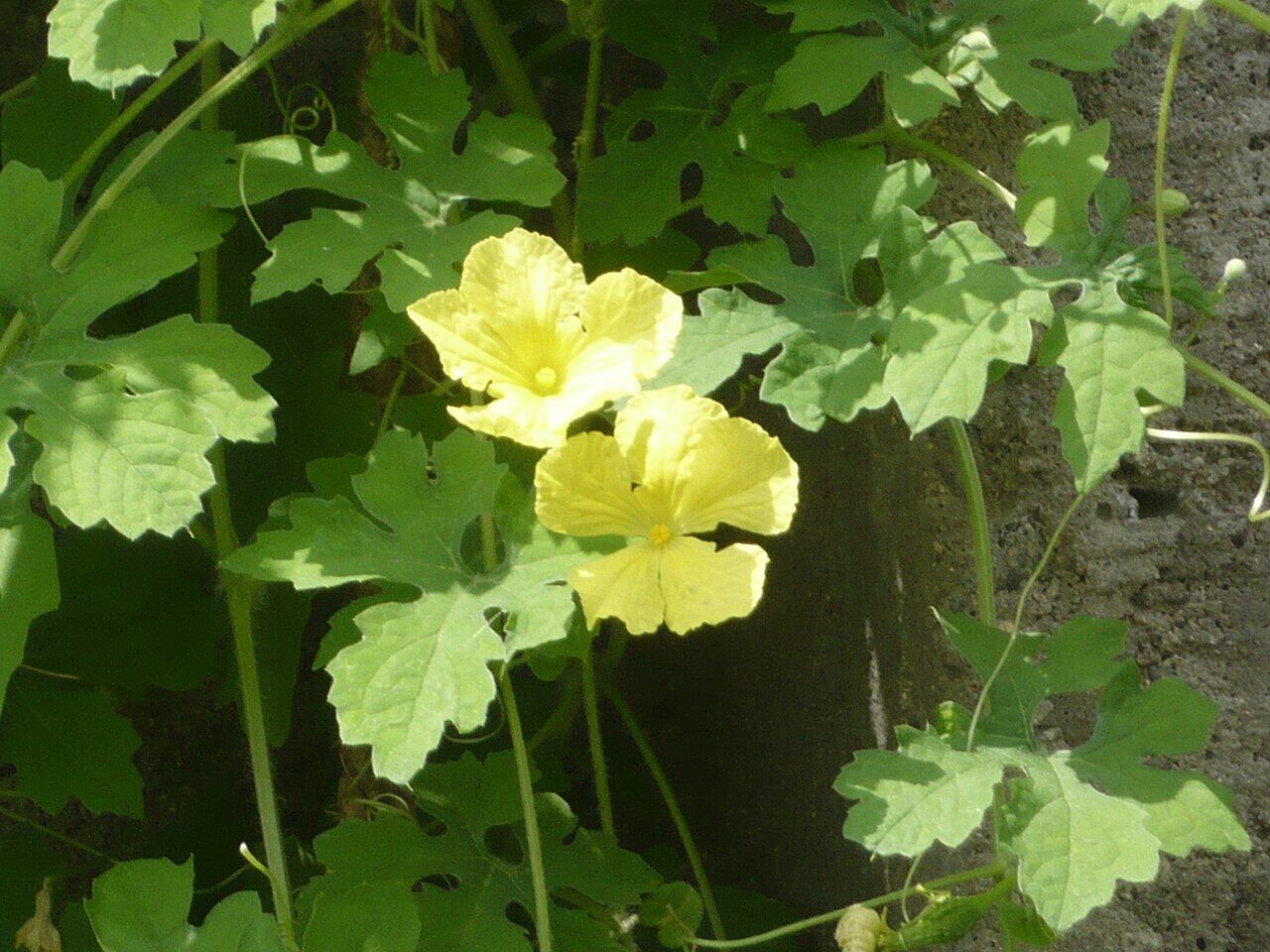
Bitter melon is a climbing, herbaceous annual with twining stems that hold on with tendrils. The leaves are simple (not divided into leaflets), palmately veined, with a lobed and crenate (round-toothed) margin, and are arranged alternately along the stem. The flowers are solitary and yellow, and the plant is monoecious, so male and female flowers are on the same plant. The fruit is a pepo (a fleshy, berry-like fruit with a hard rind) that is ovate-elliptical to elongate-fusiform in shape. Chinese varieties have warty bumps on the fruit, while Indian varieties are spiky. The fruit is usually bitter and eaten as a vegetable. The sources read do not give a leaf size, so the length and width of the leaves are not recorded here.
Where it grows
The Useful Tropical Plants entry describes the plant as an annual climber that can reach about 4 m, growing in savannah and bush, and gives a pantropical range. The NParks flora page classes it as cryptogenic in Singapore, meaning its origin there is unclear.
- Native to
- Pantropical, with an origin that is obscure, possibly Africa or India (Useful Tropical Plants). NParks also gives a pantropical distribution.
- In Nigeria
- The GBIF occurrence search returns 126 records from Nigeria for this species. The 2025 ethnobotanical survey of Oyo and Osun states (Rafiu Basirat O. et al.) records the plant in use there, but it does not give its distribution. The sources read do not describe where in Nigeria it grows wild or is cultivated.
Scientific details
- Scientific name
- Momordica charantia L.
- Family
- Cucurbitaceae
- Older names
- Momordica indica, Momordica elegans, Momordica sinensis, Momordica operculata, Momordica chinensis, Sicyos fauriei
Sources
Not yet reviewed Drafted with AI from the sources below. Treat with care.
- Bitter Melon. Memorial Sloan Kettering Cancer Center.
- Momordica charantia L. (Flora 1 4 1452). National Parks Board, Singapore (NParks FloraFaunaWeb).
- Momordica charantia L. - Useful Tropical Plants. Tropical Plants Database (tropical.theferns.info).
- Li E et al.. The efficacy and safety of herbal medicines for glycaemic control and insulin resistance in individuals with type 2 diabetes: an umbrella review. BMC Complementary Medicine and Therapies, 2025.
- Rafiu Basirat O. et al.. Ethnobotanical uses of plants in Nigeria: an analysis of current research trends and patterns. Journal of Ethnobiology and Ethnomedicine, 2025.
- Anyanwu GO et al.. An Ethnobotanical Survey and Pharmacological and Toxicity Review of Medicinal Plants Used in the Management of Obesity in the North Central Zone of Nigeria. Journal of Obesity, 2025. PMID 40026359.
- Momordica charantia L. - GBIF species match. Global Biodiversity Information Facility.