Brimstone tree
- Igbo Eze-ogu, Ogere
- Yoruba Oruwo
Morinda lucida

What it is used for
- Fever, including malaria root, stem bark, leaf · traditional use
- Cough and bronchitis traditional use
- Malaria leaf, stem bark · lab tests only
- Diabetes lab tests only
- Pain, inflammation and fever stem bark · lab tests only
Tap a use to read how it is prepared and how well it is supported.
How each use is prepared
Parts used: root, stem bark, leaf.
Fever, including malaria
Traditional useFever · root, stem bark, leaf · traditional
How it is prepared: Decoctions, infusions and plasters of root, bark or leaves, as reported in PROTA
People use it this way, but it has not been tested.
PROTA reports these preparations against fevers, including malaria, and says that in Nigeria the plant is one of the four most used traditional medicines against fever. The 2023 Kwara State survey also lists it for malaria. These are reports of use, with no trial in people read. [1][5][7]
Cough and bronchitis
Traditional useCough and breathing · traditional
People use it this way, but it has not been tested.
One Osun State survey lists the plant for bronchitis and cough. No experimental support for this use was read. [8]
Malaria
Lab or animal studiesMalaria · leaf, stem bark · antiplasmodial activity in mice and in vitro
Tested in the laboratory or in animals, not in people.
A 2022 study reported antiplasmodial activity of leaf and bark extracts in mice infected with Plasmodium berghei. PROTA reports in vitro activity of leaf extracts against Plasmodium falciparum. These are laboratory and animal results only and do not show that the plant works against malaria in people. [6][1]
Diabetes
Lab or animal studiesBlood sugar · antidiabetic effects in tests
Tested in the laboratory or in animals, not in people.
PROTA reports antidiabetic effects in several tests, and the Yoruba inventory lists diabetes among its medicinal uses. The sources read give no test details and no human trial. [1][7]
Pain, inflammation and fever
Lab or animal studiesPain and swelling · stem bark · rats
Tested in the laboratory or in animals, not in people.
PROTA reports anti-inflammatory, antifever and analgesic effects in rats. This is animal evidence only, and the sources read give no human data. [1]
Safety
No hazard is recorded for this plant in the sources read, but that does not mean it has been tested for safety. A 2022 mouse study states that further safety and toxicological research is needed. Pregnancy, interactions and use in young children have no sourced guidance, so ask a clinician before use.
Poisoning and overdose
- Useful Tropical Plants says 'Known Hazards: None known'. This records the absence of reported hazards, not a safety study. The PROTA article has no hazard section. [2][1]
- A 2022 mouse antiplasmodial study states that further research is needed to determine the safety and toxicological profile of these extracts in vivo. [6]
Pregnancy and breastfeeding
- Not documented in the sources read.
Children
- PROTA says leaves and twigs are sold in markets as a medicinal tonic for young children. The sources read give no safety data for children. [1]
About this plant
A tree whose root, bark and leaves are used in Nigerian traditional medicine, mainly for fever and malaria. Lab and animal studies exist, but the sources read include no human trial, and its safety has not been established.
How to recognise it
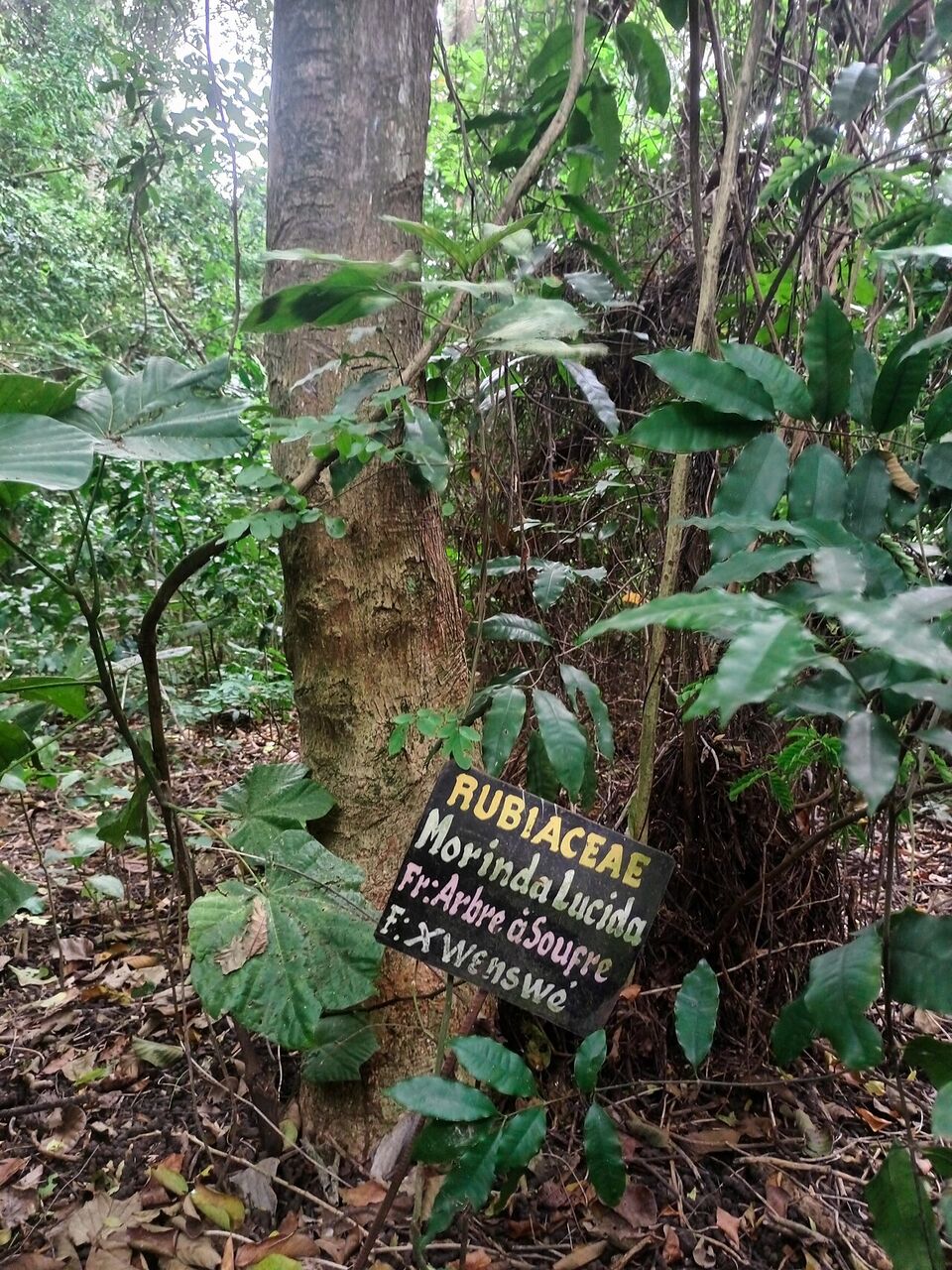
Brimstone tree is an evergreen shrub or small to medium tree that can reach about 18 m, sometimes 25 m. Its leaves are arranged opposite each other along the stem and are simple (one blade, not divided into leaflets), elliptical in shape, about 6 to 18 cm long and 2 to 9 cm wide, with an entire edge (no teeth). The upper surface of the leaf is shiny. The flowers grow in small heads on long, slender stalks, and the petal tube is white or greenish-yellow and about 1.5 cm long. The fruit is a round cluster of small drupes (fleshy fruits with a single stone), 1 to 2.5 cm across, and it turns black when ripe. The bark is smooth to slightly scaly and grey to brown, and the wood is yellow, which gives the tree its name.
Where it grows
PROTA lists grassland, exposed hillsides, thickets and forests, often on termite mounds and sometimes in areas that flood regularly, from sea level up to 1300 m.
- Native to
- From Senegal to Sudan, and southward to Angola and Zambia (PROTA).
- In Nigeria
- Recorded in ethnobotanical surveys in Kwara State and Osun State, and in a Yoruba plant inventory of southwestern Nigeria. GBIF holds 131 occurrence records from Nigeria.
- States
- Kwara, Osun
Scientific details
- Scientific name
- Morinda lucida Benth.
- Family
- Rubiaceae
Sources
Not yet reviewed Drafted with AI from the sources below. Treat with care.
- Morinda lucida Benth. (PROTA article, Pl@ntUse, oldid 198794). PROTA (Plant Resources of Tropical Africa), Pl@ntUse.
- Morinda lucida - Useful Tropical Plants. Tropical Plants Database (tropical.theferns.info).
- GBIF backbone. Morinda lucida Benth. - GBIF species match. Global Biodiversity Information Facility.
- GBIF. GBIF occurrence search, Morinda lucida, country NG. Global Biodiversity Information Facility.
- Evbuomwan IO et al.. Indigenous medicinal plants used in folk medicine for malaria treatment in Kwara State, Nigeria: an ethnobotanical study. BMC Complementary Medicine and Therapies, 2023. PMID 37716985.
- Oladeji OS et al.. Antiplasmodial activity of Morinda lucida Benth. leaf and bark extracts against Plasmodium berghei infected mice. Saudi Journal of Biological Sciences, 2022. PMID 35531230.
- Ajao AA, Mukaila YO, Sabiu S. Wandering through southwestern Nigeria: An inventory of Yoruba useful angiosperm plants. Heliyon, 2022. PMID 35024488.
- Lawal IO et al.. Ethnobotanical Survey of Plants Used for Treating Cough Associated with Respiratory Conditions in Ede South Local Government Area of Osun State, Nigeria. Plants (Basel), 2020. PMID 32443771.
- Rafiu BO, Omotayo AO, Lawal IO, Aremu AO. Ethnobotanical uses of plants in Nigeria: an analysis of current research trends and patterns. Journal of Ethnobiology and Ethnomedicine (BMC), 2025. PMID 40841969.