Moringa
- Igbo Okwe oyibo
- Yoruba Ewe ile, Gbogbonise, Ewe igbale, Idagba moloye
- Hausa Zogale
Moringa oleifera · also called Drumstick tree

What it is used for
- Infections leaf · traditional use
- Diabetes leaf · tested in people
- High cholesterol leaf · traditional use
- Food and nutrition leaf, pod · traditional use
Tap a use to read how it is prepared and how well it is supported.
How each use is prepared
Parts used: leaf, flower, pod, seed, root, bark.
Infections
Traditional useInfections · leaf · reported use
People use it this way, but it has not been tested.
The MSK integrative medicine page lists moringa as used to treat infections. That page cites no study for this use. The use is reported, not proven. [1]
Diabetes
Studied in peopleBlood sugar · leaf · blood sugar
Tested in at least one human study. Read the note for how strong the result is.
The MSK page lists moringa as used for diabetes. The Camilleri and Blundell review reports one human study in which 7 g per day of leaf powder for 90 days lowered blood glucose by 13.5%. The review does not give the study size or design, so this is weak evidence from a single small study. It does not show that moringa treats diabetes, and it should not replace diabetes medicine. [1][2]
High cholesterol
Traditional useOther · leaf
People use it this way, but it has not been tested.
The MSK page lists moringa as used for high cholesterol. The page gives no study. The use is reported, not proven. [1]
Food and nutrition
Traditional useNutrition · leaf, pod
People use it this way, but it has not been tested.
The Camilleri and Blundell review describes the leaves as a source of folate and omega fatty acids and calls the leaves the safest edible part. These are nutrient contents and food uses, not proof of a health effect. [2]
Safety
The sources reviewed do not show that moringa is safe to use as a medicine. The leaves are the part the review calls the safest to eat. Pregnancy is the main concern: the MSK page advises pregnant and breastfeeding women to avoid moringa, and the food regulator found the safety evidence insufficient. Moringa may also affect some drugs.
Side effects
- The MSK page says consumer side effects have not been reported. It also notes a case report of Stevens-Johnson syndrome, a serious skin reaction, linked to taking moringa. [1]
- In one human study, 8 g per day of leaf powder for 40 days caused no adverse effects. In a study of children given meals fortified with 20 g per day of leaf, 20% had mild nausea. [2]
Poisoning and overdose
- In mice, no deaths occurred at 6400 mg/kg of an aqueous leaf extract. The review reports dullness and sluggishness in animals given long-term doses above 1600 mg/kg. [2]
- The review warns that overconsumption can cause nerve paralysis and liver failure. The amounts involved were not confirmed in this draft. [2]
- The review says the root and bark contain compounds (spirochin and benzyl isothiocyanate) that may be toxic, and that roasted seeds may contain mutagens, which can cause DNA changes. [2]
- The review gives conflicting lethal-dose figures for the plant: 1585 mg/kg in one place and 17.8 g/kg in another. [2]
- FSANZ rejected a food application for leaves, immature pods and oil, citing a potential safety concern. The application page does not name the concern. [4]
If you take other medicines
- Moringa may inhibit CYP3A4 (and CYP2D6, per the review), liver enzymes that break down many drugs. This was seen in lab and animal tests. The MSK page lists CYP450 substrates and sitagliptin, a diabetes medicine, and says the clinical relevance has not been determined. [1][2]
Pregnancy and breastfeeding
- The MSK page advises pregnant and breastfeeding women to avoid moringa. Animal studies of root and stem-bark extracts found antifertility and abortion effects. FSANZ rejected the food application, citing a potential safety concern. A study of a different species, Moringa stenopetala, found that its seed extract caused embryo loss in rats at the highest dose tested. No human pregnancy studies were found. [1][2][4][5]
Children
About this plant
Moringa is a tree whose leaves, flowers and pods are eaten as food. The sources reviewed describe few human studies. In 2025 Food Standards Australia New Zealand (FSANZ) rejected an application to sell moringa leaves, pods and oil as food, saying the available evidence did not confirm they are safe.
How to recognise it
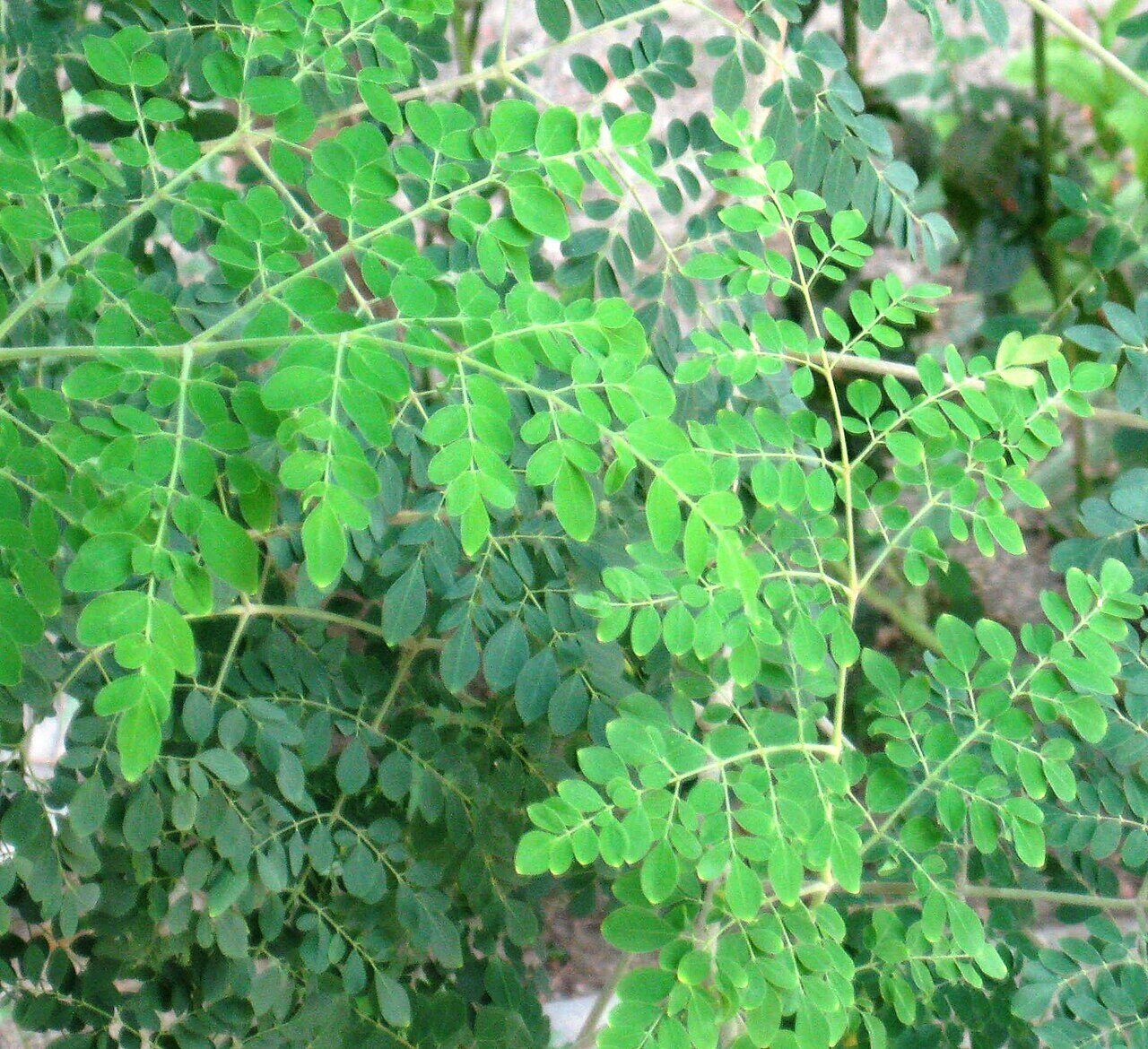
Moringa oleifera is a fast-growing, deciduous to semi-evergreen shrub or small tree, up to about 10 m tall, with a trunk up to 45 cm across and a wide, open, umbrella-shaped crown. The bark is whitish, grey or pale buff and mostly smooth, and the young shoots are purplish or greenish-white and finely hairy. The leaves are alternate (set singly along the stem, not in pairs) and two to three times pinnate, meaning the leaflets sit along both sides of a central stalk and the branches carrying them are themselves divided, which gives a feathery look. Each leaf is 6.5 to 60 cm long, with 4 to 6 pairs of side branches carrying small, rounded-oval leaflets about 0.5 to 2 cm long, dark green above and paler below. The white or cream flowers grow in loose, branching, many-flowered clusters (panicles) 8 to 30 cm long, with velvety petals and waxy yellow or orange stamens (the pollen-bearing parts). The fruit is a long, ribbed, three-part pod, 10 to 50 cm long, that turns brown and splits to release round seeds about 1 to 1.5 cm across, each with three thin papery wings; the young pods are the 'drumsticks' of the common name.
Where it grows
It grows best at lower elevations and has been found up to about 1,350 m in East Africa; it tolerates drought, with as little as 500 mm of rain a year, and prefers fertile, well-drained soils. Useful Tropical Plants reports that it readily colonises stream banks and savannah where the soils are well drained and the water table stays fairly high.
- Native to
- Northern India and Pakistan (PROTA); now introduced and naturalised across the tropics and subtropics, including many African countries.
- In Nigeria
- GBIF holds 133 occurrence records from Nigeria. The PROTA page says the plant is naturalised in many African countries, but it names no place in Nigeria where the plant grows, and the one Nigeria mention on that page is about eating the seeds.
Scientific details
- Scientific name
- Moringa oleifera
- Family
- Moringaceae
- Main compounds
- spirochin, benzyl isothiocyanate
Sources
Not yet reviewed Drafted with AI from the sources below. Treat with care.
- Memorial Sloan Kettering Cancer Center. Moringa oleifera (integrative medicine herb guide). Memorial Sloan Kettering Cancer Center (MSK) Integrative Medicine, 2023.
- Camilleri E, Blundell R. A comprehensive review of the phytochemicals, health benefits, pharmacological safety and medicinal prospects of Moringa oleifera. Heliyon, 2024. PMID 38496871.
- NMPPDB. Species with particular compound: Moringa oleifera (comp=358). NMPPDB, Nigeria.
- Food Standards Australia New Zealand (FSANZ). Application A1294: Moringa oleifera novel food. Food Standards Australia New Zealand, 2025.
- Teshome D, Tiruneh C, Berihun G. Toxicity of Methanolic Extracts of Seeds of Moringa stenopetala, Moringaceae in Rat Embryos and Fetuses. BioMed Research International, 2021.
- Ajao AA, Mukaila YO, Sabiu S. Wandering through southwestern Nigeria: An inventory of Yoruba useful angiosperm plants. Heliyon, 2022. PMID 35024488.
- Moringa oleifera. Useful Tropical Plants (tropical.theferns.info).
- Orwa C, Mutua A, Kindt R, Jamnadass R, Anthony S. Agroforestree Database 4.0: Moringa oleifera (species factsheet PDF). World Agroforestry Centre (ICRAF), 2009.
- Moringa oleifera (PROTA). PROTA (Plant Resources of Tropical Africa), Pl@ntUse.
- GBIF (Global Biodiversity Information Facility). GBIF species match: Moringa oleifera. GBIF.
- GBIF (Global Biodiversity Information Facility). GBIF occurrence search: Moringa oleifera, country NG. GBIF.