Banana
- Yoruba Ogede agbagba
Musa × paradisiaca · also called Plantain

What it is used for
- Diabetes fruit · traditional use
- Cough and whooping cough traditional use
- Malaria leaf · traditional use
- Cough and bronchitis leaf · traditional use
Tap a use to read how it is prepared and how well it is supported.
How each use is prepared
Parts used: fruit, leaf.
Diabetes
Traditional useBlood sugar · fruit
How it is prepared: Unripe fruit cooked and eaten
People use it this way, but it has not been tested.
Reported in one Ile-Ife (Osun State) survey, where the plant was named Ogede agbagba. The survey cites no experimental study. Diabetes needs proper diagnosis and treatment; this is not a substitute. [2]
Cough and whooping cough
Traditional useCough and breathing
People use it this way, but it has not been tested.
Listed for cough and whooping cough in an Ede South (Osun State) survey under the name Ogede agbagba. The table row does not state which part is used or how it is prepared. No experimental study is cited. [3]
Malaria
Traditional useMalaria · leaf
People use it this way, but it has not been tested.
Listed as a leaf remedy in a Kwara State malaria survey, where it was one of many plants recorded. The survey cites no experimental study. Malaria is a serious disease that needs a diagnosis and treatment; this is not a substitute. [4]
Cough and bronchitis
Traditional useCough and breathing · leaf
How it is prepared: Dried leaves made into a syrup
People use it this way, but it has not been tested.
Reported in an older herbal reference cited by UTP. It is not from a Nigerian survey, and no experimental study is cited. [1]
Safety
Ripe banana and plantain fruit is a common food. No safety study was found in the sources read, so safety for medicinal use is not established. Missing data does not mean the plant is safe.
Side effects
- UTP lists 'Known Hazards: None known'. That is not a safety study. Side effects of medicinal use are not documented in the sources read. [1]
Poisoning and overdose
- No toxicity data for medicinal use were found in the sources read. [1]
If you take other medicines
- Data lacking. The sources read do not cover drug interactions.
Pregnancy and breastfeeding
- Data lacking for pregnancy and breastfeeding. UTP reports that a banana leaf infusion, with sugarcane roots, was used to hasten childbirth. This comes from one older reference, and its safety is not tested. [1]
Children
- Data lacking. The sources read do not cover use in children.
About this plant
A large, cultivated herb grown for its starchy plantain fruit and sweet bananas. Unripe fruit and leaves have traditional uses reported in several Nigerian ethnobotanical surveys. These reports are not evidence that the plant works as a medicine.
How to recognise it
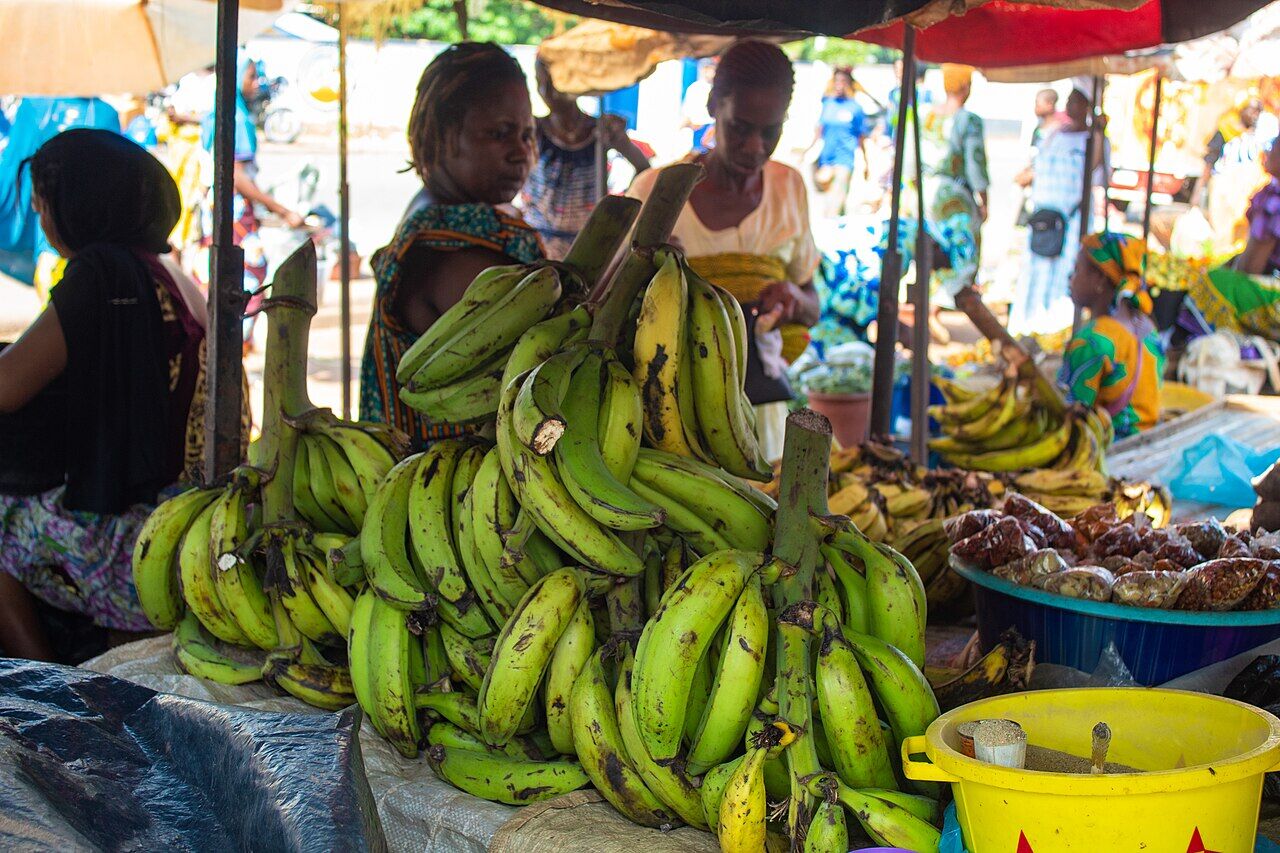
A large perennial herb, about 8 metres tall, that looks like a tree but has no woody trunk. Its top growth dies after flowering and is replaced by new growth from the rootstock (UTP). The fruit is eaten raw or cooked; plantain, the starchier type, is more often cooked (UTP). UTP's photo captions show a male flower with immature bananas behind it. The leaves are not described in the sources read, so this record does not describe their shape or colour.
Where it grows
Known only as a cultivated plant, a hybrid of Musa acuminata and Musa balbisiana (UTP). UTP, citing a gardening reference, gives about 27 C as the best temperature for fruit production, and says night temperatures should not fall much below 18 C while the fruit ripens. Wild habitat is not documented in the sources read.
- In Nigeria
- Recorded in ethnobotanical surveys from Ile-Ife and Ede South in Osun State, and from Kwara State. Grown as a food crop; the surveys do not give locations within those states.
- States
- Osun, Kwara
Scientific details
- Scientific name
- Musa × paradisiaca L.
- Family
- Musaceae
Sources
Not yet reviewed Drafted with AI from the sources below. Treat with care.
- Musa x paradisiaca. Useful Tropical Plants.
- Mukaila YO et al.. Which Plants for What Ailments: A Quantitative Analysis of Medicinal Ethnobotany of Ile-Ife, Osun State, Southwestern Nigeria. Evidence-Based Complementary and Alternative Medicine, 2021. PMID 34394387.
- Lawal IO et al.. Ethnobotanical Survey of Plants Used for Treating Cough Associated with Respiratory Conditions in Ede South Local Government Area of Osun State, Nigeria. Plants (Basel), 2020. PMID 32443771.
- Evbuomwan IO et al.. Indigenous medicinal plants used in folk medicine for malaria treatment in Kwara State, Nigeria: an ethnobotanical study. BMC Complementary Medicine and Therapies, 2023. PMID 37716985.