African peach
- Igbo ubuluinu
- Yoruba egbésí
Nauclea latifolia · also called Pin-cushion tree

What it is used for
- Fever root · traditional use
- Cough fruit · traditional use
- Indigestion root · traditional use
- Malaria root · lab tests only
Tap a use to read how it is prepared and how well it is supported.
How each use is prepared
Parts used: root, leaf, fruit.
Fever
Traditional useFever · root
People use it this way, but it has not been tested.
PFAF reports the root used as a febrifuge (a remedy for fever) and tonic. No clinical study was found in the sources read. [3]
Cough
Traditional useCough and breathing · fruit
People use it this way, but it has not been tested.
The fruit is reported as eaten as a cough remedy (ICRAF AFTPDFS factsheet and PFAF). No experimental or clinical study of this use was found in the sources read. [2][3]
Indigestion
Traditional useStomach and digestion · root
People use it this way, but it has not been tested.
PFAF reports the root used for indigestion. No experimental or clinical study of this use was found in the sources read. [3]
Malaria
Lab or animal studiesMalaria · root
Tested in the laboratory or in animals, not in people.
In Nigeria the plant is reported in traditional use as a remedy for malaria fevers (ICRAF AFTPDFS factsheet). A laboratory and mouse study of root extracts found that two compounds, betulinic acid and ursolic acid, reduced malaria parasites in mice. This is an early laboratory finding, not proof that the plant works in people. [2][6]
Safety
No human safety studies were found in the sources read, so it is not known whether the plant is safe to take by mouth. A mouse study measured an acute toxicity figure for a root extract, but this does not show that the plant is safe for people. Do not take it for malaria or fever in place of a tested treatment, and see a health worker for any fever.
Side effects
- No side effects are documented in the sources read.
Poisoning and overdose
- In a mouse acute toxicity test the root extract had a median lethal dose (LD50, the single dose that kills half the animals) of about 1500 mg/kg. The source reports this as a laboratory figure; it does not show that the plant is safe for people. [6]
If you take other medicines
- Data lacking. No drug interaction studies were found in the sources read.
Pregnancy and breastfeeding
- Data lacking. No safety data on pregnancy or breastfeeding were found in the sources read.
Children
- Data lacking. No safety data on children were found in the sources read.
About this plant
A shrub or small tree of West and Central Africa whose root, leaves and fruit are used in traditional medicine for fever, malaria, indigestion and cough. Laboratory and animal studies exist, but no human safety data were found in the sources read.
How to recognise it
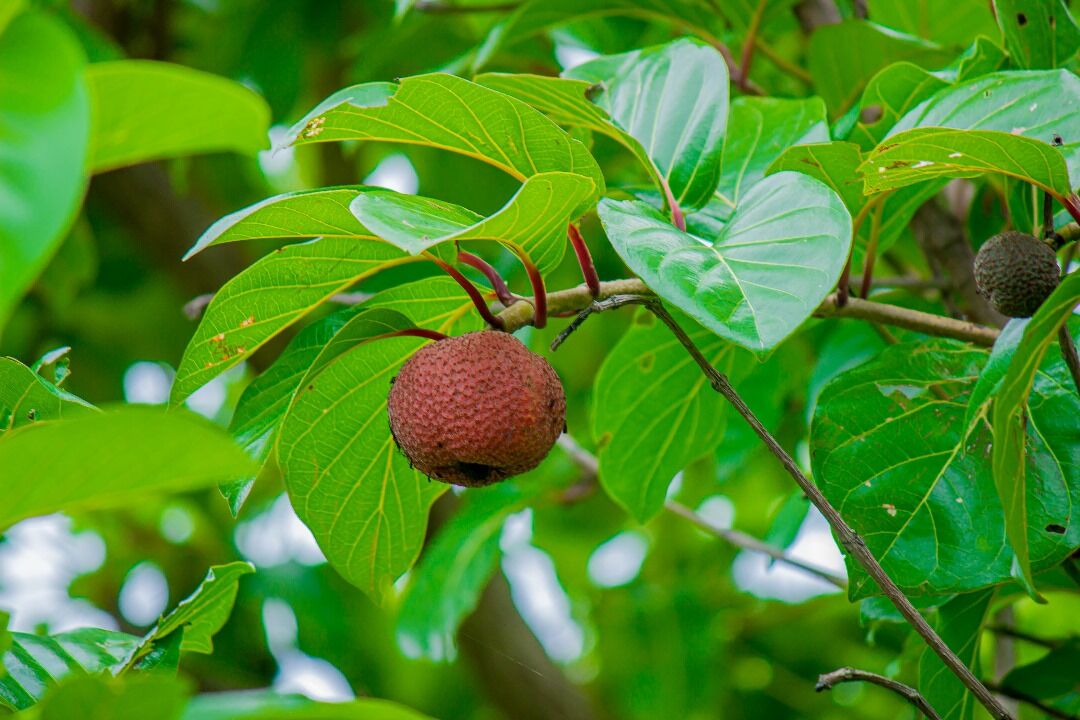
Nauclea latifolia is a shrub or multi-stemmed tree that usually grows 2 to 9 metres tall, and can reach about 12 metres in some sources. Its branchlets are thick and droop downwards. The bark is grey-brown, very fibrous and deeply cut into fissures. The leaves are shiny dark green above and paler below, wide and oval, 10 to 21 centimetres long, with a pointed tip and a rounded base. Each leaf sits on a red-purple stalk up to 2 centimetres long. The flowers are white to yellow, very fragrant, and grow in solitary round heads 4 to 5 centimetres across, borne on a stalk 1 to 2 centimetres long at the ends of the branches. The fruit is a compound, roughly round ball 5 to 8 centimetres across that turns red when ripe and has a sweet, edible flesh.
Where it grows
The sources read describe it as a plant of fringing forest and closed savannah woodland, from sea level to about 200 metres. The sources read do not give more detail on soils or habitat type.
- Native to
- Native countries listed by ICRAF (AFTPDFS): Benin, Burkina Faso, Cameroon, Democratic Republic of the Congo, Gambia, Ghana and Nigeria. PFAF gives West tropical Africa from Ghana to Gabon and the DR Congo.
- In Nigeria
- GBIF holds 329 occurrence records from Nigeria for this species. The sources read name no Nigerian states or regions for it.
Scientific details
- Scientific name
- Nauclea latifolia Sm.
- Family
- Rubiaceae
- Older names
- Sarcocephalus latifolius
- Main compounds
- betulinic acid, ursolic acid
Sources
Not yet reviewed Drafted with AI from the sources below. Treat with care.
- Sarcocephalus latifolius - ICRAF Useful Tree Species for Africa factsheet (Uganda). World Agroforestry Centre.
- Sarcocephalus latifolius - ICRAF Agroforestry Tree Database species factsheet (AFTPDFS). World Agroforestry Centre.
- Nauclea latifolia - Plants For A Future (PFAF). Plants For A Future.
- Nauclea latifolia - Useful Tropical Plants. Tropical Plants Database (tropical.theferns.info).
- Nauclea latifolia - Wikipedia. Wikipedia.
- Europe PMC full text (PMC10848498). Betulinic and ursolic acids from Nauclea latifolia roots mediate their antimalarial activities through docking and in vivo studies. Europe PMC full text. PMID 38326823.
- Neuroprotection by Nauclea latifolia extract in arsenite and high-fat diet-induced brain stress. Europe PMC full text (PMC12623113). PMID 40988551.
- Nauclea latifolia Sm. - GBIF species match (ACCEPTED). Global Biodiversity Information Facility.
- GBIF occurrence search, Nauclea latifolia, country NG. Global Biodiversity Information Facility.