Scent leaf
- Igbo Nchuawun, Nchanwu, Nchuanwa, Nchonwu
- Yoruba Efinrin nla, Efinrin-wewe
Ocimum gratissimum · also called Clove basil, African basil, Shrubby basil, East Indian basil

What it is used for
- Diarrhoea leaf · traditional use
- Fever leaf · traditional use
- Stomach pain and upset whole · traditional use
- Headache, sunstroke and influenza whole · traditional use
- Skin disease leaf · traditional use
- Inflammation of the throat, ear or eye leaf · traditional use
- Gonorrhoea seed · traditional use
- Insect repellent leaf · traditional use
- Cough and catarrh leaf · traditional use
- Weight loss traditional use
- Infections leaf · lab tests only
Tap a use to read how it is prepared and how well it is supported.
How each use is prepared
Parts used: leaf, seed, whole.
Diarrhoea
Traditional useStomach and digestion · leaf
People use it this way, but it has not been tested.
Nigeria is named for this use in the Heliyon review, and the review also lists uses in several other African countries. Laboratory and animal studies of the plant's extracts show antibacterial activity, but no human trial was found. The use is reported, not proven to help. [1][2]
Fever
Traditional useFever · leaf
People use it this way, but it has not been tested.
The PROSEA handbook lists the essential oil for fever. This is a record of traditional use. No trial was found. [2]
Stomach pain and upset
Traditional useStomach and digestion · whole
People use it this way, but it has not been tested.
The PROSEA handbook describes whole-plant preparations as a stomachic and lists the essential oil for stomach pain. This is a record of traditional use. No trial was found. [2]
Headache, sunstroke and influenza
Traditional useOther · whole
People use it this way, but it has not been tested.
The PROSEA handbook lists whole-plant preparations for these conditions. This is a record of traditional use. No trial was found. [2]
Skin disease
Traditional useSkin · leaf
People use it this way, but it has not been tested.
The PROSEA handbook lists the essential oil for skin disease, without naming the conditions. This is a record of traditional use. No trial was found. [2]
Inflammation of the throat, ear or eye
Traditional usePain and swelling · leaf
People use it this way, but it has not been tested.
The PROSEA handbook lists the essential oil for these inflammations. This is a record of traditional use. No trial was found. [2]
Gonorrhoea
Traditional useInfections · seed
People use it this way, but it has not been tested.
The PROSEA handbook says the seeds are used against gonorrhoea. Gonorrhoea is a sexually transmitted infection that needs medical treatment. No trial was found, and this use should not replace medical care. [2]
Insect repellent
Traditional useOther · leaf
People use it this way, but it has not been tested.
The PROSEA handbook lists the essential oil as an insect repellent. This is not a medical use. [2]
Cough and catarrh
Traditional useCough and breathing · leaf
How it is prepared: Leaves squeezed to make an extract that is drunk. In one account the leaves are squeezed together with utazi (Gongronema latifolium) leaves.
People use it this way, but it has not been tested.
Focus-group participants in Ebonyi State, southeast Nigeria, described scent leaf extracts for cough, catarrh and nasal congestion. Other accounts in the same study mention bitter leaf being squeezed in with scent leaf. No trial was found, and the study does not test whether the extract works. [7]
Weight loss
Traditional useOther
How it is prepared: Washed, pounded or ground to obtain juice, taken by mouth as a cup of juice daily.
People use it this way, but it has not been tested.
A survey in North Central Nigeria lists this plant as a juice taken for obesity. The table does not state which plant part is used, and the survey does not test the juice. The same review reports that leaf extracts slowed pancreatic lipase in a laboratory test, which is not evidence of an effect in people. [8]
Infections
Lab or animal studiesInfections · leaf
Tested in the laboratory or in animals, not in people.
Laboratory and animal studies show antibacterial activity, and the main component named is eugenol. In a market survey in Benin, users most often cited an antibiotic effect, but that is a belief among users, not a test result. No human trial was found, so the plant is not proven to treat infections. [1][3]
Safety
Human safety data for scent leaf are lacking. Animal studies of the plant's oil and extracts, and of its main component eugenol, report effects on the liver, blood platelets and male fertility at high doses. The main review warns that high doses are harmful to animals. Do not assume that a food amount is safe as a medicine.
Side effects
- A market survey in Benin reports that users experience side effects, but the survey does not say which ones. Data on specific side effects in people are lacking. [3]
- In animal studies of eugenol, high doses caused gastric (stomach-lining) damage and bleeding in rats and guinea pigs. Whether this happens with normal culinary or medicinal amounts of the leaf is not known. [5]
Poisoning and overdose
- Oral eugenol LD50 (the dose that kills half of test animals) is 1930 to 2680 mg/kg in rats, 3000 mg/kg in mice and 2130 mg/kg in guinea pigs. The Heliyon review lists eugenol among the plant's constituents. [5]
- In rats, high doses of eugenol over several weeks caused liver and adrenal enlargement and stomach-lining thickening. In dogs and rats, high doses were liver-toxic. [5]
- Oil at 1000 mg/kg given to rats showed no liver toxicity. In a separate study, a leaf extract given in feed at 500 mg/kg lowered platelet counts. [1]
- In a study of diabetic rats, an aqueous leaf extract impaired sperm production. Such effects have not been shown in people. [1]
- The FAO/WHO flavouring-agent committee (JECFA) gives an acceptable daily intake of eugenol as a flavouring of 0 to 2.5 mg/kg body weight. This figure is for flavouring use, not for medicinal use of the leaf. [4]
If you take other medicines
- The sources reviewed do not describe any drug interactions for scent leaf or for eugenol in people. Data are lacking. [1][4]
Pregnancy and breastfeeding
- Data are lacking. The sources reviewed contain no study of scent leaf or eugenol in pregnant women or their babies. The only reproductive data are from male animals. [1]
Children
- Data are lacking. The sources reviewed contain no study of scent leaf in children. [1]
About this plant
Scent leaf is a shrubby herb in the mint family. Across several West and Central African countries it is used as food and in home remedies. The sources reviewed show that most medicinal claims rest on traditional use and laboratory or animal studies, not on trials in people.
How to recognise it
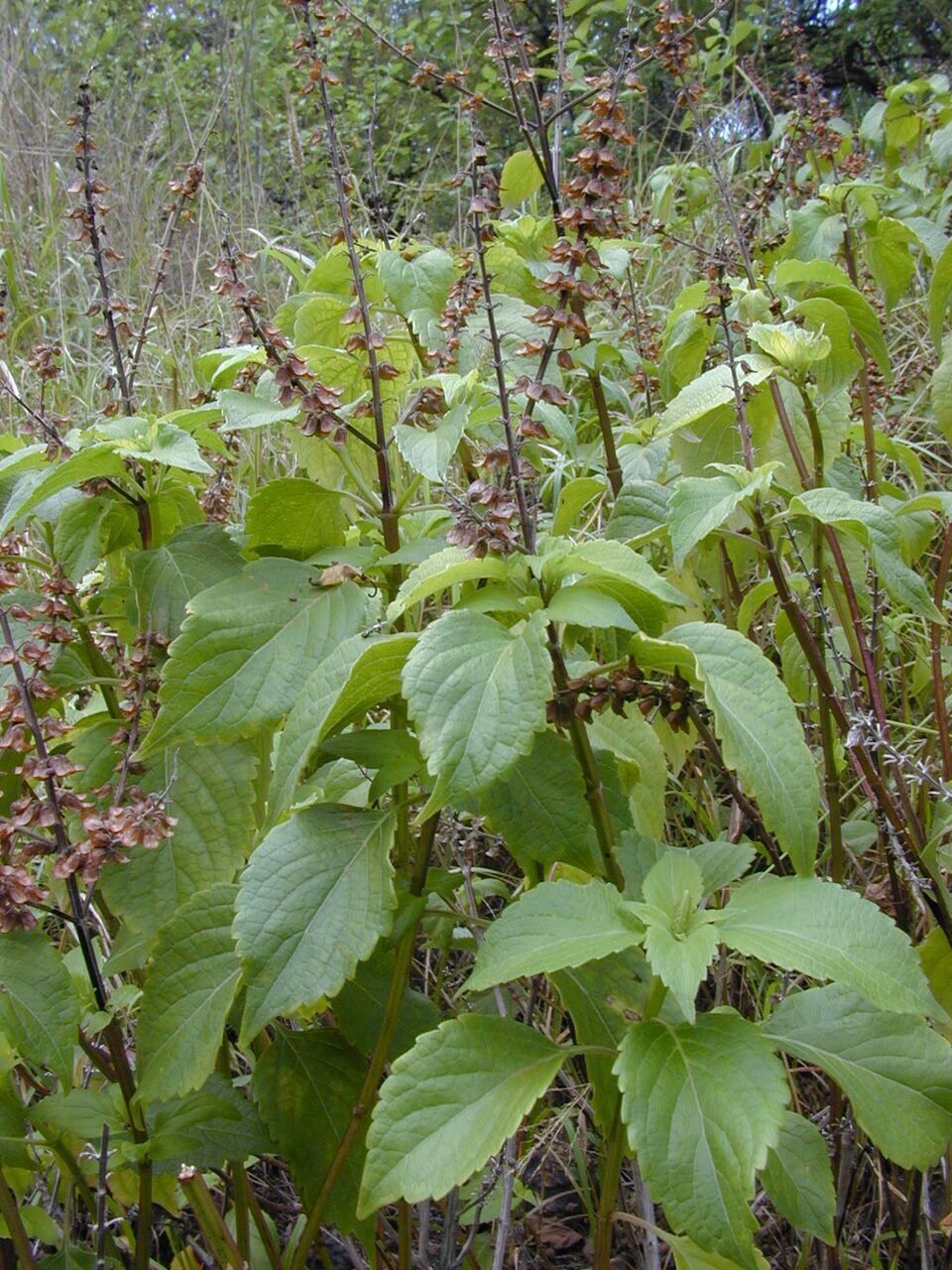
Clove basil (Ocimum gratissimum) is an aromatic, woody-based perennial herb or shrub that grows 1 to 3 m tall, with stems that are square in section and much branched; the outer skin of the lower stem often peels in strips. The leaves grow in opposite pairs on slender stalks 2 to 4.5 cm long, and the blades are oval to elliptical, about 1.5 to 16 cm long and 1 to 8.5 cm wide, with pointed tips and coarsely toothed edges. Leaves and stems hold an essential oil (a volatile oil that gives a plant its smell) that is warm and spicy, and in some forms the leaves smell strongly of clove when bruised. The small flowers are greenish-white, borne in rings of 6 to 10 around spikes (racemes) 5 to 30 cm long at the ends of the branches, and each has a two-lipped tubular calyx (the sepal ring that surrounds the flower base). The fruit holds four tiny brown seeds (nutlets) enclosed in the calyx, which stays on the fruit.
Plants it can be confused with
- Ocimum basilicum (sweet basil): Useful Tropical Plants describes sweet basil as a perennial 20 to 80 cm tall, against 50 to 300 cm for clove basil, so height is the one difference confirmed from opened pages. The Useful Tropical Plants page lists no known hazards for sweet basil. Leaf differences were not confirmed from the sources read.
Where it grows
In its native area it grows from sea level up to about 1,500 m, in coastal scrub, along lake shores, in savannah, in submontane (lower mountain) forest and on disturbed land (Agroforestree). Useful Tropical Plants gives a West African elevation range of sea level to 2,382 m.
- Native to
- Tropical Africa, and tropical Asia from India to Indonesia (Useful Tropical Plants).
- In Nigeria
- GBIF holds 113 occurrence records from Nigeria. None of the sources read names a Nigerian location, and the PROTA page for this species has no content.
Scientific details
- Scientific name
- Ocimum gratissimum L.
- Family
- Lamiaceae
- Main compounds
- eugenol, thymol, citral, linalool, geraniol, ethyl cinnamate
Sources
Not yet reviewed Drafted with AI from the sources below. Treat with care.
- Ugbogu OC, et al.. A review on the traditional uses, phytochemistry, and pharmacological activities of clove basil (Ocimum gratissimum L.). Heliyon, 2021. PMID 34901489.
- PROSEA. Ocimum gratissimum L. (PROSEA handbook entry). Plant Resources of South East Asia (PROSEA).
- Kpetehoto et al.. Survey of Ocimum gratissimum use in 34 markets of Cotonou, Benin (exact title not recorded; check the repository record). University of Abomey-Calavi repository (dspace.uac.bj), 2020.
- Joint FAO/WHO Expert Committee on Food Additives (JECFA). JECFA evaluation: Eugenol (JECFA No. 1529). INCHEM (IPCS).
- Joint FAO/WHO Expert Committee on Food Additives. Eugenol (FAO Nutrition Meetings Report Series 44A, 1967). INCHEM (IPCS), 1967.
- Ajao AA, Mukaila YO, Sabiu S. Wandering through southwestern Nigeria: An inventory of Yoruba useful angiosperm plants. Heliyon, 2022. PMID 35024488.
- Agu et al. (full author list to be completed from the repository record). Examining the use of complementary and alternative medicine among older persons in Ebonyi State, Southeast Nigeria: a qualitative study. BMC Complementary Medicine and Therapies, 2026. PMID 42056961.
- Anyanwu et al. (full author list to be completed from the repository record). An Ethnobotanical Survey and Pharmacological and Toxicity Review of Medicinal Plants Used in the Management of Obesity in the North Central Zone of Nigeria. Journal of Obesity, 2025. PMID 40026359.
- Ibrahim MB, Odewo AS, Lawal BA, Oyedeji OF, Balogun NA, Tijani WA, Abdulraheem AS, Shafiyi J, Ilomuanya MO. Traditional contraceptive practices: survey of medicinal plants used to control birth in four states in Nigeria. BMC, 2025. PMID 40490736.
- Orwa C, Mutua A, Kindt R, Jamnadass R, Anthony S. Agroforestree Database 4.0: Ocimum gratissimum (species factsheet PDF). World Agroforestry Centre (ICRAF), 2009.
- Ken Fern (Plants For A Future), per the page attribution. Ocimum gratissimum. Useful Tropical Plants (tropical.theferns.info).
- Ken Fern (Plants For A Future), per the page attribution. Ocimum basilicum. Useful Tropical Plants (tropical.theferns.info).
- GBIF (Global Biodiversity Information Facility). GBIF species match: Ocimum gratissimum. GBIF.
- GBIF (Global Biodiversity Information Facility). GBIF occurrence search: Ocimum gratissimum, country NG. GBIF.
- Rafiu BO, Omotayo AO, Lawal IO, Aremu AO. Ethnobotanical uses of plants in Nigeria: an analysis of current research trends and patterns. Journal of Ethnobiology and Ethnomedicine (BMC), 2025. PMID 40841969.
- Maluwa C, Zinan'dala B, Chuljerm H, Parklak W, Kulprachakarn K. Ethnobotany, Phytochemistry, and Pharmacological Activities of Ocimum Species in Low- and Middle-Income Countries: A Systematic Review. International Journal of Molecular Sciences (MDPI), 2026. PMID 42353254.
- Keziah EA, Nukenine EN, Danga SP, Younoussa L, Esimone CO. Creams formulated with Ocimum gratissimum L. and Lantana camara L. crude extracts and fractions as mosquito repellents against Aedes aegypti L. (Diptera: Culicidae). Journal of Insect Science, 2015. PMID 25881633.
- Oyedemi SO, Oyedemi BO, Ijeh II, Ohanyerem PE, Coopoosamy RM, Aiyegoro OA. Alpha-Amylase Inhibition and Antioxidative Capacity of Some Antidiabetic Plants Used by the Traditional Healers in Southeastern Nigeria. The Scientific World Journal, 2017. PMID 28367491.