African locust bean
- Igbo Ogiri-igala, Ogiri
- Yoruba Iru, Igba, Lasangba
- Hausa Dawadawa, Dorawa
Parkia biglobosa

What it is used for
- Diarrhoea and mouth thrush in children leaf, bark, root · traditional use
- Diabetes leaf · traditional use
- Wounds bark · traditional use
- High blood pressure bark · traditional use
- Food seasoning seed · traditional use
- Pain and inflammation bark · lab tests only
Tap a use to read how it is prepared and how well it is supported.
How each use is prepared
Parts used: seed, leaf, bark, fruit, root.
Diarrhoea and mouth thrush in children
Traditional useStomach and digestion · leaf, bark, root
How it is prepared: Decoction or powder, as reported
People use it this way, but it has not been tested.
The scoping review lists this plant for these two uses in its table of records. The rows read give no dose or age, and no clinical study of this use was opened. [8]
Diabetes
Traditional useBlood sugar · leaf · leaves as an infusion taken by mouth, Ogun State
How it is prepared: Leaves made into an infusion and taken by mouth, as reported in one Nigerian survey
People use it this way, but it has not been tested.
This is a single reported use in one survey. No study of the leaves for diabetes was opened. [5]
Wounds
Traditional useWounds · bark · bark decoction used as a body bath, Oyo State
How it is prepared: Bark decoction used as a body bath, as reported
People use it this way, but it has not been tested.
Reported in one Nigerian survey as a bath, not a dressing or a drink. No study of this use was opened. [5]
High blood pressure
Traditional useBlood pressure · bark · bark soaked and taken by mouth, Borno State
How it is prepared: Bark soaked in water and taken by mouth, as reported
People use it this way, but it has not been tested.
Reported in one Nigerian survey. PROTA also says an alcoholic extract of crude seeds showed anti-hypertensive activity, but PROTA does not state the study type, so this is not confirmed as animal or laboratory work. No human study was opened. [5][1]
Food seasoning
Traditional useNutrition · seed · fermented seeds, iru or dawadawa
How it is prepared: Seeds fermented into a condiment used to season sauces and soups
People use it this way, but it has not been tested.
This is a food use, not a medicine. The fermented seed condiment is listed in Nigerian food inventories. PROTA says the seeds contain antinutritional factors and must be processed before use as food or feed. [1][6][7]
Pain and inflammation
Lab or animal studiesPain and swelling · bark · laboratory test in mice, bark extracts
How it is prepared: Bark extracts tested in mice. PROTA does not give the dose or route.
Tested in the laboratory or in animals, not in people.
PROTA reports analgesic (pain-relieving) and anti-inflammatory activity of bark extracts in mice. This is an animal result. It does not show that the bark relieves pain in people. [1]
Safety
The bark and pods are reported to be toxic to fish, and the seeds are reported to be poisonous to fish and to snails. The seeds contain antinutritional factors and must be processed before eating. No human safety study, and no source on pregnancy, breastfeeding or children's dosing, was opened, so the plant should not be treated as safe for these groups.
Side effects
Poisoning and overdose
- The bark and pods contain substances toxic to fish. Useful Tropical Plants names the alkaloid parkine, which occurs in the pods and bark, as a possible cause. [2]
- PROTA reports that the seeds are ichthyotoxic (poisonous to fish) and molluscicidal (kill snails), which it attributes to saponins. [1]
- The seeds contain antinutritional factors and have to be processed before use as food or livestock feed. [1]
- A rat study of stem bark (Benin, dose 5000 mg/kg) is marked 'Toxicity: Present' in a scoping review table. The rows read give no finding for this result. [8]
- In a 2025 study, stem-bark extracts were reported harmless in brine shrimp (Artemia salina) and in female Wistar rats. This is a short animal test, not a full safety study. [9]
If you take other medicines
- No drug interactions are documented in the sources read. [1][2]
- PROTA reports that coumarin derivatives in leaf extracts have anticoagulant (blood-thinning) activity. The sources read do not say whether this matters when the leaves are taken with blood-thinning medicines. [1]
Pregnancy and breastfeeding
- No source opened gives pregnancy or breastfeeding guidance. PROTA reports that an alcoholic extract of crude seeds increased the tonus and mobility of the uterus, but the study type is not stated. [1]
Children
- The scoping review lists this plant in paediatric traditional medicine for diarrhoea and oral thrush, but gives no dose, age limit or safety data for children. [8]
About this plant
A savanna tree whose fermented seeds, called iru or dawadawa, are a common seasoning for soups and sauces in Nigeria. Its bark and leaves appear in several traditional remedies in Nigerian surveys, and some laboratory and animal studies exist, but no human trial of its medicinal use was opened.
How to recognise it
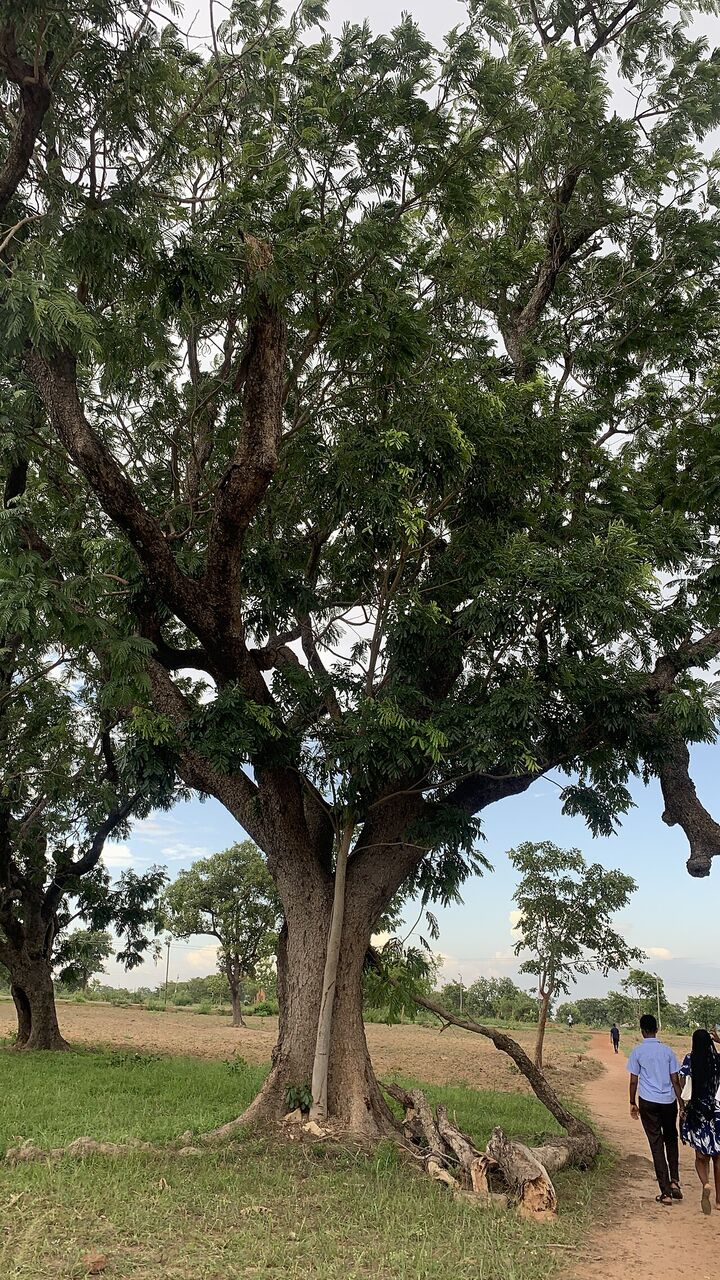
African locust bean is a deciduous tree (it loses its leaves in the dry season) that grows to about 15 m. Its leaves are alternate (one leaf at each point on the stem) and bipinnate, meaning each leaf is divided into side stalks (pinnae), and each of those carries many small leaflets. A leaf can reach about 30 cm long (up to 40 cm), with a stalk of 4 to 12.5 cm, up to 17 pairs of pinnae, and 13 to 60 pairs of leaflets on each pinna. Each leaflet is oblong, about 8 to 30 mm long and 1.5 to 8 mm wide. The flowers form round, hanging heads on stalks 10 to 35 cm long, which turn salmon-pink as they open. The fruit is a flat, brown pod 12 to 35 cm long and 1.5 to 2.5 cm wide when ripe, holding 5 to 23 seeds surrounded by a yellowish, sweet, starchy pulp. The seeds are the part used to make iru and dawadawa.
Where it grows
Protected and planted farm fields, farm woodland and open savanna woodland, and wasteland in savanna. PROTA says it grows up to about 1350 m altitude, and the dry season lasts 5 to 7 months a year where it grows. Useful Tropical Plants describes it as a semi-cultivated tree below 600 m in farm woodland and open savanna woodland.
- Native to
- Between 5 and 15 degrees North, from the Atlantic coast of Senegal to southern Sudan and northern Uganda (PROTA).
- In Nigeria
- GBIF holds 193 occurrence records from Nigeria for this species. PROTA estimates seed production in northern Nigeria at about 200,000 tonnes a year. No Nigerian state is named by the sources read for this species.
Scientific details
- Scientific name
- Parkia biglobosa (Jacq.) R.Br. ex G.Don
- Family
- Fabaceae
- Older names
- Inga biglobosa, Mimosa biglobosa, Parkia africana, Parkia clappertoniana
- Main compounds
- saponins, tannins, flavonoids, coumarin derivatives, parkine
Sources
Not yet reviewed Drafted with AI from the sources below. Treat with care.
- Parkia biglobosa (Jacq.) R.Br. ex G.Don (PROTA, Plant Resources of Tropical Africa, on Pl@ntUse). PROTA, Pl@ntUse.
- Parkia biglobosa - Useful Tropical Plants. Tropical Plants Database (tropical.theferns.info).
- GBIF backbone. Parkia biglobosa (Jacq.) R.Br. ex G.Don - GBIF species match. Global Biodiversity Information Facility.
- GBIF. GBIF occurrence search, Parkia biglobosa, country NG. Global Biodiversity Information Facility.
- Rafiu BO, et al.. Ethnobotanical uses of plants in Nigeria: an analysis of current research trends and patterns. Journal of Ethnobiology and Ethnomedicine (full text via Europe PMC, PMC12369106), 2025. PMID 40841969.
- Falana MB, et al.. An inventory of selected Nigerian fermented foods: enhancing the trajectory of sustainable development goals. npj Science of Food (full text via Europe PMC, PMC13279987), 2026. PMID 42010238.
- Olanbiwoninu AA, et al.. Ethnogeographic Distribution of Nigerian Fermented Foods and the Prospects for Bioeconomy Improvements. Foods (full text via Europe PMC, PMC13564609), 2026. PMID 42737331.
- Zanele Geraldin S, et al.. A scoping review on ethnobotanical uses, pharmacological and toxicological profiles of traditional medicinal plants in paediatric healthcare across Sub-Saharan Africa and South Asia. BMC Complementary Medicine and Therapies (full text via Europe PMC, PMC13127026), 2026. PMID 41862891.
- Dangnon B, et al.. Gastroprotective, Antioxidant, Anti-Inflammatory, and Toxicological Evaluation of Stem Bark Extracts of Vitellaria paradoxa and Parkia biglobosa. Pharmaceuticals (Basel) (full text via Europe PMC, PMC12389382), 2025. PMID 40872575.