Avocado
- Igbo Ubebekee, Ube Oyibo
Persea americana · also called Avocado pear, Pear

What it is used for
- Cough leaf, seed · traditional use
- High blood pressure and stroke leaf · traditional use
- Dysentery leaf · traditional use
- Skin problems seed · traditional use
- Blood sugar seed · lab tests only
Tap a use to read how it is prepared and how well it is supported.
How each use is prepared
Parts used: leaf, seed, fruit.
Cough
Traditional useCough and breathing · leaf, seed · reported folk use
How it is prepared: Decoction of leaves and seeds
People use it this way, but it has not been tested.
A survey in Osun State records a leaf and seed decoction for cough. The survey records what people say they use, not whether it works. No study of this use was read. [5]
High blood pressure and stroke
Traditional useBlood pressure · leaf · reported folk use
How it is prepared: Decoction of the leaves
People use it this way, but it has not been tested.
A survey in Ile-Ife, Osun State, records a leaf decoction for high blood pressure (31 informant mentions) and for stroke (29 mentions). Counting mentions shows how common a use is, not whether it lowers blood pressure. Stroke is a medical emergency and this leaf use must not replace urgent care. No study in people was read. [6]
Dysentery
Traditional useStomach and digestion · leaf · reported folk use
How it is prepared: Infusion (steeped in hot water) of the leaves
People use it this way, but it has not been tested.
The Agroforestry Database profile reports a leaf infusion for dysentery. No study of this use was read. Dysentery can be serious, especially in children, and needs medical assessment. [3]
Skin problems
Traditional useSkin · seed · reported folk use
How it is prepared: Seed ground into an ointment
People use it this way, but it has not been tested.
The Agroforestry Database profile reports that the ground seed is made into an ointment for various skin conditions. The conditions are not named, and no study of this use was read. [3]
Blood sugar
Lab or animal studiesBlood sugar · seed · laboratory and animal studies
How it is prepared: Aqueous (water) seed extract, given to rats
Tested in the laboratory or in animals, not in people.
An aqueous seed extract lowered blood sugar in diabetic rats, and a separate in vitro study found that seed extracts slowed digestive enzymes in test tubes. These are animal and laboratory results only. They do not show an effect in people, and the sources do not give a safe human dose. [7][8]
Safety
No safe dose or tested preparation of avocado leaf or seed for people was found in the sources read, and the seed evidence comes only from rats and test tubes. The unripe fruit, the ground seed and the bark, leaves and seeds (for livestock) are described as poisonous in the sources, and avocado should not be used in pregnancy or breastfeeding without advice. People taking medicine for diabetes or high blood pressure, and parents of young children, should check with a health professional first.
Side effects
- No side effects in people were reported in the sources read. This means data are lacking, not that the leaves or seeds are safe. [3][5][6]
Poisoning and overdose
- The unripe fruit is described as poisonous. [3]
- The ground seed mixed with cheese has been used as a rat and mouse poison, which shows that the seed is toxic to animals. [3]
- The bark, leaves and seeds are toxic to browsing livestock. [1]
- Useful Tropical Plants states that the leaf and seed contain cyanide. This is a secondary statement, attributed to a book on Guiana medicinal plants, and was not checked against a primary source. [4]
If you take other medicines
- No drug interaction studies were found in the sources read. People taking medicine for diabetes or high blood pressure should ask a pharmacist before using avocado leaves or seeds. [3][2]
Pregnancy and breastfeeding
- The Agroforestry Database profile says avocado is said to have abortive properties. This is reported without a study, and no pregnancy safety data were found, so avocado should be avoided in pregnancy unless a health professional advises it. [3]
Children
- No child-specific safety data were found in the sources read. The unripe fruit and the ground seed are described as poisonous, so these should be kept away from young children. [3]
About this plant
Avocado is a tree whose leaves and seeds are used in folk medicine in parts of Nigeria, but the seeds have been tested only in rats and in test tubes. The unripe fruit, the ground seed and parts of the tree are described as poisonous, and no safe dose was found in the sources read.
How to recognise it
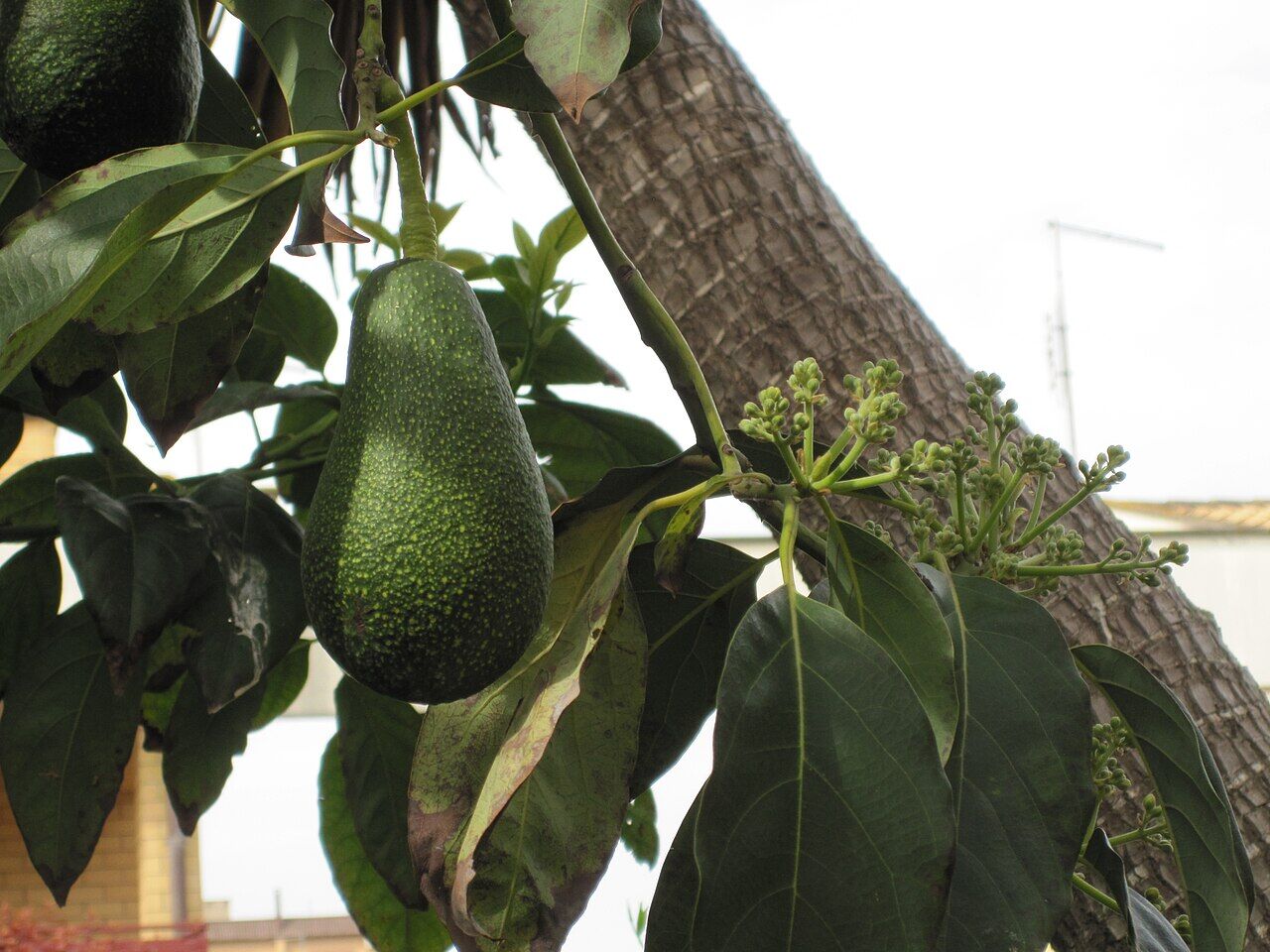
Avocado (Persea americana) is an evergreen tree that grows to about 9 to 20 m tall, with a grey-brown bark. Its leaves are simple (one blade per stalk) and arranged alternately along the twig, and they are large and oval to elliptic or lanceolate (narrow with a pointed tip). One source gives the leaves as 7 to 41 cm long, while another describes them as up to about 20 cm long; the upper surface is shiny, leathery and dark green, and the young leaves are pinkish or reddish before turning bright green. The veins are very clear. The flowers are pale yellow and grow in large heads at the ends of the branches, and only a small share of them produce fruit. The fruit is a berry, round to pear-shaped and up to about 25 cm long, holding one large seed. Leaf edge and leaf smell are not described in the sources read.
Where it grows
The Kenyan factsheet says avocado grows in a wide range of conditions, from highland to lowland, and that varieties are adapted to different climates. Other habitat details are not documented in the sources read.
- In Nigeria
- GBIF holds 65 occurrence records from Nigeria (occurrence search for country NG). The sources read do not name the states or regions where it grows. Ethnobotany surveys in Osun and Lagos States record avocado use, but these were places where people were interviewed, not confirmed growing sites.
Scientific details
- Scientific name
- Persea americana Mill.
- Family
- Lauraceae
Sources
Not yet reviewed Drafted with AI from the sources below. Treat with care.
- Persea americana. Useful Trees factsheet for Kenya. World Agroforestry Centre (ICRAF).
- Orwa et al.. Persea americana. Agroforestry Database 4.0. World Agroforestry Centre (ICRAF), 2009.
- Persea americana. Agroforestry Database 4.0 species profile. World Agroforestry Centre (ICRAF).
- Persea americana. Useful Tropical Plants.
- Lawal IO, Olufade II, Rafiu BO, et al.. Ethnobotanical Survey of Plants Used for Treating Cough Associated with Respiratory Conditions in Ede South Local Government Area of Osun State, Nigeria. Plants (Basel), 2020. PMID 32443771.
- Mukaila YO, Oladipo OT, Ogunlowo I, et al.. Which Plants for What Ailments: A Quantitative Analysis of Medicinal Ethnobotany of Ile-Ife, Osun State, Southwestern Nigeria. Evidence-Based Complementary and Alternative Medicine, 2021. PMID 34394387.
- Ojo OA, Amanze JC, Oni AI, et al.. Antidiabetic activity of avocado seeds (Persea americana Mill.) in diabetic rats via activation of PI3K/AKT signaling pathway. Scientific Reports, 2022. PMID 35190649.
- Eyong ED, Iwara IA, Agwupuye EI, et al.. In vitro and in silico pharmaco-nutritional assessments of some lesser-known Nigerian nuts: Persea americana, Tetracarpidium conophorum, and Terminalia catappa. PLOS ONE, 2025. PMID 40202972.
- Rafiu BO, Omotayo AO, Lawal IO, Aremu AO. Ethnobotanical uses of plants in Nigeria: an analysis of current research trends and patterns. Journal of Ethnobiology and Ethnomedicine (BMC), 2025. PMID 40841969.