Stonebreaker
- Yoruba Eyin olobe
Phyllanthus amarus · also called Carry me seed, Gale of wind, Hurricane weed

What it is used for
- Fever traditional use
- Diarrhoea, dysentery and stomach-ache leaf · traditional use
- Diabetes sap · traditional use
- Malaria lab tests only
- Liver protection lab tests only
Tap a use to read how it is prepared and how well it is supported.
How each use is prepared
Parts used: leaf.
Fever
Traditional useFever
People use it this way, but it has not been tested.
Reported in a Yoruba inventory of useful plants as used for fever. No preparation, dose or human study for this use was found in the sources read, so the use is weakly documented. [3]
Diarrhoea, dysentery and stomach-ache
Traditional useStomach and digestion · leaf
How it is prepared: Leaves are reported as used for these complaints (PROTA); Kenya uses a leaf maceration for stomach-ache.
People use it this way, but it has not been tested.
Reported in PROTA's medicinal-use section and, for dysentery, in the Yoruba inventory. These are traditional reports without experimental support in the sources read. [1][3]
Diabetes
Traditional useBlood sugar · sap
How it is prepared: Sap is reported as used in Congo and DR Congo (PROTA); the Yoruba inventory also lists diabetes.
People use it this way, but it has not been tested.
Traditional reports only. The sources read include laboratory and animal studies of antidiabetic activity, but no human trial was found, so this use is not evidence that it lowers blood sugar in people. [1][3][5]
Malaria
Lab or animal studiesMalaria · animal study only
Tested in the laboratory or in animals, not in people.
An alkaloid-rich extract was tested in 35 mice infected with Plasmodium berghei, a malaria parasite of rodents, and reported an antimalarial therapeutic index of 30.13. This is an animal study only. No human trial was found in the sources read, so it does not show that the plant treats malaria in people. [4]
Liver protection
Lab or animal studiesOther · laboratory and animal studies
Tested in the laboratory or in animals, not in people.
A review lists hepatoprotective (liver-protecting) activity among the reported effects of the plant. These are laboratory and animal findings, and the review does not show benefit in people. [5]
Safety
In one mouse study, an extract showed no deaths and no liver test changes at doses up to 5000 mg/kg, but that is an animal study and not proof of safety for people. No human safety data for pregnancy, breastfeeding or children were found in the sources read, and laboratory studies suggest the plant can affect how some drugs are handled by the body. Do not take it in pregnancy, while breastfeeding, by children, or with prescription medicines without advice from a health worker.
Poisoning and overdose
- In a mouse study, the LD50 (the dose that kills half the animals) was above 5000 mg/kg, with no deaths and no liver biochemical changes up to 5000 mg/kg. [4]
If you take other medicines
- Laboratory studies only: extracts activated P-gp and PXR, proteins that affect how the body handles many drugs. [5]
- Laboratory studies only: an interaction with 5-fluorouracil was reported in HepG2 liver cells in culture. [5]
Pregnancy and breastfeeding
- Data are lacking. No pregnancy or breastfeeding studies were found in the sources read.
Children
- Data are lacking. No studies of use in children were found in the sources read.
About this plant
Phyllanthus amarus is a small annual herb, known in Yoruba as eyin olobe, that is used in folk medicine for fever, digestive complaints and diabetes. Animal studies exist, but no human safety data were found in the sources read, so it should not be taken in pregnancy, by children, or with prescription medicines without advice from a health worker.
How to recognise it
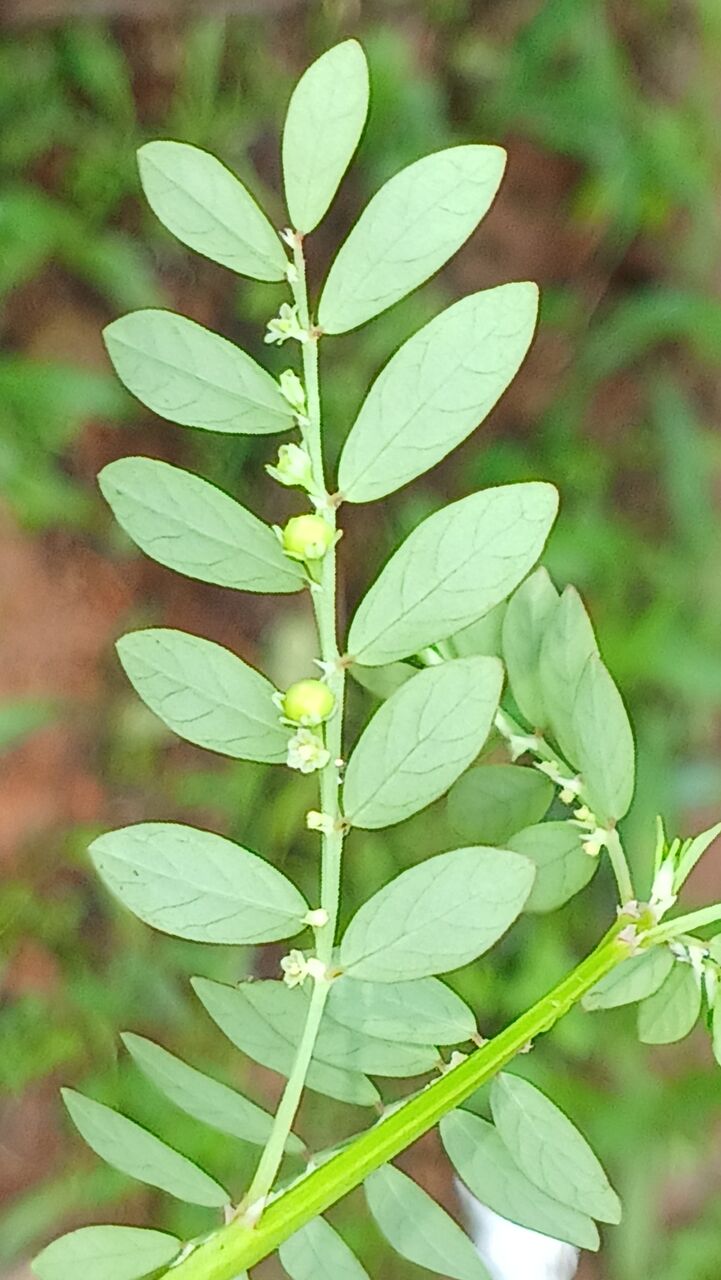
Phyllanthus amarus is an erect, glabrous (smooth), annual herb, reddish in colour, that grows up to about 60 cm, though many plants are under 30 cm. Its leaves are alternate and arranged in two rows (distichous) along flattened side branches, with simple, untoothed (entire), stalkless (sessile) blades that are oblong to elliptical, about 7 to 12 mm long and 3 to 6 mm wide. Its small flowers are pale green and often flushed red, and grow one or two in each leaf axil (the angle between leaf and stem). The fruit is a small, hanging, three-lobed capsule about 2 to 2.5 mm long that holds six seeds, each about 1 mm; the capsules can burst open explosively and scatter seed. The whole plant is easy to miss because it is small and grows low among weeds.
Plants it can be confused with
- Phyllanthus fraternus: PROTA states that pharmacological literature has confused P. fraternus with P. amarus. The sources read do not compare the two species for toxicity, so do not assume they share the same properties.
Where it grows
A weed of villages, gardens and cultivated fields, and of open localities up to about 1,000 m altitude (Useful Tropical Plants).
- Native to
- Tropical America is given as its origin, and it has since spread widely through the tropics, including Africa (PROTA).
- In Nigeria
- GBIF holds 151 occurrence records from Nigeria. The Yoruba plant inventory records it among useful plants of southwestern Nigeria; no state is named.
Scientific details
- Scientific name
- Phyllanthus amarus Schumach. & Thonn.
- Family
- Phyllanthaceae
Sources
Not yet reviewed Drafted with AI from the sources below. Treat with care.
- Phyllanthus amarus (PROTA) - Pl@ntUse. PROTA (Plant Resources of Tropical Africa), Wageningen; year given is the access date, 2026.
- Phyllanthus amarus - Useful Tropical Plants. Useful Tropical Plants database.
- Wandering through southwestern Nigeria: An inventory of Yoruba useful angiosperm plants. Heliyon, 2022. PMID 35024488.
- Safety and antimalarial therapeutic index of alkaloid-rich extract of Phyllanthus amarus Schumach. & Thonn. in mice. Heliyon, 2023. PMID 38076132.
- An insight into the potent medicinal plant Phyllanthus amarus Schum. and Thonn.. The Nucleus, 2022.
- GBIF species match: Phyllanthus amarus Schumach. & Thonn. (usageKey 5382589). Global Biodiversity Information Facility.
- GBIF occurrence search: Phyllanthus amarus, country NG (count 151). Global Biodiversity Information Facility.