Akuamma
- Yoruba Eso Abere
Picralima nitida

What it is used for
- Fever and malaria seed, bark, root · traditional use
- Pain relief seed · lab tests only
- Intestinal worms seed · lab tests only
- Stomach problems and colitis seed · lab tests only
Tap a use to read how it is prepared and how well it is supported.
How each use is prepared
Parts used: seed, bark, root.
Fever and malaria
Traditional useMalaria · seed, bark, root
How it is prepared: Seeds or bark crushed and chewed or eaten, as reported in PROTA.
People use it this way, but it has not been tested.
PROTA says the seeds, bark and roots have a reputation as a febrifuge and a remedy for malaria across the plant's range. PROTA also reports in vitro activity against Plasmodium falciparum, including chloroquine-resistant strains. The traditional use is not evidence that the plant treats malaria. Malaria needs prompt diagnosis and tested treatment. [1]
Pain relief
Lab or animal studiesPain and swelling · seed · analgesic
Tested in the laboratory or in animals, not in people.
PROTA reports that seed extracts have analgesic activity comparable to morphine in rats. The analgesia is linked to opioid receptor activity, which is why PROTA flags the risk of addiction and dependence. No human trial was opened. [1]
Intestinal worms
Lab or animal studiesWorms and parasites · seed · anthelmintic
How it is prepared: Extract given by mouth in a mouse study (dose 500 mg/kg).
Tested in the laboratory or in animals, not in people.
In a mouse study of Heligmosomoides bakeri, a 500 mg/kg P. nitida extract suppressed the parasite by about 92% (chemosuppression), close to albendazole at about 93%. Mouse results do not show the same effect in people. The study used a mouse parasite, not human worms. [4]
Stomach problems and colitis
Lab or animal studiesStomach and digestion · seed
Tested in the laboratory or in animals, not in people.
PROTA lists stomach problems among traditional uses. A rat study of acetic acid-induced colitis found that a total crude alkaloid extract of the seeds protected the colon and was compared with sulphasalazine. This is animal evidence only and does not show the extract is safe or effective for people. [1][3]
Safety
The seeds contain opioid-acting alkaloids. In rat tests, the seed extract relieved pain at a level comparable to morphine, and PROTA flags the potential for addiction and dependence. There are no human safety data, so do not use the plant without medical advice, and do not combine it with opioids or other sedatives.
Side effects
- The seed alkaloids act on opioid receptors in laboratory tests. PROTA flags the potential for addiction and dependence, which has not been studied. [1]
- Akuammine has strong sympathomimetic and local analgesic activity. In dogs it caused marked and lasting low blood pressure without affecting breathing, according to PROTA. [1]
Poisoning and overdose
- In rats, acute intraperitoneal toxicity was dose-dependent (PROTA). No oral human toxicity data were opened. [1]
- A mouse study used extracts in an acute toxicity test with doses up to 5000 mg/kg. The outcome is not summarised in this record. [4]
If you take other medicines
- No interaction study was opened. Because the seeds contain opioid-acting alkaloids, tell a clinician about use alongside opioids or other sedatives. This is a precaution, not a sourced interaction. [1]
Pregnancy and breastfeeding
- Not documented in the sources read.
Children
- Not documented in the sources read.
About this plant
A shrub or tree whose seeds, bark and roots are used in West and Central African traditional medicine, including for fever and malaria. The seeds contain opioid-acting alkaloids, and there are no human safety data for the plant, so it should not be taken to treat illness without medical advice.
How to recognise it
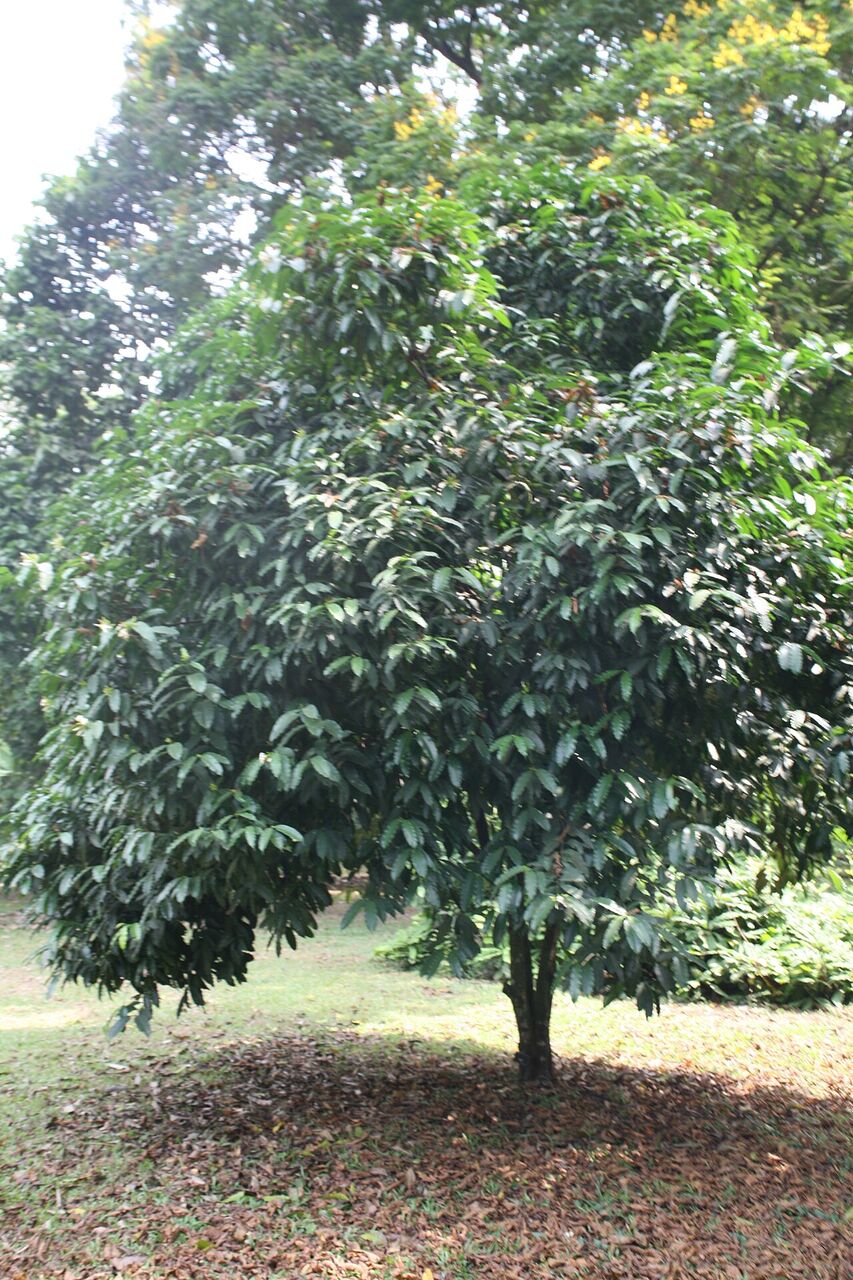
Picralima nitida is a shrub or tree that can grow up to about 35 m tall, with a bole up to about 60 cm across. All parts contain a white latex, and the plant is hairless (glabrous). The leaves are opposite (two per node), simple (one blade, not divided) and entire (smooth-edged), with no stipules. Each leaf has a petiole (leaf stalk) about 1 to 2 cm long. The blade is elliptical to oblong, about 5 to 26 cm long and 2 to 13 cm wide, with a wedge-shaped base, a sharply pointed tip, and 14 to 23 pairs of side veins. The leaves are thick and papery to thinly leathery. Flowers and fruits are not described in the sources read.
Where it grows
- Native to
- Côte d'Ivoire east to Uganda, and south to DR Congo and Cabinda (Angola) (PROTA).
- In Nigeria
- Listed among the useful angiosperms of southwestern Nigeria with the Yoruba name Eso Abere (Ajao et al., 2022). The survey text read does not give a finer locality.
Scientific details
- Scientific name
- Picralima nitida (Stapf) T.Durand & H.Durand
- Family
- Apocynaceae
- Main compounds
- akuammidine, akuammine, pseudo-akuammigine, akuammicine, akuammigine
Sources
Not yet reviewed Drafted with AI from the sources below. Treat with care.
- PROTA (Plant Resources of Tropical Africa). Picralima nitida (Stapf) T.Durand & H.Durand (PROTA species record). Pl@ntUse, PROTA.
- Ajao AA, Mukaila YO, Sabiu S. Wandering through southwestern Nigeria: An inventory of Yoruba useful angiosperm plants. Elsevier, 2022. PMID 35024488.
- Acetic acid-induced colitis modulating potential of total crude alkaloidal extract of Picralima nitida seeds in rats. Europe PMC (PMC10165953).
- In vivo anthelmintic potentials of Gongronema latifolium and Picralima nitida against gastrointestinal parasite (Heligmosomoides bakeri). Europe PMC (PMC10787636).
- Picralima nitida (Stapf) T.Durand & H.Durand GBIF species record (backbone taxonomy). Global Biodiversity Information Facility.