Castor oil plant
- Yoruba Eso laa
Ricinus communis · also called Castor

What it is used for
- Laxative seed · traditional use
- Headache and boils leaf · traditional use
- Birth control seed · traditional use
- Wounds, swellings and skin infections leaf · lab tests only
Tap a use to read how it is prepared and how well it is supported.
How each use is prepared
Parts used: leaf, seed.
Laxative
Traditional useStomach and digestion · seed · purgative use of castor oil
People use it this way, but it has not been tested.
PROTA states that castor oil is used primarily as a purgative in medicine, and Useful Tropical Plants calls the oil a very well-known laxative used for over 2,000 years. Both sources describe long-standing use; no trial of this use was read. Castor oil can cause diarrhoea (see safety). [1][2]
Headache and boils
Traditional useSkin · leaf
How it is prepared: Leaves applied as a poultice
People use it this way, but it has not been tested.
Useful Tropical Plants reports that the leaves are used as a poultice to relieve headaches and treat boils, citing a glossary of Indian medicinal plants. No study of this use was read. The same source calls the leaves only mildly poisonous, whereas PROTA says young leaves are more toxic. [2][1]
Birth control
Traditional useWomen's health · seed
People use it this way, but it has not been tested.
A 2025 survey of medicinal plants used to control birth in four Nigerian states recorded castor (Eso laa, Yoruba) with seed as the part used. The survey reports only that the plant is used this way. It does not show that castor prevents pregnancy, and because the seeds are poisonous this is not a safe or reliable method. [5]
Wounds, swellings and skin infections
Lab or animal studiesWounds · leaf · antimicrobial studies
How it is prepared: Leaves used as a poultice, as reported in the review
Tested in the laboratory or in animals, not in people.
A 2025 review states that African and Middle Eastern societies have used the leaves as poultices for wounds and swellings. It also summarises laboratory (in vitro) and animal (in vivo) studies of antimicrobial activity against surgical site infection bacteria. The underlying lab and animal studies were not opened, so their strength, doses and relevance to people are not known, and no human trial was read. [6]
Safety
Raw castor seeds and the pressed seed cake are poisonous because they contain ricin, and a case report describes poisoning after a person swallowed six castor beans. Do not chew or eat the seeds, and do not use the plant or its preparations for pregnancy, labour, birth control or any other purpose without medical advice. Seek urgent medical care after any suspected ingestion of castor seeds.
Side effects
- Castor oil taken by mouth commonly causes diarrhoea and nausea, as reported in a cohort study of castor oil for labour induction. [4]
- Castor seeds are allergenic and may cause asthmatic reactions in sensitive people, according to PROTA. [1]
Poisoning and overdose
- The seeds (castor beans) contain ricin and are the most poisonous part. A case report describes ricin poisoning in a 47-year-old woman after she swallowed six castor beans. [3]
- The presscake, the solid residue left after the oil is pressed from the seeds, is poisonous and allergenic. PROTA says it is mainly used as fertiliser or fuel and that methods to detoxify it exist. [1]
- Useful Tropical Plants describes the whole plant as very poisonous and the leaves as only mildly poisonous, while PROTA says young leaves are more toxic. Leaves should not be eaten, and the sources disagree about how toxic they are. [2][1]
- Castor oil is a different product from the raw seeds and presscake, and the oil is the form used as a laxative. The sources read do not show whether the pressing process removes all ricin, so home-pressed oil and raw seeds must not be treated as the same thing. [1][4]
Pregnancy and breastfeeding
- PROTA says castor oil given by mouth is used to induce labour in pregnancy at term. A cohort study titled as showing castor oil to be a safe and effective labour-induction method notes in its introduction that guidelines do not recommend it. Castor seeds, leaves and seed cake must not be used in pregnancy. Castor oil should not be taken in pregnancy without medical supervision. No breastfeeding data were found in the sources read. [1][4]
Children
About this plant
The castor oil plant is a fast-growing shrub with large, hand-shaped leaves, grown across the tropics for its oil. Its seeds and the solid cake left after the oil is pressed out contain ricin, a very poisonous protein, so the seeds must never be chewed or eaten.
How to recognise it
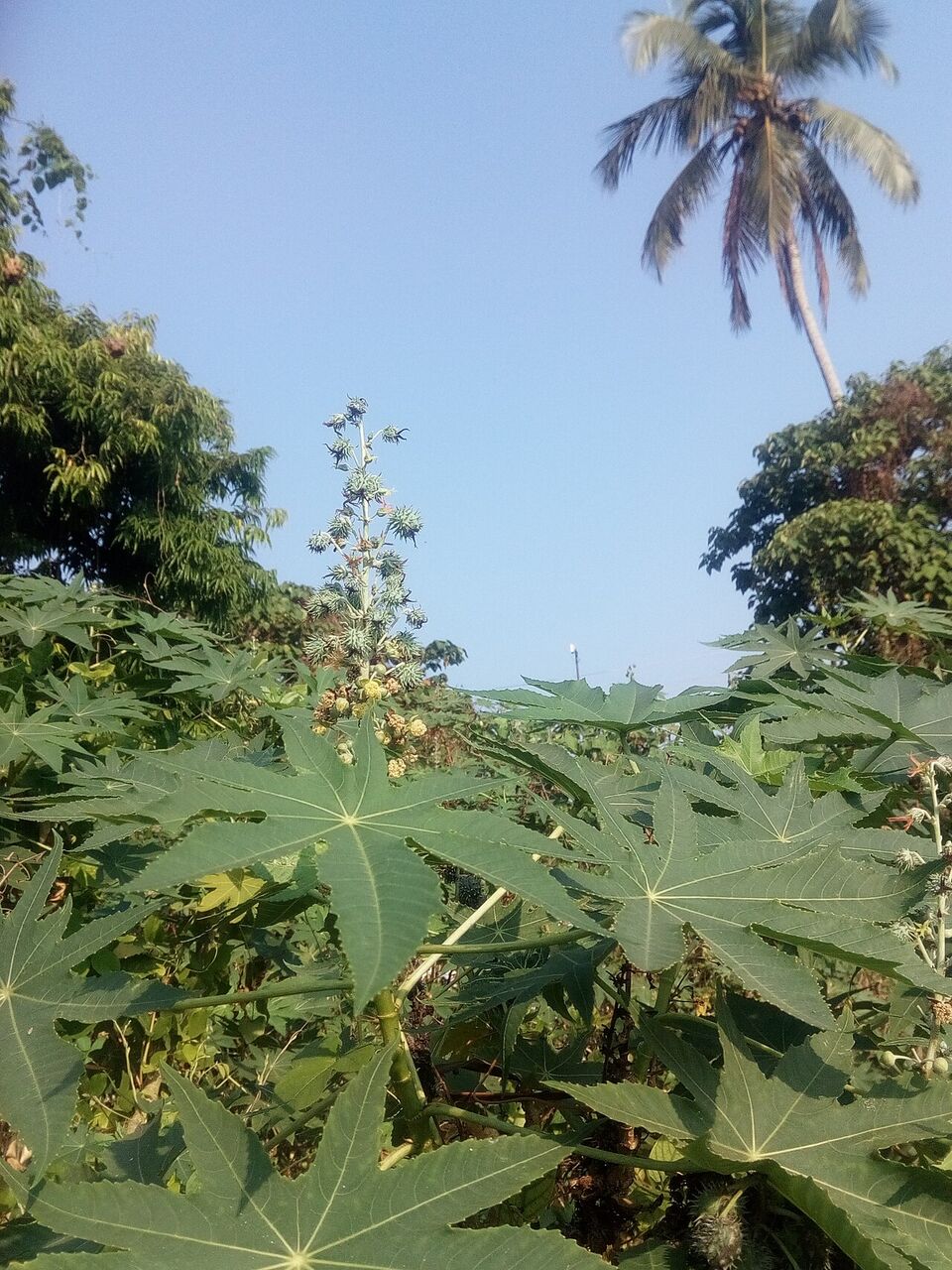
The castor oil plant is a much-branched, short-lived perennial shrub with stout, hollow stems, which Useful Tropical Plants gives as about 1.5 m tall, while PROTA reports plants up to 7 m. Its leaves are arranged spirally (one leaf at each point along the stem, set around it in a turning pattern) and are simple, meaning each leaf is a single blade rather than split into leaflets. Each leaf has a stalk (petiole) 3.5 to 50 cm long and a thin blade up to about 50 cm across, occasionally 70 cm, cut into 5 to 12 lobes that spread from one point like the fingers of a hand (palmately lobed). The leaf edge bears small glandular teeth (tiny gland-tipped notches), and two leaf-like stipules 1 to 3 cm long clasp the stem where each leaf joins it, falling off early. The flowers are unisexual, meaning male and female flowers occur separately on the same plant, and they have no petals; they are borne in an erect branched cluster (panicle) up to 40 cm long at the ends of the branches. The fruit is a rounded capsule (a dry fruit that splits open when ripe) that releases seeds 9 to 17 mm long.
Where it grows
Useful Tropical Plants states that the species is not known in a truly wild situation. Wild habitat is otherwise not documented in the sources read.
- Native to
- PROTA states that it is indigenous to north-eastern tropical Africa. Useful Tropical Plants describes its original home as obscure, but probably north-west Africa, so the two sources differ.
- In Nigeria
- GBIF holds 117 occurrence records from Nigeria. No source read names the states or regions where it grows.
Scientific details
- Scientific name
- Ricinus communis L.
- Family
- Euphorbiaceae
- Main compounds
- ricin, ricinoleic acid
Sources
Not yet reviewed Drafted with AI from the sources below. Treat with care.
- Maroyi A.. Ricinus communis L. (PROTA record). PROTA (Plant Resources of Tropical Africa), Pl@ntUse, 2007.
- Ricinus communis - Useful Tropical Plants. Useful Tropical Plants database.
- Noumi Noumi LJ, El-Hanna S, Reine Sandrine Mendeuka NM, et al.. Ricin intoxication by lethal dose of castor seeds ingestion: a case report.. J Med Case Rep, 2024. PMID 39210364.
- Jakubowski P, Hoffmann D, Schönfisch B, et al.. Castor Oil for Induction of Labor: A Safe and Effective Method: A Large Retrospective Cohort Study in a University Hospital Setting.. Healthcare (Basel), 2026. PMID 41754009.
- Ibrahim MB, Odewo AS, Lawal BA, et al.. Traditional contraceptive practices: survey of medicinal plants used to control birth in four states in Nigeria.. BMC Complement Med Ther, 2025. PMID 40490736.
- Arya AK, Kumar G, Singh V, et al.. Unveiling the Antimicrobial Potential of Ricinus communis: A Comprehensive Review of Its Relevance to Surgical Site Infection (SSI) Pathogens.. Cureus, 2025. PMID 41573499.
- GBIF Backbone Taxonomy: species match for Ricinus communis (accepted, exact match, usageKey 5380041). GBIF.
- GBIF occurrence search: Ricinus communis in Nigeria (country NG, taxonKey 5380041; count 117). GBIF.