Violet tree
- Hausa Uwar magunguna, Sanya
Securidaca longepedunculata · also called Fibre tree, Rhodesian violet

What it is used for
- Eye complaints, such as conjunctivitis root · traditional use
- Malaria root · traditional use
- Stomach problems and dysentery root · traditional use
- Rheumatism root · traditional use
- Young leaves as a vegetable leaf · traditional use
- Seizure-like paroxysms lab tests only
- Diabetes root · lab tests only
Tap a use to read how it is prepared and how well it is supported.
How each use is prepared
Parts used: root, leaf, bark.
Eye complaints, such as conjunctivitis
Traditional useOther · root
People use it this way, but it has not been tested.
Reported in the Agroforestree profile as a root remedy for eye complaints. Roots are toxic in excess (see safety). No experimental work on this use was found in the sources read. [1]
Malaria
Traditional useMalaria · root
People use it this way, but it has not been tested.
Reported in the Agroforestree profile as a root remedy for malaria. No experimental work on this use was found in the sources read. [1]
Stomach problems and dysentery
Traditional useStomach and digestion · root
People use it this way, but it has not been tested.
Roots in small doses are reported as purgative, diuretic, diaphoretic and emetic, and drastic and dangerous in larger doses (Agroforestree profile). No experimental work on these uses was found in the sources read. [1]
Rheumatism
Traditional usePain and swelling · root
People use it this way, but it has not been tested.
Reported in the Agroforestree profile as a root remedy for rheumatism. No experimental work on this use was found in the sources read. [1]
Young leaves as a vegetable
Traditional useNutrition · leaf
People use it this way, but it has not been tested.
The Agroforestree profile reports that young leaves are eaten as a vegetable or in sauces. This is a food use reported in one source, not a medicinal use. [1]
Seizure-like paroxysms
Lab or animal studiesOther · zebrafish study
Tested in the laboratory or in animals, not in people.
In a zebrafish study, extracts inhibited seizure-like paroxysms induced by a convulsant drug. The authors suggest antiepileptic promise. This is animal evidence only, with no human testing. The study also found toxicity, and an ethanol extract and benzyl benzoate caused paradoxical excitation. [4]
Diabetes
Lab or animal studiesBlood sugar · root · alloxan-diabetic rats
Tested in the laboratory or in animals, not in people.
In alloxan-diabetic rats, extracts at 100, 200 and 400 mg/kg were tested, and 200 and 400 mg/kg in a sugar-tolerance test. The study title describes the extracts as reversing experimental diabetes. This is animal evidence only. The study compared them with glibenclamide, and the liver and kidney findings are conflicting (see safety and review notes). [5]
Safety
The roots are the most dangerous part. A saponin in the roots can damage bone marrow and cause the breakdown of red blood cells, and the root bark contains methyl salicylate, which can poison severely in amounts of 10 to 30 ml. Data from animal and zebrafish studies only. There are no human safety studies in the sources read, so it cannot be called safe for people.
Side effects
- Not documented in the sources read for people. [1]
Poisoning and overdose
- The trees, especially the roots, are a toxicity risk if taken in excess. [1]
- A saponin in the roots can cause severe damage to bone marrow and haemolysis (breakdown of red blood cells) when in contact with blood. [1]
- The solid portion of the root is said to be the most lethal part. [1]
- The root bark contains 0.42% methyl salicylate. About 10 to 30 ml of methyl salicylate can cause severe poisoning. [1]
- Roots in small doses are purgative, diuretic, diaphoretic and emetic, and drastic and dangerous in larger doses. [1]
- In the diabetes study in rats, the abstract reports no adverse effect on the liver and kidney. The full text reports some degree of hepatotoxicity (liver toxicity) and possible hepatotoxicity at relatively high doses. [5]
If you take other medicines
- Data lacking. No drug interaction studies were found in the sources read. The rat diabetes study used glibenclamide as a comparison, not to test interactions. [5]
Pregnancy and breastfeeding
- Data lacking. No pregnancy studies were found in the sources read. Given the root toxicity described in the Agroforestree profile, use in pregnancy cannot be called safe. [1]
Children
- Data lacking. No safety data for children were found in the sources read. The root toxicity described in the Agroforestree profile applies. [1]
About this plant
A tree of the milkwort family, known as the violet tree, that grows across much of Africa. Its roots and root bark are poisonous if taken in excess, and the root contains a saponin that can damage the bone marrow and blood. Its traditional uses are wide, but the only experimental studies found are in animals and zebrafish.
How to recognise it
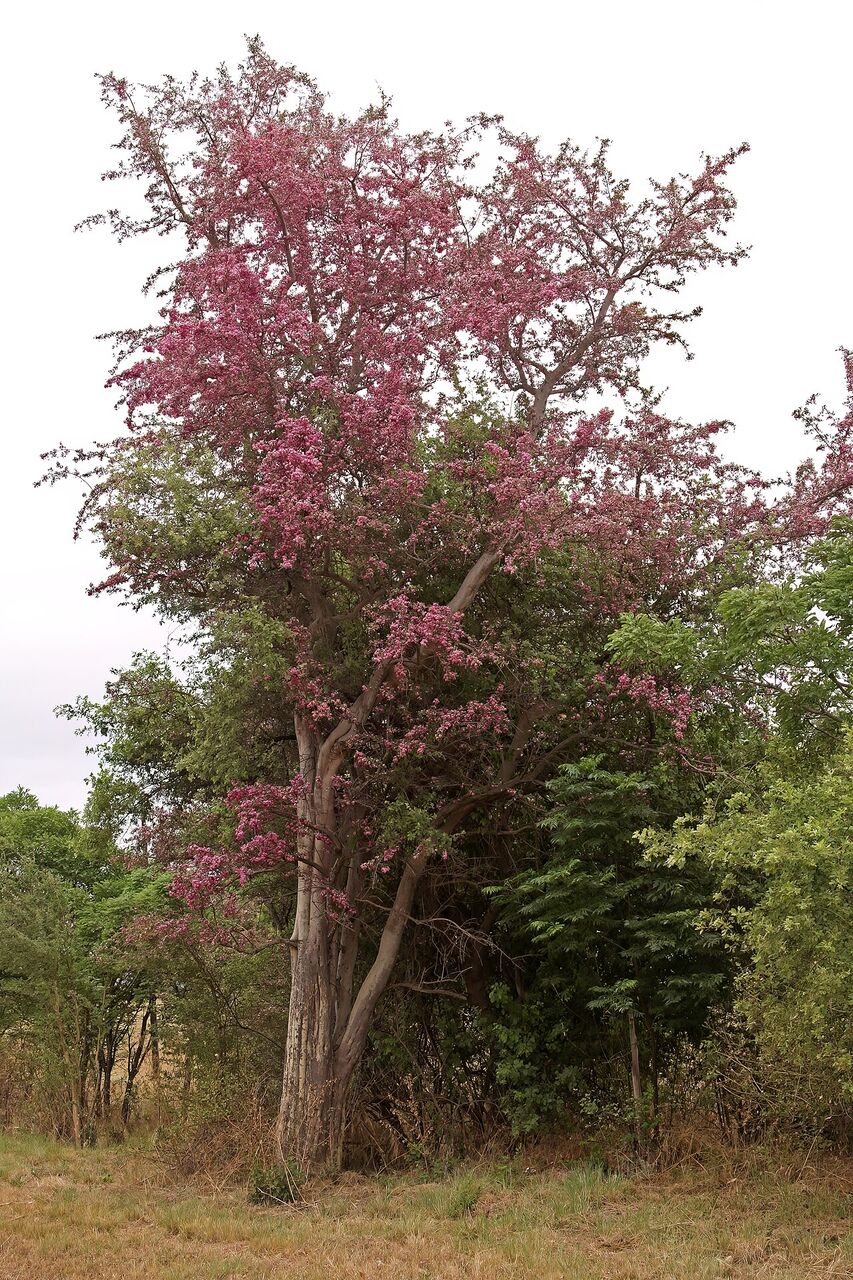
A tree whose flowers are about 10 mm long, pink to lilac or purple, sweetly scented, and carried on long slender stalks in terminal sprays 3 to 5 cm long. The flowers appear with the very young leaves (Agroforestree profile). The fruit is flat and hatchet-shaped, which gives the genus its name, and it stays on the tree for a year or more (Agroforestree profile). The Commons photos show the tree in flower in savannah and the dry fruit. Identification here rests on the source descriptions and the Commons photos listed below.
Where it grows
Found in a wide range of climates, from hot, arid subtropical areas to summer-rainfall and equatorial humid areas. It grows in vegetation from semi-arid scrub to dense forest, including woodland, bush and gallery forest (Agroforestree profile).
- Native to
- Africa. The Agroforestree profile lists Nigeria within its native range.
- In Nigeria
- Agroforestree lists Nigeria within the native range, but names no state. GBIF has 105 occurrence records with country=NG. This is a record count only, not a map of where it grows.
Scientific details
- Scientific name
- Securidaca longepedunculata Fresen.
- Family
- Polygalaceae
- Older names
- Elsota longipedunculata (Fresen.) Kuntze, Lophostylis angustifolia Hochst., Lophostylis oblongifolia Hochst., Lophostylis pallida Klotzsch, Securidaca angustifolia (Hochst.) Miq., Securidaca longepedunculata var. angustifolia Robyns, Securidaca oblongifolia Benth. & Hook.f., Securidaca oblongifolia Benth. & Hook.f. ex Sond., Securidaca spinosa Sim
- Main compounds
- saponin, methyl salicylate
Sources
Not yet reviewed Drafted with AI from the sources below. Treat with care.
- Securidaca longepedunculata species profile (World Agroforestry tree database). World Agroforestry (ICRAF).
- GBIF species match: Securidaca longepedunculata. Global Biodiversity Information Facility.
- GBIF occurrence search, country=NG, Securidaca longepedunculata (record count). Global Biodiversity Information Facility.
- Inhibition of Seizure-Like Paroxysms and Toxicity Effects of Securidaca longepedunculata Extracts and Constituents in Zebrafish Danio rerio.. American Chemical Society (DOI 10.1021/acschemneuro.3c00642), 2024. PMID 38270158.
- Hypoglycaemic Principles of Securidaca longepedunculata Extracts Reverses Experimental Diabetes and Diabetes Associated Pathology in Wistar Albino Rats.. DOI 10.1155/bri/7173019 (journal not recorded in the sources read), 2025. PMID 40778292.