Ringworm bush
- Igbo Ogala, Omirima
- Yoruba Asunwon oyinbo
- Hausa Rai dore
Senna alata · also called Candle bush
.jpg)
What it is used for
- Laxative or purgative leaf · traditional use
- Skin problems, including ringworm and herpes leaf · traditional use
- Scabies leaf · tested in people
- Worms and Guinea worm infection leaf, root · traditional use
- Diabetes leaf · traditional use
Tap a use to read how it is prepared and how well it is supported.
How each use is prepared
Parts used: leaf, pod, root, bark.
Laxative or purgative
Traditional useStomach and digestion · leaf · to empty the bowels
How it is prepared: Decoction of the leaves, as reported by PROTA.
People use it this way, but it has not been tested.
PROTA names a leaf decoction as its main laxative use. A 2024 review reports that all parts of the plant are used as laxatives in Cuba, Nigeria and Egypt. The laxative compounds are anthraquinones. No clinical study of this use was found in the sources read, so the evidence is traditional only. [2][1][6]
Skin problems, including ringworm and herpes
Traditional useSkin · leaf
How it is prepared: Leaf sap or fresh leaves rubbed on the skin (PROTA); squeezed leaf juice applied to the affected area (Yoruba use recorded in a 2026 review).
People use it this way, but it has not been tested.
PROTA reports leaf sap or fresh leaves rubbed on the skin for skin problems. A 2026 review records Yoruba use of squeezed leaf juice on dermatitis. A 2024 review reports skin illnesses such as herpes treated with the plant in Cuba, Nigeria and Egypt. No controlled study of ringworm or herpes in people was found in the sources read, so the evidence is traditional only. [1][2][6][8]
Scabies
Studied in peopleSkin · leaf
How it is prepared: Dried leaves boiled and applied to the skin, at 80% and 50% concentrations, as used in the trials reviewed.
Tested in at least one human study. Read the note for how strong the result is.
A 2025 systematic review pooled two small randomised trials of this preparation against placebo (157 patients) and one trial against 10% crotamiton, a standard scabies cream (64 patients). Against placebo the pooled relative risk was 4.94 (95% CI 1.67 to 14.62). The review rated the certainty of this evidence as very low, and the crotamiton comparison as low. It states that adequately powered trials are needed. These trials were done in the Philippines and are not a record of Nigerian use. The review also notes that the Philippine Department of Health lists this plant among the scientifically validated plants for antifungal use. [7]
Worms and Guinea worm infection
Traditional useWorms and parasites · leaf, root
How it is prepared: Preparation not specified in the sources read.
People use it this way, but it has not been tested.
A 2022 inventory of Yoruba useful plants lists the plant as an anthelmintic (a remedy for worms). A 2025 Nigerian survey records its leaves and root for Guinea worm infection. No clinical study was found in the sources read, so the evidence is traditional only. [4][5]
Diabetes
Traditional useBlood sugar · leaf · survey report only
How it is prepared: Leaves macerated (soaked) and taken by mouth, as recorded in an Ogun State survey.
People use it this way, but it has not been tested.
A 2025 Nigerian ethnobotanical survey records this use in Ogun State. No trial of blood-sugar effects in people was found in the sources read, so this entry records a reported use and is not evidence that the plant lowers blood sugar. [5]
Safety
Senna alata is used as a laxative and on the skin, but the sources read give little safety information. It is reported to be poisonous to goats, and a strong decoction of the dried leaves is reported to be used to end pregnancy. Safety data for pregnancy, breastfeeding and children are lacking, so do not use it in these groups unless a health worker advises it.
Side effects
- The sources read describe no common side effects of the laxative or skin uses. In the 2025 scabies review, no serious adverse events were reported across the trials, but the adverse-event estimates were imprecise and rated low certainty. [7]
Poisoning and overdose
- PROTA and Useful Tropical Plants report that the plant is poisonous to goats and is not eaten by livestock. [2][1]
- PROTA reports that the bark is used as a fish poison. [2]
- The plant contains anthraquinones (aloe-emodin, chrysophanol, isochrysophanol and rhein), the compounds behind its laxative effect. [1]
- In a rat acute oral toxicity test cited by a 2024 review, no signs of toxicity were seen. This is an animal test and does not show that the plant is safe for people. [6]
Pregnancy and breastfeeding
- PROTA reports that the leaves are used for stomach pain in pregnancy, and that a strong decoction of dried leaves is used as an abortifacient (to end a pregnancy). This is a reported use, not a tested one. No safety data for pregnancy or breastfeeding were found in the sources read, so avoid use in pregnancy unless a health worker advises it. [2]
Children
About this plant
A shrub with compound leaves and bright yellow flower spikes, used in Nigerian folk medicine as a laxative and on the skin. The sources read include only small trials of its use on scabies, and they give little safety information. It is poisonous to goats, and a strong leaf decoction is reported to be used to end pregnancy, so it should not be taken by pregnant women.
How to recognise it
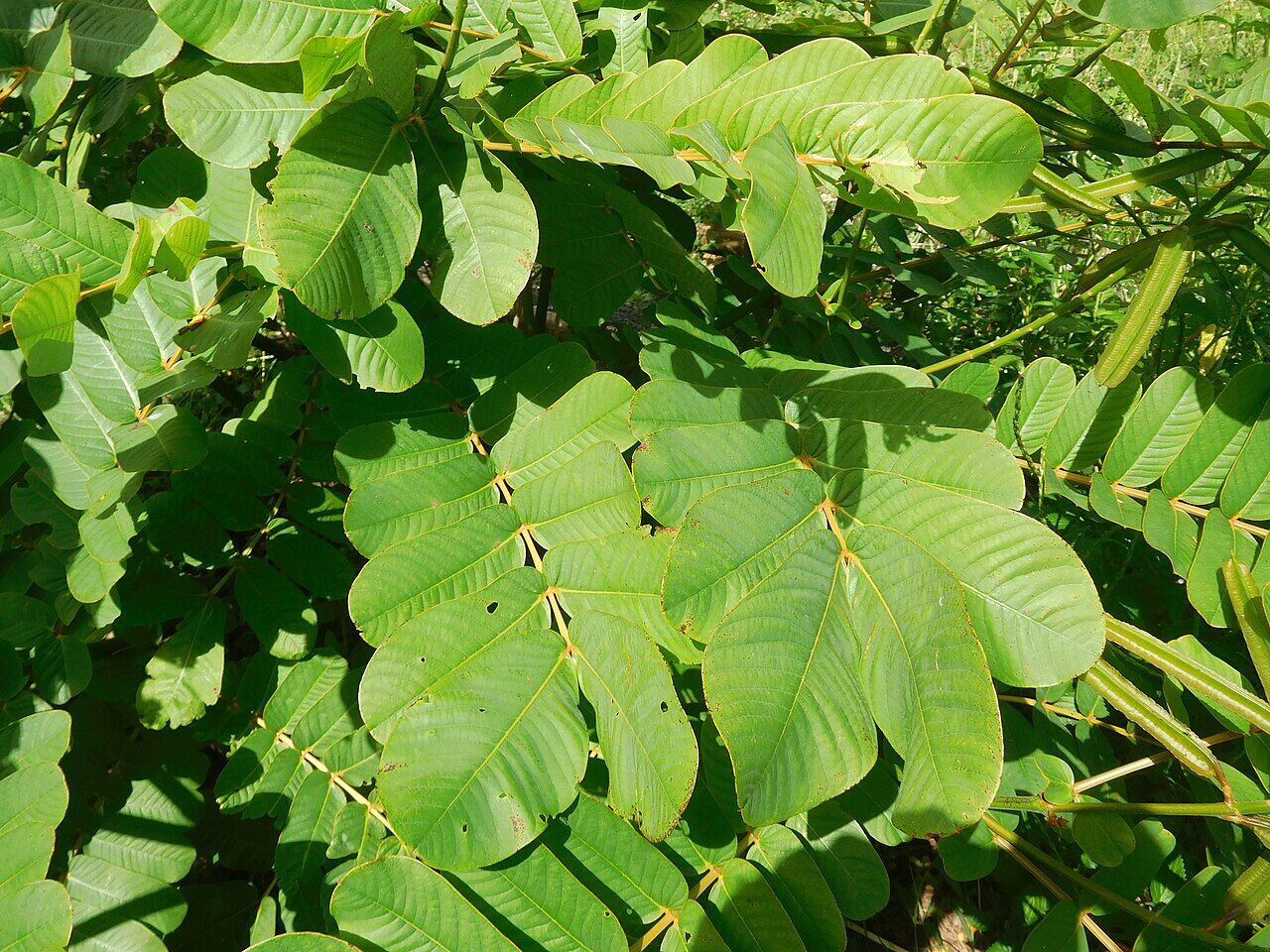
Senna alata is a deciduous shrub (a plant that sheds its leaves), usually about 2 m tall, though it can reach about 8 m. Its leaves are compound, meaning each leaf is made of many small leaflets joined to one central stalk, and the leaves are arranged alternately, spiralling up the stem. Each leaf has 8 to 20 pairs of leaflets, and each leaflet is oblong to oval, 5 to 15 cm long and 3 to 7 cm wide, with no single leaflet at the tip of the stalk. The flowers are bright yellow, with petals 16 to 24 mm long, borne in an upright cluster (raceme) 20 to 50 cm long at the ends of the branches. The fruit is a winged pod about 10 to 15 cm long that holds the seeds.
Where it grows
A weed of pastures and tropical Africa, naturalised and often found in disturbed ground (PROTA; Useful Tropical Plants).
- Native to
- Native to South America and now pantropical, meaning it grows throughout the tropics (PROTA).
- In Nigeria
- GBIF holds 114 occurrence records from Nigeria. PROTA reports the plant as naturalised and often a weed in tropical Africa.
Scientific details
- Scientific name
- Senna alata (L.) Roxb.
- Family
- Fabaceae
- Older names
- Cassia alata L.
- Main compounds
- aloe-emodin, chrysophanol, isochrysophanol, rhein
Sources
Not yet reviewed Drafted with AI from the sources below. Treat with care.
- Senna alata (L.) Roxb.. Useful Tropical Plants.
- Senna alata (PROTA). Pl@ntUse (PROTA).
- GBIF species match: Senna alata. GBIF.
- Ajao et al.. Wandering through southwestern Nigeria: An inventory of Yoruba useful angiosperm plants. Heliyon, 2022. PMID 35024488.
- Rafiu et al.. Ethnobotanical uses of plants in Nigeria: an analysis of current research trends and patterns. Journal of Ethnobiology and Ethnomedicine, 2025. PMID 40841969.
- Colin et al.. Review on Cassia alata Bioactive Compounds: In silico, in vitro, and in vivo Studies. Drug Design, Development and Therapy, 2024. PMID 39381590.
- Pasion et al.. Efficacy and Safety of Gliricidia sepium, Senna alata, and Tinospora rumphii in the Treatment of Filipino Patients with Scabies: A Systematic Review and Meta-analysis. Acta Medica Philippina, 2025. PMID 41502969.
- A scoping review on ethnobotanical uses, pharmacological and toxicological profiles of traditional medicinal plants in paediatric healthcare across Sub-Saharan Africa and South Asia. BMC Complementary Medicine and Therapies, 2026. PMID 41862891.