Coffee senna
- Igbo Sigbunmuo, Akidi-agbara
- Yoruba Jelenubenu
- Hausa Rai daure
- Nupe Gayà ebá
Senna occidentalis · also called Septic weed

What it is used for
- Constipation and digestion traditional use
- Wounds traditional use
- Weight loss leaf · traditional use
- Malaria root, leaf · lab tests only
Tap a use to read how it is prepared and how well it is supported.
How each use is prepared
Parts used: leaf, root, seed.
Constipation and digestion
Traditional useStomach and digestion · folk use
People use it this way, but it has not been tested.
A Kaduna State entry in a 2025 national survey lists the plant for constipation and for improving digestion. The table layout makes it unclear whether the parts and preparation belong to this species alone, so this use is marked as uncertain. No study of the effect on digestion was found. The sources read describe the species as often used as a laxative (a substance that loosens the bowels), which is a serious concern given the poisoning reports. [9][7]
Wounds
Traditional useWounds · folk use
People use it this way, but it has not been tested.
A Kaduna State entry in the same 2025 national survey lists the plant for wounds. The table layout is unclear, as described above. No study of wound healing was found. [9]
Weight loss
Traditional useOther · leaf · folk use
How it is prepared: Leaves ground and mixed with a cup of tea, taken by mouth, one cup a day
People use it this way, but it has not been tested.
A 2025 survey in the North Central zone reports this tea from eight informants. No study of this tea's effect on body weight was found in the sources read, so the evidence is only what people reported. [5]
Malaria
Lab or animal studiesMalaria · root, leaf · folk use
Tested in the laboratory or in animals, not in people.
The highest level found is a mouse study of a root extract, which reported that it inhibited malaria parasite growth in infected mice. A Kwara State survey records the plant in folk malaria treatment. No human trial was found, so the evidence does not show that the plant works against malaria in people. [3][4]
Safety
Senna occidentalis seeds and other parts are poisonous, and the sources read report liver failure in children and in an adult. Its folk uses rest on traditional reports and laboratory or animal work only, and no safe dose is documented, so it should not be taken without a clinician's advice.
Side effects
Poisoning and overdose
- Three children in a North Indian case series developed hepatomyoencephalopathy (liver failure with brain involvement) after poisoning by the plant. [6]
- A woman developed liver failure after Senna occidentalis poisoning, reported as an uncommon cause of liver failure. [7]
- The 2019 case report describes all parts of the plant as highly toxic to cattle and small herbivores. [7]
- An abstract reports an association between children's deaths and eating the seeds (abstract read only; full text not read). [8]
- An abstract reports raised liver enzymes and liver lesions in rats fed 0.5 to 2 percent seed in their diet for 28 days (abstract read only). [8]
If you take other medicines
- No source opened documents drug interactions. Data are lacking.
Pregnancy and breastfeeding
- No source opened addresses pregnancy. A clinician should advise before use.
Children
About this plant
Coffee senna is a shrub used in some Nigerian folk medicine, but its seeds and other parts are poisonous. The studies found so far are laboratory or animal work, and no human trial was found.
How to recognise it
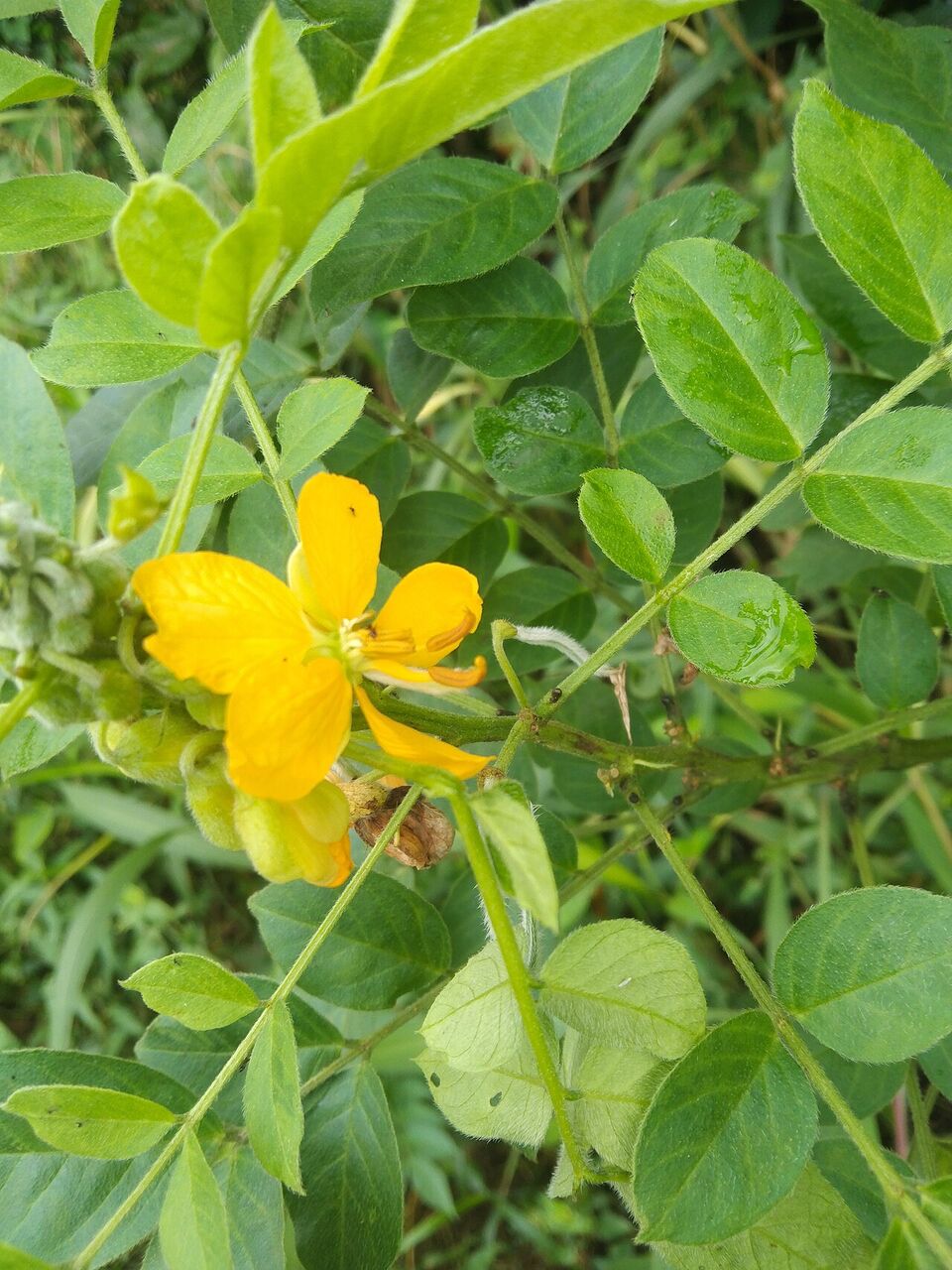
Coffee senna is an upright shrub or subshrub, about 0.5 to 1.5 m tall (one source gives up to 2 m), with partly woody stems. Its leaves are paripinnate, meaning they are made of pairs of small leaflets along a central stalk with no single leaflet at the tip, and each leaf is 15 to 20 cm long. The number and shape of the leaflets are not documented in the sources read. The flowers are yellow and grow in clusters at the ends of the stems. The fruit is a pod that holds the seeds, and the seeds are the most toxic part of the plant. The plant has a strong smell, which one source describes as foetid (unpleasant) and another as fragrant. Bark and root details are not documented in the sources read.
Where it grows
- Native to
- Described by Useful Tropical Plants as native from South America through southern North America and the Caribbean. A 2025 study describes the species as pantropical, meaning widespread across the tropics.
- In Nigeria
- GBIF holds 142 occurrence records from Nigeria. A Kwara State survey of plants used in folk malaria treatment lists the plant, and a survey of plants used for weight loss in the North Central zone also lists it.
- States
- Kwara
Scientific details
- Scientific name
- Senna occidentalis (L.) Link
- Family
- Fabaceae
- Older names
- Cassia occidentalis
Sources
Not yet reviewed Drafted with AI from the sources below. Treat with care.
- Senna occidentalis (Useful Tropical Plants database entry). Useful Tropical Plants.
- Combined effect of methanolic extracts of Senna occidentalis (Fabaceae) and Khaya senegalensis (Meliaceae) collected in the far-north region (Cameroon) on adults of Anopheles gambiae senso stricto GILES 1902. Parasite Epidemiology and Control, 2025. PMID 40727086.
- Mogaka S, et al.. Antimalarial Efficacy and Safety of Senna occidentalis (L.) Link Root Extract in Plasmodium berghei-Infected BALB/c Mice. BioMed Research International, 2023. PMID 37583959.
- Evbuomwan IO, et al.. Indigenous medicinal plants used in folk medicine for malaria treatment in Kwara State, Nigeria: an ethnobotanical study. BMC Complementary Medicine and Therapies, 2023. PMID 37716985.
- Anyanwu GO, et al.. An Ethnobotanical Survey and Pharmacological and Toxicity Review of Medicinal Plants Used in the Management of Obesity in the North Central Zone of Nigeria. Journal of Obesity, 2025. PMID 40026359.
- Chhapola V, et al.. Hepatomyoencephalopathy Secondary to Cassia occidentalis Poisoning: Report of Three Cases from North India. Indian Journal of Critical Care Medicine, 2018. PMID 29962748.
- Ish P, et al.. Senna Occidentalis Poisoning: An Uncommon Cause of Liver Failure. ACG Case Reports Journal, 2019. PMID 31616727.
- Panigrahi G, et al.. Association between children death and consumption of Cassia occidentalis seeds: clinical and experimental investigations. Food and Chemical Toxicology, 2014. PMID 24614135. Source not checked
- Rafiu BO, et al.. Ethnobotanical uses of plants in Nigeria: an analysis of current research trends and patterns. Journal of Ethnobiology and Ethnomedicine, 2025. PMID 40841969.
- Rafiu BO, Omotayo AO, Lawal IO, Aremu AO. Ethnobotanical uses of plants in Nigeria: an analysis of current research trends and patterns. Journal of Ethnobiology and Ethnomedicine (BMC), 2025. PMID 40841969.