Waterleaf
- Igbo Mgbolodi
- Yoruba Gbure
- Hausa Alenyruwai
Talinum fruticosum · also called Water leaf

What it is used for
- Vegetable and soup thickener leaf · traditional use
- Blood tonic and malaria traditional use
- Diabetes lab tests only
Tap a use to read how it is prepared and how well it is supported.
How each use is prepared
Parts used: leaf.
Vegetable and soup thickener
Traditional useNutrition · leaf
How it is prepared: The leaves and young shoots are eaten cooked, and are used to thicken soups and stews.
People use it this way, but it has not been tested.
Reported as a food in southern Nigeria by PROTA and NParks. PROTA gives the following composition per 100 grams of edible portion (from a 1968 analysis): water 90.8 g, energy 25 kcal, protein 2.4 g, carbohydrate 4.4 g, fibre 1.0 g, calcium 121 mg, iron 5.0 mg and ascorbic acid (vitamin C) 31 mg. [1][3]
Blood tonic and malaria
Traditional useMalaria · recorded in Lagos
People use it this way, but it has not been tested.
A Nigerian ethnobotany review records this use for Lagos, with the local names given above. The part used and the preparation are recorded as unspecified. The review gives no evidence of effect, and the primary source behind this row was not opened. [4]
Diabetes
Lab or animal studiesBlood sugar · animal and laboratory studies only
Tested in the laboratory or in animals, not in people.
NParks states that the plant has anti-diabetic effects and cites a study from 2012 (Babu et al.), which was not opened. The only support seen is this summary statement, so it is a laboratory or animal claim at best, and it shows nothing about effects in people. [3]
Safety
The leaves are eaten cooked in southern Nigeria, and cooking matters: the leaves contain oxalate, which can cause kidney stones in excess, and a cyanide-releasing compound that cooking destroys. Nitrates are not removed by cooking, so caution is advised in infant foods. No pregnancy, children or drug-interaction data were found in the sources read.
Side effects
Poisoning and overdose
- The leaves contain a high proportion of soluble oxalate (more than 90 percent of total oxalate, according to the sources). Too much oxalate can contribute to kidney stones. Cooking removes about half of it. [1][2]
- The leaves contain hydrocyanic acid (a cyanide-releasing compound). Cooking destroys it, so eat raw leaves only in small amounts. [1][2]
- Nitrates and nitrites are not removed by cooking, so use caution in infant foods. [1][2]
If you take other medicines
Pregnancy and breastfeeding
- The sources read contain no data on the safety of Talinum fruticosum in pregnancy or breastfeeding. Data are lacking. [1][2]
Children
About this plant
Talinum fruticosum is a fleshy, succulent herb whose leaves are cooked as a vegetable and used to thicken soups in southern Nigeria. Its use as a blood tonic, against malaria and against diabetes is reported in Nigerian and other sources, but the sources read contain no human trial results for any of these uses.
How to recognise it
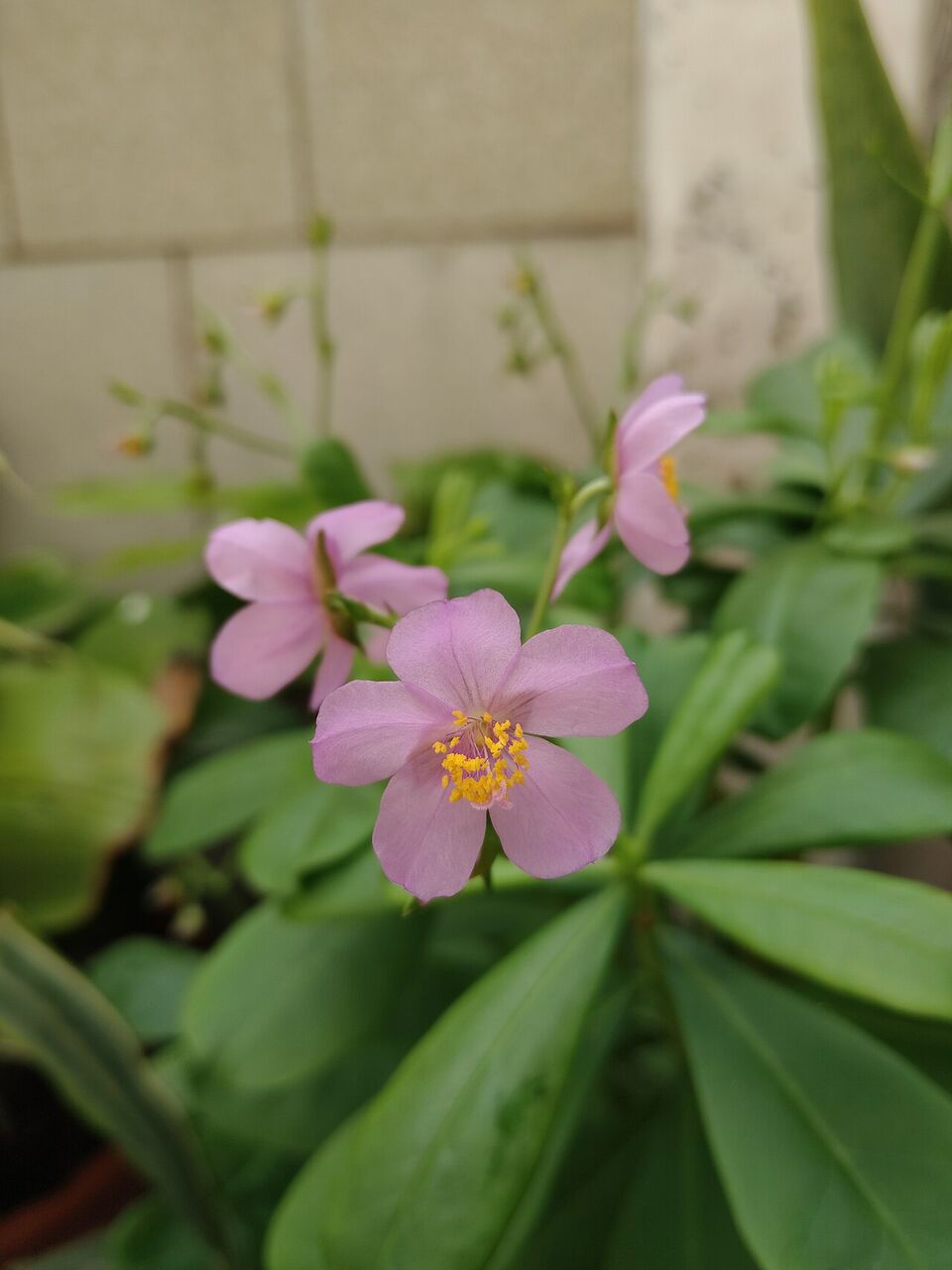
Talinum fruticosum is an erect, branching, short-lived perennial herb about 30 to 100 centimetres tall, with succulent (water-filled, fleshy) stems and swollen fleshy roots. The leaves are alternate (one leaf at each point along the stem), almost stalkless, thick and fleshy, and have no stipules (small leaf-base appendages). Each leaf blade is obovate to spatulate (broadest near the tip and narrowing towards the base), about 3 to 15 centimetres long and 1 to 6 centimetres wide, with a rounded to notched tip, a long tapering base and smooth edges. The sources disagree on leaf arrangement: NParks describes the leaves as rosette-like, while the other sources describe them as alternate. The pink, star-shaped flowers have petals up to 1 centimetre long and many stamens (pollen-bearing parts), and they grow in a branched cluster at the top of a three-angled stalk up to 12 centimetres long. The fruit is a round to oval capsule 4 to 7 millimetres across that splits into 2 or 3 parts, each holding shining black seeds about 1 millimetre wide, with more than 20 seeds per fruit.
Where it grows
Roadsides, waste places and forest edges, from sea level up to about 1,000 metres.
- Native to
- Disputed in the sources read. Useful Tropical Plants gives northern South America to Mexico; PROTA gives a South American origin, now a widespread weed of the humid tropics; NParks gives tropical Africa.
- In Nigeria
- GBIF holds 67 occurrence records from Nigeria. The leaves are eaten in southern Nigeria (PROTA), and a Lagos use is recorded in a Nigerian ethnobotany review.
Scientific details
- Scientific name
- Talinum fruticosum (L.) Juss.
- Family
- Talinaceae
- Older names
- Talinum triangulare
Sources
Not yet reviewed Drafted with AI from the sources below. Treat with care.
- Talinum fruticosum (L.) Juss., PROTA (Plant Resources of Tropical Africa), Pl@ntUse. PROTA.
- Talinum fruticosum, Useful Tropical Plants database. Useful Tropical Plants.
- Talinum fruticosum, NParks Flora & Fauna Web. National Parks Board, Singapore.
- Rafiu T et al.. Ethnobotanical uses of plants in Nigeria: an analysis of current research trends and patterns. Journal of Ethnobiology and Ethnomedicine, 2025. PMID 40841969.
- GBIF species match: Talinum fruticosum (L.) Juss. (accepted key 3084670; synonym Talinum triangulare key 3084671). GBIF.
- GBIF occurrence search, Nigeria, taxonKey 3084670 (67 records). GBIF.