Tamarind
- Hausa Tsamiya
Tamarindus indica
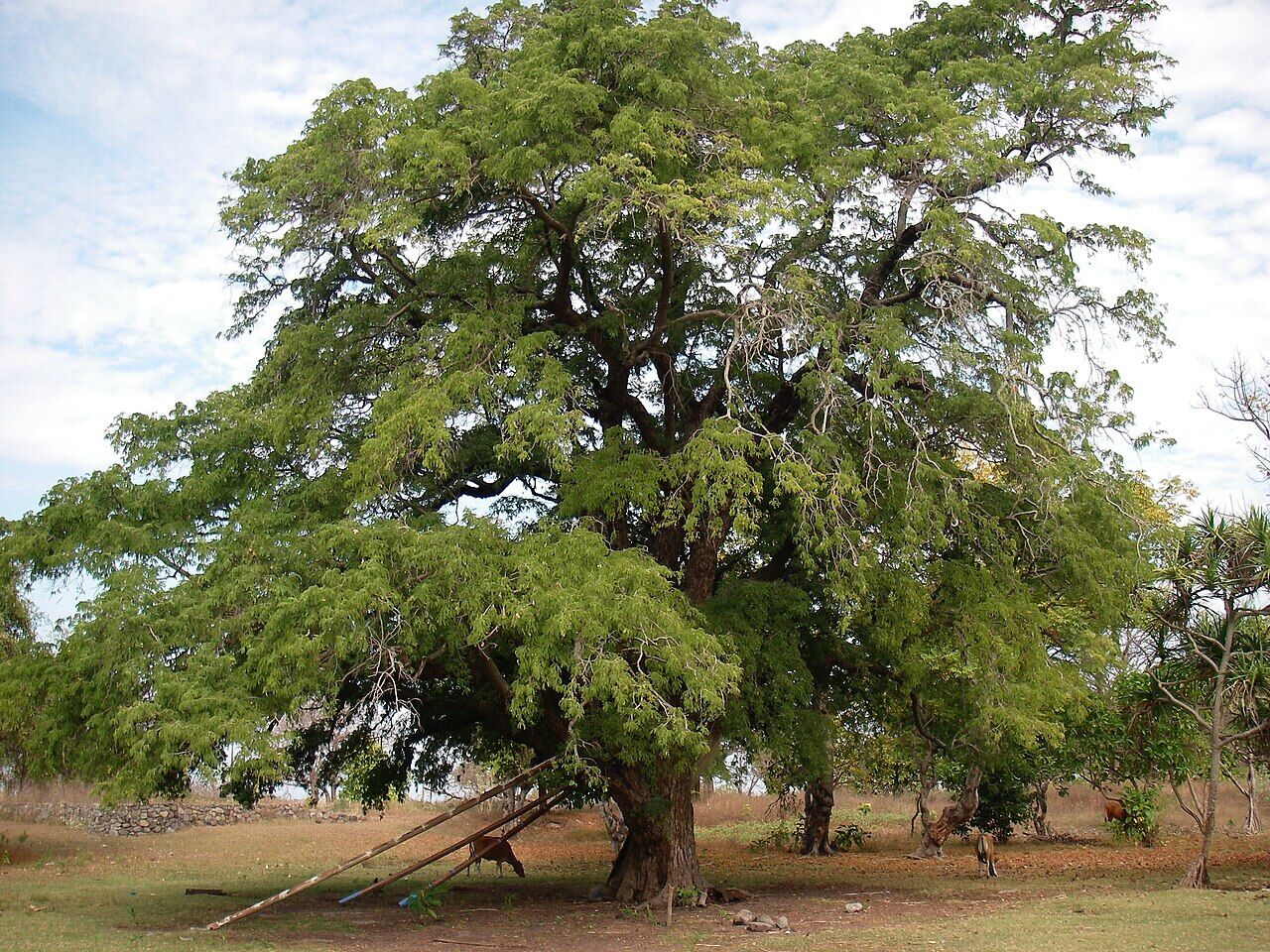
.jpg)
What it is used for
- Weight control fruit · traditional use
- Drinks and food from the pulp fruit · traditional use
- Obesity fruit · lab tests only
Tap a use to read how it is prepared and how well it is supported.
How each use is prepared
Parts used: fruit.
Weight control
Traditional useOther · fruit
How it is prepared: As reported in the survey: chew or "leak" (sic) 5 to 7 pod-like fruits twice daily, or drink a cup with a teaspoon of honey twice daily. The survey does not say what the cup contains.
People use it this way, but it has not been tested.
This is a use reported in an ethnobotanical survey of north central Nigeria, which records what people do and does not test whether it works. Nothing in the sources read shows that tamarind helps with weight. [3]
Drinks and food from the pulp
Traditional useNutrition · fruit
How it is prepared: The pulp is boiled and used in kunu zaki and kunu geda drinks.
People use it this way, but it has not been tested.
Reported as a common food use in the same Nigerian survey. It describes what the fruit is used for in food, not a health effect. [3]
Obesity
Lab or animal studiesOther · fruit · animal and laboratory studies
Tested in the laboratory or in animals, not in people.
The Nigerian survey's review of pharmacology reports animal and laboratory studies of tamarind, including a study in which pulp extract was given to obese rats on a high-fat diet. These studies were not opened directly, so the details are as summarised in the survey; they are animal and laboratory results only and show nothing about effects in people. [3]
Safety
The fleshy pulp is eaten in Nigeria, and the Useful Tropical Plants database lists no known hazards for it. The seeds are the danger: in one case series, children had tamarind seeds lodged in their airways and needed emergency bronchoscopy to remove them. No human data on pregnancy, breastfeeding or drug interactions were found in the sources read.
Side effects
Poisoning and overdose
- Whole seeds can lodge in the airways. In a case series of five patients, median age 10 years, tamarind seeds were found in the windpipe and airways and removed by rigid bronchoscopy. [4]
- The pulp and fruit are listed as having no known hazards. [2]
If you take other medicines
- In an animal study reported in a review of herbal extracts, tamarind fruit extract reduced liver damage caused by isoniazid and rifampicin. This is an animal result, not a known interaction in people. No human interaction data were found. [5]
Pregnancy and breastfeeding
Children
- Seeds can lodge in the airways of children, as seen in a case series of five patients, median age 10 years. Keep whole seeds out of children's food and reach. [4]
About this plant
Tamarind is a large evergreen tree of the bean family whose sour-sweet pulp is made into drinks and eaten as food in parts of Nigeria. Some Nigerian users take the fruit for weight control, but the sources read contain no human trial results for this use.
How to recognise it
Tamarind is a large evergreen tree that can reach 30 metres tall, with a trunk (bole) usually only 1 to 2 metres long and a dense, widely spreading crown. The bark is rough, deeply fissured and greyish-brown. The leaves are alternate (one leaf at each point along the stem) and pinnately compound, meaning many small leaflets sit in pairs along a central stalk like the barbs of a feather. Each leaf has 10 to 18 pairs of narrowly oblong leaflets, about 12 to 32 millimetres long and 3 to 11 millimetres wide, with smooth edges that are fringed with fine hairs. The small stipules (leaf-base appendages) fall off early. The flowers are pale yellow or pinkish and grow in loose spikes about 2.5 centimetres across, appearing with new leaf growth. The fruit is a brown, velvety pod about 10 to 18 centimetres long and 4 centimetres wide that does not split open; it holds 3 to 10 seeds in a sticky, sour-sweet, dark brown pulp that is edible when ripe.
Where it grows
Low-altitude woodland, savannah and bush, including termite mounds and stream and river banks, from sea level up to about 1,500 metres.
- Native to
- Probably tropical Africa; now grown throughout the tropics.
- In Nigeria
- GBIF holds 114 occurrence records from Nigeria. The sources read do not name particular Nigerian states or regions for this species.
Scientific details
- Scientific name
- Tamarindus indica L.
- Family
- Fabaceae
- Older names
- Tamarindus occidentalis, Tamarindus officinalis, Tamarindus umbrosa
Sources
Not yet reviewed Drafted with AI from the sources below. Treat with care.
- Tamarindus indica factsheet (PDF). World Agroforestry Centre (ICRAF).
- Tamarindus indica, Useful Tropical Plants database. Useful Tropical Plants.
- Anyanwu et al.. An Ethnobotanical Survey and Pharmacological and Toxicity Review of Medicinal Plants Used in the Management of Obesity in the North Central Zone of Nigeria. Journal of Obesity, 2025. PMID 40026359.
- Borkar R et al.. Tamarind Seeds in Tracheobronchial Tree: Challenges during Rigid Bronchoscopy. Journal of Indian Association of Pediatric Surgeons, 2024. PMID 38912035.
- Ravedar SM et al.. Effect of Herbal Extracts on Antituberculosis Drug-Induced Hepatotoxicity: A Systematic Review. Journal of Toxicology, 2026. PMID 42812992.
- GBIF species match: Tamarindus indica L. (accepted key 2975768). GBIF.
- GBIF occurrence search, Nigeria, taxonKey 2975768 (114 records). GBIF.