Ugu
- Igbo Ugu, Ugwu
- Yoruba Iroko
- Efik Ubong
- Edo Umeke
Telfairia occidentalis · also called Fluted pumpkin

What it is used for
- Food vegetable and seed leaf, seed · traditional use
- Anaemia or low blood leaf, fruit · lab tests only
- Blood sugar leaf · lab tests only
- Uterine fibroids leaf · lab tests only
Tap a use to read how it is prepared and how well it is supported.
How each use is prepared
Food vegetable and seed
Traditional useNutrition · leaf, seed
People use it this way, but it has not been tested.
Useful Tropical Plants says the leaves and young shoots are cooked as a vegetable and used in stews, and that immature seeds are cooked or roasted. It also says mature seeds are not eaten directly because they have a high content of antinutrients (substances that reduce the body's uptake of nutrients). This is a food use, not evidence of a medicinal effect. [1]
Anaemia or low blood
Lab or animal studiesOther · leaf, fruit · leaf juice used as a blood tonic, as reported
Tested in the laboratory or in animals, not in people.
Useful Tropical Plants reports that pregnant women and patients with anaemia use the leaf juice as a tonic to strengthen the blood. A 2023 study gave the fruit mesocarp (the fleshy part of the fruit) to rats made anaemic with phenylhydrazine and reported blood-building and liver-protective effects. The authors say blood-building effects are not proven and that leaves may be preferable. In a Bayelsa State survey of adolescents, the plant was named for boosting blood; those respondents were students, not herbal practitioners. No human study was read. [1][2][8]
Blood sugar
Lab or animal studiesBlood sugar · leaf · studied in rats only
Tested in the laboratory or in animals, not in people.
Two rat studies looked at blood sugar. One found that leaf fractions changed glucose handling in the liver (glycolysis). The other reported low blood sugar (hypoglycaemia) in rats given leaf extract at 100 and 200 mg/kg for 7 to 14 days. Neither was a human study, so these findings do not show that the plant lowers blood sugar safely in people. [3][4]
Uterine fibroids
Lab or animal studiesWomen's health · leaf · rat model only
Tested in the laboratory or in animals, not in people.
A 2025 study gave an aqueous leaf extract to albino rats with fibroids (non-cancerous growths in the womb) induced by monosodium glutamate (MSG). It measured antioxidant activity, enzyme inhibition and hormone levels, and added computer modelling. The study was in rats and in silico (computer-based) work only. No human study was read, so this is not evidence that the plant helps women with fibroids. [7]
Safety
Data on safe use in people are lacking. In male rats, leaf extract affected sperm and the testes at higher doses, and the highest dose tested reduced testis weight, sperm motility and sperm count. Useful Tropical Plants lists "none known" as its hazard, but that is not a safety assessment. Pregnant and breastfeeding women, children, and people with diabetes or male fertility concerns should ask a clinician before use.
Side effects
- No human side-effect data were found in the sources read. Useful Tropical Plants lists known hazards as 'none known', but it does not say that the plant is safe to take as a medicine. [1]
Poisoning and overdose
- Mature seeds are not eaten directly because they have a high content of antinutrients (Useful Tropical Plants). [1]
- In a 2018 study in male rats, an aqueous leaf extract at 300 mg/kg for 2 and 4 weeks reduced sperm motility and morphology (shape), testosterone levels and Leydig cells (the cells in the testes that make testosterone). The study tested 100, 200 and 300 mg/kg. [5]
- In a sub-chronic (repeated-dose) study of a hydroethanolic leaf extract in male rats, the 2,000 mg/kg dose reduced testis weight, sperm motility and sperm count. The 400 mg/kg dose, the intended therapeutic dose, showed no adverse effects on organs. The authors describe the extract as reasonably safe after acute and sub-chronic oral use at low to moderate doses. This is animal data only. [6]
- In mice, the oral LD50 (the dose that kills half of the animals) was above 5 g/kg, and the intraperitoneal (injected into the abdomen) LD50 was 3,200 mg/kg. [6]
Pregnancy and breastfeeding
- Data lacking. No source read tests the leaves, leaf juice or seeds in pregnant or breastfeeding people. Use as a blood tonic in pregnancy is a traditional practice (Useful Tropical Plants), not evidence that it is safe.
Children
- Data lacking. No source read tests the plant in children. Rat studies do not establish safety in children.
About this plant
A climbing vegetable plant from West Africa. Its leaves and young shoots are eaten, and its leaf juice has a traditional use as a blood tonic. Rat studies have looked at blood sugar, blood-forming effects, fibroids and male reproductive organs, but human studies on safety and effectiveness are lacking. Do not use it as a medicine without advice, and avoid it if you have diabetes or take blood-sugar medicines.
How to recognise it
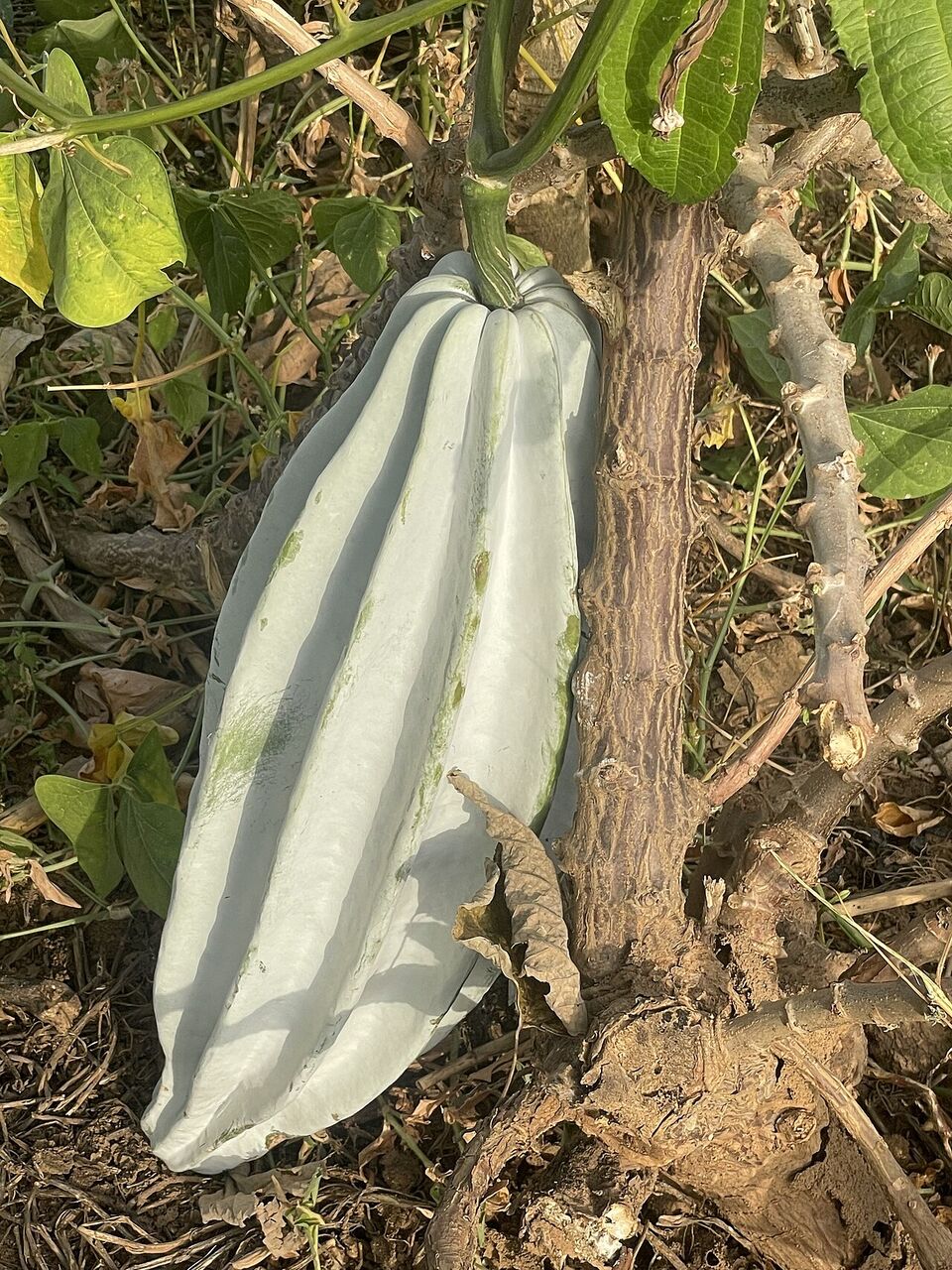
Fluted pumpkin is a perennial climbing plant with long, herbaceous (soft, non-woody) stems that can grow 15 metres or more. It climbs by means of tendrils, which are thin coiling stems that wrap around supports. The sources read do not describe the leaf shape in detail, but the leaves and young shoots are the parts most often eaten. Each plant is either male or female (the species is dioecious), so both sexes must be grown if fruit and seed are wanted. Male plants flower about three months after planting, a month before the females. The fruit can weigh up to 50 kg, and the large seeds are up to 5 cm across.
Plants it can be confused with
- Telfairia pedata (oysternut): Useful Tropical Plants says Telfairia occidentalis is sometimes wrongly called Telfairia pedata, the oysternut, which is a distinct species. The source does not compare the two for toxicity, so the risk from the other species is not known.
Where it grows
Useful Tropical Plants describes it in lowland rainforest and on riversides, from low ground up to about 1,200 metres.
- Native to
- West tropical Africa, from Benin to Cameroon (Useful Tropical Plants).
- In Nigeria
- GBIF holds 72 occurrence records from Nigeria. The sources read do not name any Nigerian state or region where the plant grows.
Scientific details
- Scientific name
- Telfairia occidentalis Hook.f.
- Family
- Cucurbitaceae
Sources
Not yet reviewed Drafted with AI from the sources below. Treat with care.
- Telfairia occidentalis - Useful Tropical Plants. Tropical Plants Database (tropical.theferns.info).
- Nneoyi-Egbe, Onyenweaku, Akpanukoh. Haematinic and hepatoprotective effects of Telfairia occidentalis fruit mesocarp in phenylhydrazine-induced anaemic rats. Biochemistry Research International, 2023. PMID 37849648.
- Salman, Iyanda, Alli-oluwafuyi. Hepatic glycolysis in rats after administration of Telfairia occidentalis leaf fractions. Metabolism Open, 2021. PMID 33997754.
- Salman, Alagbonsi, Sulaiman. Counter-regulatory responses to Telfairia occidentalis-induced hypoglycaemia in rats. Metabolism Open, 2020. PMID 33235989.
- Yawson Emmanuel O, Obasi K K, Lawal I. Spermatogenic and spermatotoxic effects of aqueous leaf extract of Telfairia occidentalis in male rats. Toxicology Reports, 2018. PMID 30258790.
- Akindele, Oladimeji-Salami, Oyetola. Sub-chronic toxicity of hydroethanolic leaf extract of Telfairia occidentalis in male rats, with acute toxicity in mice. Medicines, 2018. PMID 29316640.
- Ogunlakin et al.. Telfairia occidentalis aqueous leaf extract in rats with monosodium glutamate-induced uterine leiomyomas. Frontiers in Nutrition, 2025. PMID 41459082.
- Alade, Okpako, Ajibesin. Indigenous knowledge of herbal medicines among adolescents in Amassoma, Bayelsa State, Nigeria. Global Journal of Health Science, 2016. PMID 26234964.
- GBIF backbone. Telfairia occidentalis Hook.fil. - GBIF species match. Global Biodiversity Information Facility.
- GBIF. GBIF occurrence search, Telfairia occidentalis, country NG. Global Biodiversity Information Facility.
- Oladele JO, Ajayi EI, Oyeleke OM, Oladele OT, Olowookere BD, Adeniyi BM, Oyewole OI, Oladiji AT. A systematic review on COVID-19 pandemic with special emphasis on curative potentials of Nigeria based medicinal plants. Heliyon, 2020. PMID 32929412.