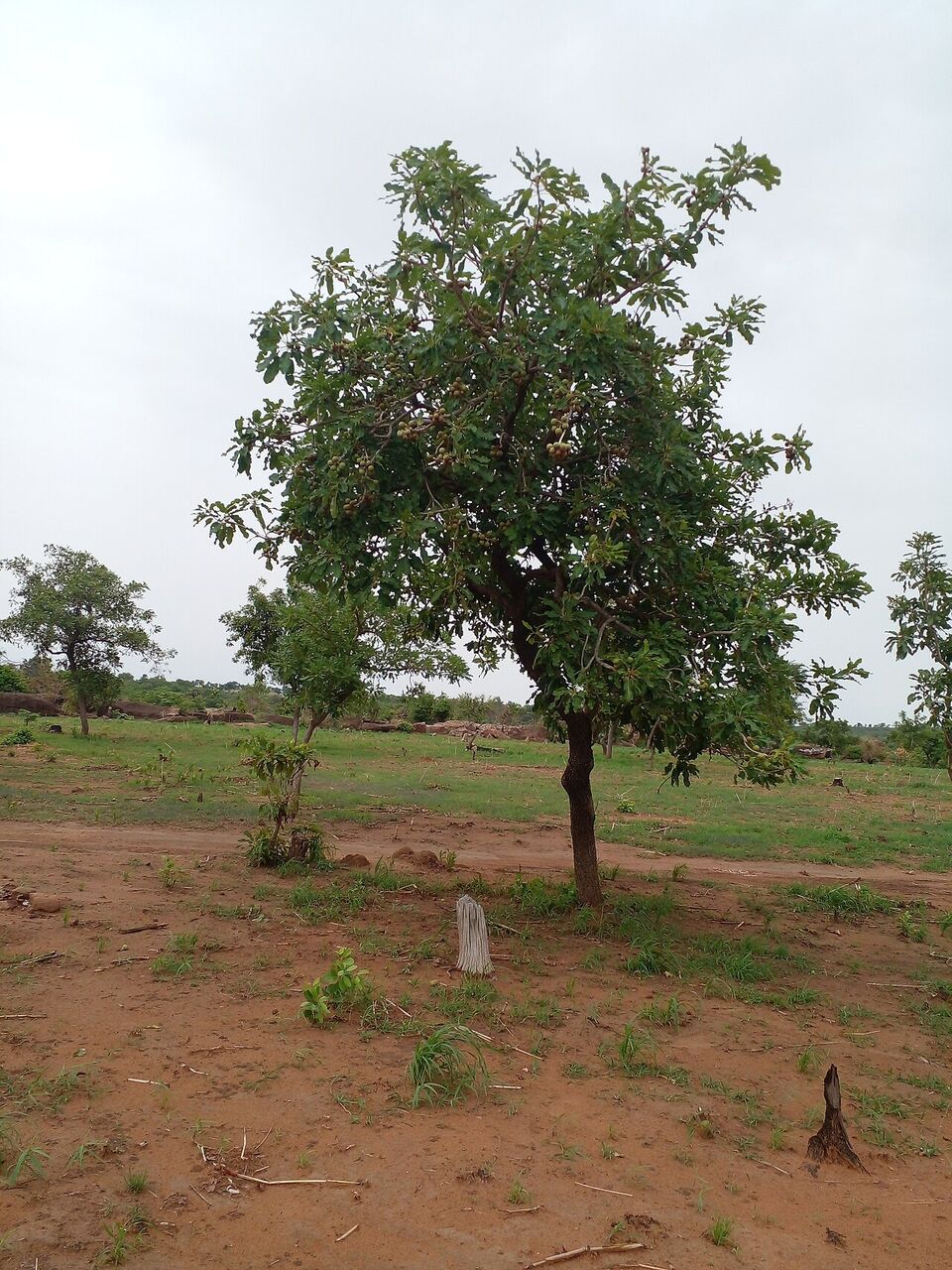
Shea butter tree
- Igbo Okwuma
- Yoruba Ori, Emiyemi
- Hausa Dan ka'raye, Kade
Vitellaria paradoxa · also called Shea tree
.jpg)
What it is used for
- Joint pain, wounds and bruises seed · traditional use
- Wounds bark · traditional use
- Swollen pain and toothache fruit, bark · traditional use
- Cough and flu seed · traditional use
- Sleeping sickness parasites lab tests only
- Stomach ulcer bark · lab tests only
Tap a use to read how it is prepared and how well it is supported.
How each use is prepared
Parts used: fruit, seed, leaf, bark.
Joint pain, wounds and bruises
Traditional usePain and swelling · seed
How it is prepared: Shea butter applied to the skin, as reported in the botany sources
People use it this way, but it has not been tested.
Useful Tropical Plants and PROTA both describe shea butter as a base for topical medicines and list these uses. Neither source gives a trial, and the sources read do not say how much or how often the butter was applied. [1][2]
Wounds
Traditional useWounds · bark · bark powder applied to the skin, Oyo State
How it is prepared: Bark powder applied to the wound, as reported
People use it this way, but it has not been tested.
A survey of Nigerian ethnobotany reports this use. No experimental or human study of this use was opened. [5]
Swollen pain and toothache
Traditional usePain and swelling · fruit, bark · fruit or bark heated or pounded, applied to the body, Borno State
How it is prepared: Fruit or bark heated or pounded, then applied externally, as reported
People use it this way, but it has not been tested.
Reported in the same Nigerian survey. The use is external only in that report. No trial was opened. [5]
Cough and flu
Traditional useCough and breathing · seed · seeds fried, Oyo State
How it is prepared: Seeds fried, then used nasally or on the skin, as reported. The survey gives no dose.
People use it this way, but it has not been tested.
Reported in one Nigerian survey. The route described is nasal and topical, not swallowed. No study of this use was opened, so its effect is unknown. [5]
Sleeping sickness parasites
Lab or animal studiesWorms and parasites
Tested in the laboratory or in animals, not in people.
Extracts and compounds from the plant killed trypanosomes in the laboratory. This is a test-tube result. It does not show that the plant works in people, and no human study was opened. [6]
Stomach ulcer
Lab or animal studiesStomach and digestion · bark
How it is prepared: Ethanol extract of stem bark, given to rats
Tested in the laboratory or in animals, not in people.
The abstract of this study says the extract protected the stomach lining of rats. This is an animal result. It is not evidence that the bark helps people with stomach ulcers. [8]
Safety
The botany sources list no known hazards for this plant, but that is a statement in those sources, not a safety study. No human safety study was opened, and the seed cake and mouldy seeds carry known risks. Animal studies of bark and leaf extracts are not a safety assessment for people.
Side effects
Poisoning and overdose
- Useful Tropical Plants and PROTA both give the known hazards as 'None known'. [1][2]
- The seed cake left after oil extraction is described as a potential livestock feed, but it has low digestibility and toxic properties attributed to saponins or tannins. [1]
- Mouldy seeds contain relatively low quantities of aflatoxin, a fungal toxin. PROTA reports that commercial samples have a maximum of 20 micrograms of aflatoxin B1 per kg. [1]
If you take other medicines
Pregnancy and breastfeeding
Children
About this plant
A savanna tree whose seed fat, called shea butter, is used in West Africa as a cooking fat and as a base for skin preparations. The sources read describe traditional uses and some laboratory and animal studies, but no human trial of its medicinal use was opened.
How to recognise it
Shea is a deciduous tree (it loses its leaves in the dry season) that usually grows to about 15 m and occasionally to about 25 m. Its bark is blackish, grey or reddish and cracked deeply into corky scales, and the tree gives off a white, milky latex (sap) when cut. The leaves are simple (one blade, not divided into leaflets) and leathery, arranged spirally but crowded in dense clusters at the ends of the branches. Each leaf has a stalk 3 to 10 cm long and a blade that is lanceolate to ovate-oblong (narrow to broadly oval, with the widest part towards the tip or middle), 10 to 25 cm long and 4 to 14 cm wide, with an edge that is smooth or gently wavy. The flowers are white or cream, fragrant, and grow in small bunches (fascicles) from about November to January. The fruit is a berry about 4 to 5 cm long (occasionally up to 8 cm), round to oval, with usually one seed (sometimes two), gathered from about June to August. The pulp is sweet and the seed is the source of shea butter.
Where it grows
Open sites and parkland savanna of the West African savanna, also present in the southern Sahel (Useful Tropical Plants and PROTA). In the subspecies paradoxa, PROTA reports that it grows mostly at 100 to 600 m altitude. Farmers protect the trees when they clear new fields, so the tree is common in farmed parkland.
- Native to
- Indigenous to the Guinea and Sudan savanna zone from Senegal to Sudan, and to western Ethiopia and Uganda, in a belt 500 to 700 km wide (PROTA).
- In Nigeria
- Nigeria is the leading producer of shea seeds, with 355,000 t in 1999, which PROTA says is 58 percent of African production. In Ghana and Nigeria the tree occurs within 50 km of the coast (PROTA). The GBIF occurrence search returns 277 records from Nigeria for this species.
Scientific details
- Scientific name
- Vitellaria paradoxa C.F.Gaertn.
- Family
- Sapotaceae
- Older names
- Bassia parkii, Butyrospermum mangifolium, Butyrospermum niloticum, Butyrospermum paradoxum, Butyrospermum parkii, Butyrospermum poissonii, Lucuma paradoxa, Mimusops capitata, Mimusops pachyclada
Sources
Not yet reviewed Drafted with AI from the sources below. Treat with care.
- Vitellaria paradoxa C.F.Gaertn. (PROTA, Plant Resources of Tropical Africa, on Pl@ntUse). PROTA, Pl@ntUse.
- Vitellaria paradoxa - Useful Tropical Plants. Tropical Plants Database (tropical.theferns.info).
- GBIF backbone. Vitellaria paradoxa C.F.Gaertn. - GBIF species match. Global Biodiversity Information Facility.
- GBIF. GBIF occurrence search, Vitellaria paradoxa, country NG. Global Biodiversity Information Facility.
- Rafiu BO, et al.. Ethnobotanical uses of plants in Nigeria: an analysis of current research trends and patterns. Journal of Ethnobiology and Ethnomedicine (full text via Europe PMC, PMC12369106), 2025. PMID 40841969.
- Bairy G, et al.. In vitro trypanocidal activity of extracts and compounds isolated from Vitellaria paradoxa. BMC Complementary Medicine and Therapies (full text via Europe PMC, PMC10540432), 2023. PMID 37770899.
- Oyibo A, et al.. Ethanol extract of Vitellaria paradoxa (Gaertn, F) leaves protects against sodium arsenite - induced toxicity in male wistar rats. Toxicology Reports (full text via Europe PMC, PMC8027566), 2021. PMID 33854955.
- Dangnon B, et al.. Gastroprotective, Antioxidant, Anti-Inflammatory, and Toxicological Evaluation of Stem Bark Extracts of Vitellaria paradoxa and Parkia biglobosa. Pharmaceuticals (Basel) (full text via Europe PMC, PMC12389382), 2025. PMID 40872575.