Uda
- Igbo Uda
- Yoruba Eru-alamo, Eru-awonka, Eeru
- Hausa Kimba
- Urhobo Urherien
Xylopia aethiopica · also called Ethiopian pepper, Grains of Selim

What it is used for
- Milk flow after childbirth seed · traditional use
- Tonic for women after childbirth fruit · traditional use
- Bronchitis fruit, bark · traditional use
- Worms seed, fruit · traditional use
- Constipation and dysentery root, fruit · traditional use
- Spice for food fruit, seed · traditional use
- Fibroids fruit · lab tests only
- Painful periods fruit · lab tests only
Tap a use to read how it is prepared and how well it is supported.
How each use is prepared
Parts used: fruit, seed, bark, root, leaf.
Milk flow after childbirth
Traditional useWomen's health · seed · ground seed given to nursing mothers
How it is prepared: Ground seed given to lactating mothers. PROTA gives no dose.
People use it this way, but it has not been tested.
PROTA lists the ground seed as a galactagogue, a substance that increases milk flow, given to nursing mothers. No clinical trial was found in the sources read. [1]
Tonic for women after childbirth
Traditional useWomen's health · fruit
How it is prepared: Fruit tonic. PROTA gives no dose.
People use it this way, but it has not been tested.
PROTA says the fruit tonic is recommended for women who want to improve fertility and for women who have recently given birth. This is a traditional use only. No human study of this use was found. Animal studies on fertility are listed under safety. [1]
Bronchitis
Traditional useCough and breathing · fruit, bark · traditional
How it is prepared: Fruit extract or bark decoction. PROTA gives no dose.
People use it this way, but it has not been tested.
PROTA lists the fruit extract or bark decoction for bronchitis and dysenteric conditions. No clinical trial was found in the sources read. [1]
Worms
Traditional useWorms and parasites · seed, fruit · traditional
How it is prepared: Seed extract taken by mouth for roundworms. PROTA gives no dose.
People use it this way, but it has not been tested.
PROTA lists the seeds as a vermifuge (anti-worm) and the fruit as anthelmintic. No clinical trial was found in the sources read. [1]
Constipation and dysentery
Traditional useStomach and digestion · root, fruit · traditional
How it is prepared: Powdered root mixed with salt, taken for constipation. Fruit extract for dysenteric conditions.
People use it this way, but it has not been tested.
PROTA lists these uses and describes the fruit as purgative. No clinical trial was found in the sources read. Purgative action is a bowel-emptying effect, not a treatment claim. [1]
Spice for food
Traditional useOther · fruit, seed · flavouring and pepper substitute
How it is prepared: Dried fruit crushed to a powder and used as a pepper. Seeds used as a pepper substitute.
People use it this way, but it has not been tested.
PROTA says the fruit is used as a spice to flavour food and is a trade item in local markets. A 2017 study says the seeds or pods are widely consumed as a spice in some parts of Nigeria. [1][4]
Fibroids
Lab or animal studiesWomen's health · fruit
How it is prepared: Fruit preparation given to rats in a laboratory model. Not a human use.
Tested in the laboratory or in animals, not in people.
A 2026 study in rats and in silico (computer-based) work reports multi-mechanism effects of the fruit on uterine fibroids. This is animal and computer research, not evidence that the plant works in people. [7]
Painful periods
Lab or animal studiesWomen's health · fruit
How it is prepared: Given to rats in a laboratory model. Not a human use.
Tested in the laboratory or in animals, not in people.
A 2025 study in rats reports hormonal and lipid effects in a painful-period model. This is animal research, not evidence that the plant works in people. [8]
Safety
No human pregnancy, fertility or childbirth safety data were found in the sources read. PROTA lists traditional use after childbirth and to increase milk flow, and describes the fruit as emmenagogue, meaning it promotes menstrual flow. Animal studies in male rats report lower sperm quality and lower testosterone with stem bark or seed extracts, and changes in female reproductive hormones with seed extract. The most recent rat toxicity study reports low acute toxicity. Data on long-term human safety are lacking.
Side effects
- No human side-effect data were found in the sources read. Data lacking.
Poisoning and overdose
- A 2026 rat study of the dried fruit gives an acute LD50 (the dose that kills half of the animals) above 2000 mg/kg. The abstract read reports possible thrombocytopenia (low platelet count) in the 14-day and 90-day rat studies. [5]
- Male rats given ethanolic stem bark extract at 200 to 800 mg/kg showed changes in fertility indices, including sperm changes and hormone changes. [3]
- Male rats given ethanolic seed or pod extract showed lower testosterone and lower sperm quality. [4]
- Female rats given seed extract with cadmium chloride showed changes in ovary tissue and in LH and FSH hormone levels. [6]
- PROTA lists the safety section as None known, but this is a summary of an older source and does not cover pregnancy or fertility. [1]
If you take other medicines
- Interactions with other medicines were not found in the sources read. Data lacking.
Pregnancy and breastfeeding
- No human pregnancy data were found in the sources read. PROTA lists the fruit as emmenagogue, meaning it promotes menstrual flow. Animal studies show effects on male and female reproductive hormones and sperm. The safety of use in pregnancy is unknown from these sources. [1][3][4][6][8]
Children
- Data lacking. The sources read do not give safe use in children, apart from the spice use described by PROTA. [1]
About this plant
Xylopia aethiopica is a tree of tropical Africa. Its dried, crushed fruit is used as a pepper-like spice. Traditional uses recorded by PROTA include use after childbirth and to increase milk flow, and treatment of chest and worm problems. Animal studies have looked at effects on male and female reproductive hormones and on the testes and ovaries of rats. No human pregnancy or fertility data were found in the sources read.
How to recognise it
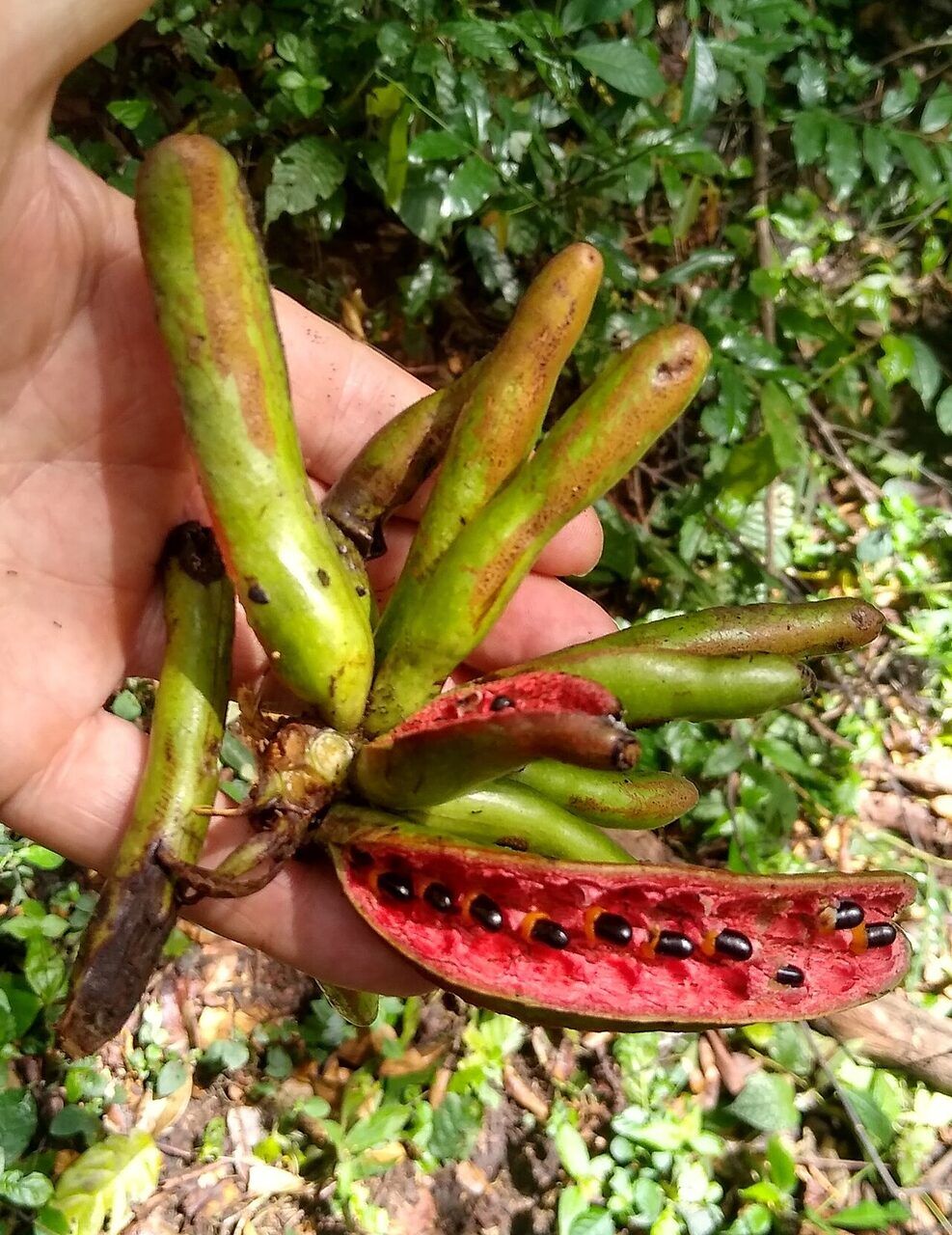
An evergreen tree, 15 to 30 m tall, with a many-branched, narrow crown. The straight bole can be 25 to 70 cm in diameter and often has short prop roots or buttresses. The bark is white, sappy and fragrant. The leaves have a pungent smell. The fruits are narrow, dark brown or black, about 5 cm long, and borne in bunches on a stout stalk. The roots are strongly aromatic. PROTA does not describe the flowers. Data on flowers are lacking.
Where it grows
PROTA lists lowland rainforest, coastal brackish swamps and littoral formations, and the deciduous and fringing forests of the Guinean savanna zones. It grows at 200 to 500 m altitude, in well-drained loamy and sandy loam soils, and with a mean annual temperature of 20 to 31 degrees C. PROTA describes it as a pioneer species that forms small woods on the savanna.
- Native to
- PROTA gives the range as tropical Africa, from Senegal to Sudan, south to Angola, Zambia and Mozambique.
- In Nigeria
- PROTA does not give a Nigeria-specific range. The fruit is widely used as a spice in some parts of Nigeria, according to s4. Data on distribution within Nigeria are lacking in the sources read.
Scientific details
- Scientific name
- Xylopia aethiopica (Dunal) A.Rich.
- Family
- Annonaceae
Sources
Not yet reviewed Drafted with AI from the sources below. Treat with care.
- PROTA (Plant Resources of Tropical Africa) / Useful Tropical Plants. Xylopia aethiopica - PROTA / Useful Tropical Plants entry. PROTA / Useful Tropical Plants.
- Global Biodiversity Information Facility (GBIF). GBIF species match: Xylopia aethiopica (accepted name, exact match, usageKey 3157151). GBIF.
- Toxicity study of ethanolic stem bark extract of Xylopia aethiopica on fertility indices of male rats: An experimental study. International Journal of Reproductive BioMedicine, 2020. PMID 32494765.
- Effect of Ethanolic Extract from Seeds or Pods of Xylopia Aethiopica (Dunal) A. Rich (Annonaceae) on the Testicular Function of Adult Male Rats. Indian Journal of Clinical Biochemistry, 2017. PMID 29062173.
- Acute (14-Day) and Subchronic (90-Day) Toxicity Evaluation of the Dried Fruit Spice Xylopia aethiopica (Dunal) A. Rich. (Annonaceae) in Male and Female Wistar Rats. Journal of Toxicology, 2026. PMID 42179896.
- Xylopia aethiopica ethanol seed extract suppresses Cadmium chloride-induced ovary and gonadotropins toxicity in adult female Wistar rats. JBRA Assisted Reproduction, 2021. PMID 33507724.
- Multi-Mechanistic Effects of Xylopia aethiopica Fruits on Uterine Fibroids: Insights From In Vivo and In Silico Evidence. Chemistry & Biodiversity, 2026. PMID 42741910.
- Antioxidant and ameliorative effects of selected Nigerian plants on hormonal imbalance associated with dysmenorrhea in albino rats. Frontiers in Nutrition, 2025. PMID 40735234.
- Ajao AA, Mukaila YO, Sabiu S. Wandering through southwestern Nigeria: An inventory of Yoruba useful angiosperm plants. Heliyon, 2022. PMID 35024488.
- Evuen UF, Okolie NP, Apiamu A. Evaluation of the mineral composition, phytochemical and proximate constituents of three culinary spices in Nigeria: a comparative study. Nature Publishing Group, 2022. PMID 36456798.