Ginger
- Igbo Jinja
- Yoruba Atale funfun
Zingiber officinale

What it is used for
- Nausea and vomiting in pregnancy rhizome · tested in people
- Motion sickness in children rhizome · traditional use
- Knee osteoarthritis pain rhizome · tested in people
- Inflammation and blood sugar in diabetes rhizome · tested in people
Tap a use to read how it is prepared and how well it is supported.
How each use is prepared
Parts used: rhizome.
Nausea and vomiting in pregnancy
Studied in peopleWomen's health · rhizome
How it is prepared: Ginger doses of 500 to 1,500 mg a day were used in the trials summarised in source 4. The form is not stated.
Tested in at least one human study. Read the note for how strong the result is.
Several systematic reviews and meta-analyses report less nausea with ginger than with placebo, but the evidence is rated low quality, and the umbrella review's own ratings are mostly low or critically low. One review found ginger eased nausea but not vomiting. The evidence is weak and does not establish that ginger treats nausea in pregnancy. [4][5][6]
Motion sickness in children
Traditional useOther · rhizome
How it is prepared: 250 to 500 mg, as listed in the EMA monograph
People use it this way, but it has not been tested.
The EMA monograph lists this as a traditional use only. It is not an established medical use, and the EMA does not recommend ginger under 6 years. [2]
Knee osteoarthritis pain
Studied in peoplePain and swelling · rhizome
How it is prepared: A standardised extract given for 6 weeks. The extract also contained Alpinia galanga.
Tested in at least one human study. Read the note for how strong the result is.
One randomised trial of 261 patients found a moderate reduction in knee pain with the extract. The product was a combined ginger and Alpinia galanga extract, not ginger alone. The trial is small and short, and its results need confirmation. [3]
Inflammation and blood sugar in diabetes
Studied in peopleBlood sugar · rhizome
How it is prepared: Doses of 1 to 3 g a day were used in the trials summarised in source 4. The form is not stated.
Tested in at least one human study. Read the note for how strong the result is.
A review of meta-analyses reports lower CRP and TNF-alpha levels, and improved HbA1c and fasting glucose in type 2 diabetes. Heterogeneity between studies was very high (I-squared 98.1 percent), and the authors call for more randomised trials. This is weak evidence and does not show that ginger treats diabetes. [4]
Safety
Ginger is a common food spice. Small trials suggest it may help nausea in pregnancy and knee pain from osteoarthritis, but the evidence is mixed and of low quality. Heartburn, stomach upset, nausea and belching are the side effects reported. Pregnant or breastfeeding people, children and anyone taking prescription medicines should check with a health professional first.
Side effects
- Heartburn, stomach upset, nausea and belching have been reported. [2][4]
- In the knee osteoarthritis trial, stomach and bowel side effects were reported by 59 people on the extract and 21 people on placebo. [3]
Poisoning and overdose
- The sources reviewed do not describe serious toxicity at the doses studied. Safety at high doses and with long-term use is not well documented. [2][4]
If you take other medicines
- The EMA monograph lists no known interactions. The NCCIH advises asking a health provider about possible harmful interactions with other medicines and herbs. [1][2]
Pregnancy and breastfeeding
- Ginger was studied for nausea in pregnancy. The NCCIH says it may be safe but advises checking with a provider. The EMA says avoiding it is the precautionary choice in pregnancy, although it reports no malformations in 300 to 1,000 outcomes. Pregnant people should ask a doctor before use. For breastfeeding, the EMA says use is not recommended and its safety is not established, and the NCCIH says little is known. [1][2]
Children
- The EMA lists a traditional use for motion sickness in children aged 6 to 12 at 250 to 500 mg, and does not recommend ginger under 6. Safety for other uses in children under 18 is not established. These are regulatory dosing guidelines, not proof that ginger is safe for children. [2]
About this plant
Ginger is a plant whose underground stem (rhizome) is eaten as a spice and used in traditional medicine. Studies suggest it may help some people with nausea in pregnancy and knee osteoarthritis pain, but the trials are small or rated low quality.
How to recognise it
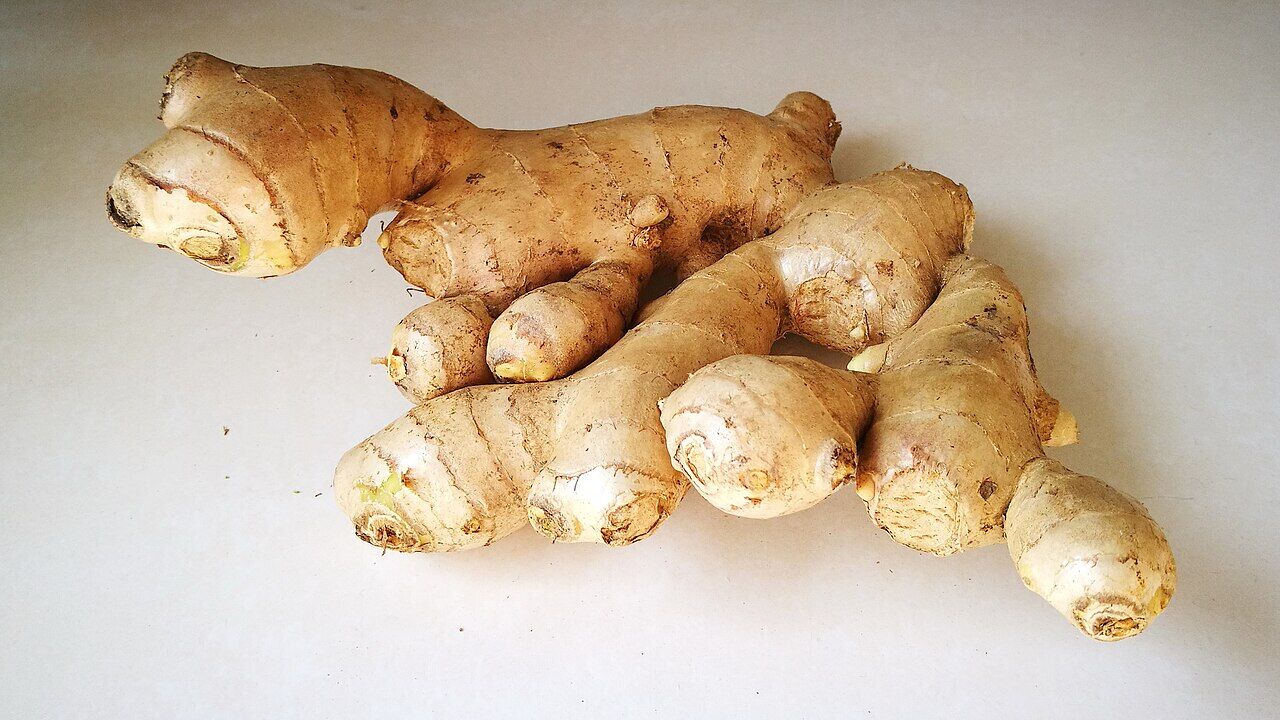
Ginger is a slender, erect herbaceous perennial, meaning a soft-stemmed plant that lives for more than one year. The Useful Tropical Plants database gives its height as 30 to 150 centimetres, and the NEPC profile describes annual stems about a metre tall. The leaves are long, narrow, green and ribbed (raised lines run along the blade), about 5 to 25 centimetres long and 1 to 3 centimetres wide. The plant grows from a robust, branched rhizome (a thickened horizontal underground stem) that lies near the soil surface and carries leafy shoots close together. The flowers come in clusters of buds that open white or yellowish-green, according to Agriculture Nigeria, though the NEPC profile describes them as yellow. The fruit and seed are not described in the sources read.
Plants it can be confused with
- Curcuma longa (turmeric): Both are in the ginger family (Zingiberaceae). According to the Useful Tropical Plants database, turmeric is about 1 metre tall, tillers strongly, and has 6 to 10 tufted leaves, 30 to 50 centimetres long, from an underground rhizome. Ginger is 30 to 150 centimetres tall, with its rhizome lying horizontally near the soil surface and leafy shoots close together. The National Parks Board (Singapore) sheet says turmeric's leaves are elliptic or oblong-lanceolate (oval or lance-shaped) and up to 70 centimetres long, that its rhizome is dull dark orange in cross-section, and that its pale yellow flowers emerge from pouch-like lower bracts (leaf-like structures beneath the flower). Ginger's cut rhizome colour was not documented in the sources read.
Where it grows
Not known in a truly wild situation. It is widely cultivated in tropical areas, from sea level up to 1,500 metres (Useful Tropical Plants database).
- Native to
- Probably tropical Asia; now widely cultivated across the tropics
- In Nigeria
- Grown in several Nigerian states. The NEPC profile (2018) names Kaduna as the major producer, with Nasarawa, Benue, Niger and Gombe also producing, and Agriculture Nigeria lists Kaduna, Taraba, Sokoto and Plateau, among others. GBIF holds 22 occurrence records from Nigeria (queried 2026-10-09).
Scientific details
- Scientific name
- Zingiber officinale Roscoe
- Family
- Zingiberaceae
- Older names
- Amomum angustifolium, Amomum zingiber, Amomum zinziba, Curcuma longifolia, Zingiber aromaticum, Zingiber majus, Zingiber cholmondeleyi, Zingiber missionis
Sources
Not yet reviewed Drafted with AI from the sources below. Treat with care.
- National Center for Complementary and Integrative Health (NCCIH). Ginger (Zingiber officinale). NCCIH, US National Institutes of Health.
- Committee on Herbal Medicinal Products (HMPC). European Union herbal monograph on Zingiber officinale Roscoe, rhizoma (Final, Revision 1), EMA/HMPC/885789/2022. European Medicines Agency, 2025.
- Altman RD, Marcussen KC. Effects of a ginger extract on knee pain in patients with osteoarthritis. Arthritis and Rheumatism, 2001. PMID 11710709.
- Paudel KR et al.. Pharmacological properties of ginger (Zingiber officinale): what do meta-analyses say? a systematic review. Frontiers in Pharmacology, 2025. PMID 40808693.
- Tahergorabi Z et al.. Treatment of Nausea and Vomiting With Zingiber officinale in Pregnancy: An Umbrella Review of Systematic Reviews With Meta-Synthesis. Phytotherapy Research, 2026. PMID 42322087.
- Tan et al.. The efficacy and safety of complementary and alternative medicine in the treatment of nausea and vomiting during pregnancy: A systematic review and meta-analysis. Frontiers in Public Health, 2023. PMID 36969661.
- Ajao AA, Mukaila YO, Sabiu S. Wandering through southwestern Nigeria: An inventory of Yoruba useful angiosperm plants. Heliyon, 2022. PMID 35024488.
- Zingiber officinale. Useful Tropical Plants database.
- Muhammed Alhassan. Ginger. Agriculture Nigeria.
- Nigerian Export Promotion Council (NEPC). Ginger - Profile. Nigerian Export Promotion Council, 2018.
- GBIF (Global Biodiversity Information Facility). GBIF occurrence search for Zingiber officinale (taxonKey 2757280), country NG. Global Biodiversity Information Facility, 2026.
- Curcuma longa. Useful Tropical Plants database.
- Plant Information Unit, National Parks Board, Singapore. Comparison of similar looking plants: Boesenbergia rotunda and Curcuma longa (Edible plants, Herbs and Spices (I)). National Parks Board, Singapore, 2016.
- Rafiu BO, Omotayo AO, Lawal IO, Aremu AO. Ethnobotanical uses of plants in Nigeria: an analysis of current research trends and patterns. Journal of Ethnobiology and Ethnomedicine (BMC), 2025. PMID 40841969.